3.4.2 - DNA and protein synthesis
 Call Kai
 Learn
 Practice Test
 Spaced Repetition
 Match
 Flashcards
 Knowt Play
1/26

There's no tags or description
Looks like no tags are added yet.
27 Terms
genome meaning
the complete set of genes in a cell (including those in mitochondria and / or chloroplasts)
proteome meaning
the full range of proteins that a cell can produce (coded for by the cell’s DNA / genome)
describe the two stages of protein synthesis
transcription
translation
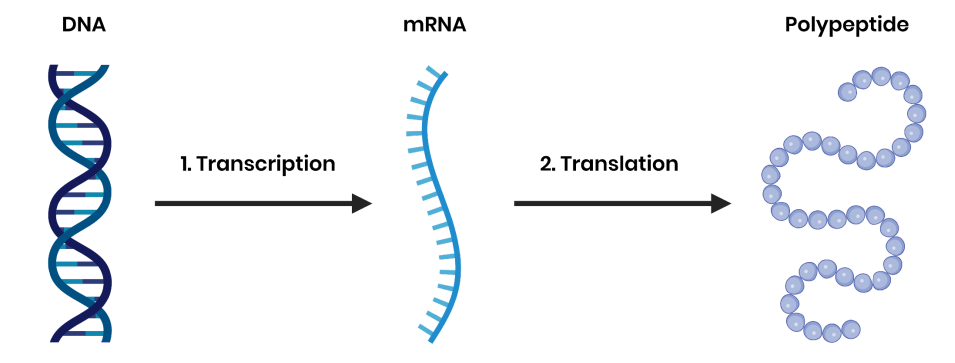
transcription meaning
where does this occur
production of mRNA from DNA
in the nucleus
translation meaning
where does this occur
production of polypeptides from the sequence of codons carried by mRNA
at ribosomes
what is RNA
a polymer
made up of repeating mononucleotide sub-units
RNA forms a single strand made up of what 3 components?
the pentose sugar ribose
a phosphate group
one of the organic bases A, T, C, or U (uracil)
mRNA is a l____ s______ arranged in a s______ h_____
mRNA is a long strand arranged in a single helix
how many diff. types of tRNA are there
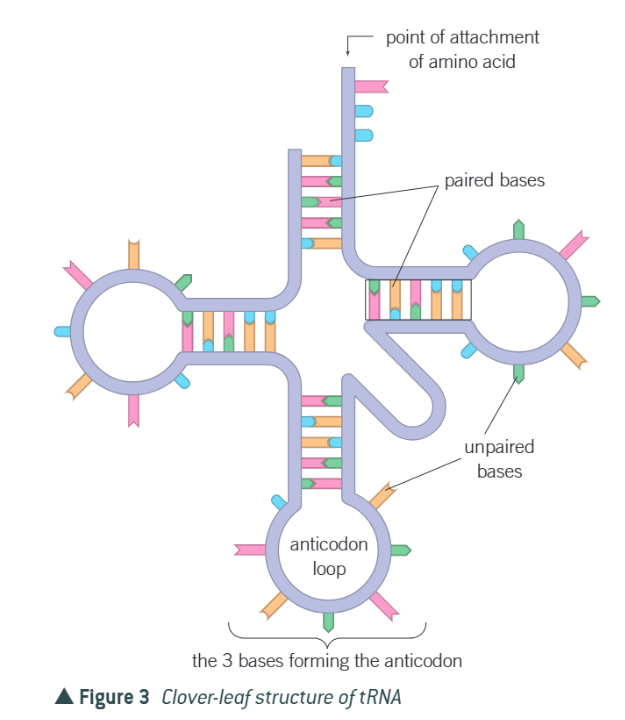
diagram of tRNA
many types —→ each binds to a specific AA
similarity btw mRNA and tRNA
both single polynucleotide strands
difference in how tRNA and mRNA are folded
tRNA is a single-stranded chainfolded into a ‘clover leaf shape’
mRNA is linear / straight
differences in what tRNA and mRNA have btw their bases
tRNA has hydrogen bonds between paired bases, mRNA doesn’t (bc bases are not paired)
differences in tRNA and mRNA lengths
tRNA is a shorter, fixed length
mRNA is a longer, variable length (more nucleotides)
mRNA has c_______, tRNA has an a_____________
mRNA has codons, tRNA has an anticodon (at the bottom of tRNA)
what binding site does tRNA have that mRNA doesn’t
AA binding site (at the top of tRNA)
describe how mRNA is formed by transcription in eukaryotic cells
an enzyme acts on a region of the DNA, causing the H bonds btw DNA bases = break and the 2 strands to separate
one of the 2 DNA strands acts as the template strand
free RNA nucleotides in the nucleus pair with their complementary bases on the template strand. in RNA, uracil is used in place of thymine (pairing with adenine, A, in DNA)
RNA polymerase, an enzyme, moves along the strand and joins the nucleotides tg to form phosphodiester bonds —→ via condensation rxns
a molecule of pre-mRNA is formed
and this is spliced to remove introns, forming (mature) mRNA
transcription in prokaryotic cells directly produces mRNA from DNA.
transcription in eukaryotic cells produces pre-mRNA.
how does this turn into mRNA
it is spliced to remove introns (which would prevent the synthesis of a polypeptide)
during splicing, the exons are also then joined tg
describe how production of messenger RNA (mRNA) in a eukaryotic cell is different from the production of mRNA in a prokaryotic cell
pre-mRNA = prod. in eukaryotic cells, mRNA = prod. directly in prokaryotic cells
this is bc genes in prokaryotic cells = don’t contain introns, so no splicing in prokaryotic cells
Describe how translation leads to the production of a polypeptide
1. mRNA attaches to a ribosome and the ribosome moves to a start codon (AUG)
2. tRNA brings a specific amino acid
3. tRNA anticodon binds to complementary mRNA codon
4. ribosome moves along to next codon and another tRNA binds
so 2 amino acids can be joined by a condensation rxn forming a peptide bond
using energy from hydrolysis of ATP
5. tRNA released after amino acid joined polypeptide
6. ribosome moves along mRNA to form the polypeptide, until a stop codon is reached
role of ATP in translation
Hydrolysis of ATP to ADP + Pi releases energy
So amino acids join to tRNAs and peptide bonds form between amino acids
role of tRNA in translation
Attaches to / transports a specific amino acid, in relation to its anticodon
the tRNA anticodon complementary base pairs to mRNA codon, forming H bonds
2 tRNAs bring amino acids together so peptide bond can form
role of ribosomes in translation
mRNA binds to ribosome, with space for 2 codons
Allows tRNA with anticodons to bind
Catalyses formation of peptide bond between amino acids (held by tRNA molecules)
Moves along (mRNA to the next codon) / translocation