Translation of mRNA
 Call Kai
 Learn
Learn Practice Test
 Spaced Repetition
 Match
Match Flashcards
 Knowt Play
1/14

There's no tags or description
Looks like no tags are added yet.
Name | Mastery | Learn | Test | Matching | Spaced | Call with Kai | Chat |
|---|
No analytics yet
Send a link to your students to track their progress
15 Terms
An enzyme matches the __ and tRNA. Specific __ pairs the tRNA with the correct amino acid. ATP is used to covalently attach the amino acid to the tRNA
amino acids : aminoacyl-tRNA synthetases
How is mRNA Translated into Protein?
All that is needed (in addition to mRNA) is: __ & __
tRNA and Ribosome
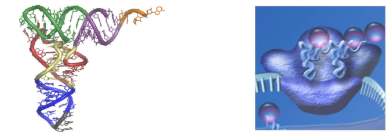
Ribosomes consist of a __ subunit and a __ subunit. The small subunit matches tRNAs to the codons of mRNA (aka “the __”). The large subunit catalyzes the peptide bonds between the amino acids (aka “the __”)
large : small : reader : builder

The RNA Message is Decoded on Ribosomes: The two subunits ‘clamp’ onto the beginning of the mRNA molecule (i.e. the __) and pull the transcript through like a piece of tape, one codon at a time. When translation is finished, the two subunits separate
5’ end
Each ribosome contains three key sites:
-_ site: discharged tRNA exit at this site
-_ site: tRNA at this site carry the growing peptide chain
-_ site: accepts incoming charged tRNA
E : P : A

Three steps in translation: Initiation, __, then termination. Ribosome: Composed of many proteins and __ strands and composed of a small and large subunits
Elongation : rRNA

Initiation:
1.The tRNA for the start codon (__ tRNA) will bind to the __ ribosomal unit
2.The small subunit bind at the __ of the mRNA with the help of various translation initiation factors
3.The small subunit scans ( _ ) the mRNA for the first AUG in the correct contexts (e.g. __)
1.initiator : small
2.5’ CAP
3.5’ to 3’ : Kozak

Initiation
4.The initiation factors dissociate and the initiator tRNA sits at the ‘P’ site
5.The large subunit binds to the small subunit, which is now sitting at the __
6.Amino-acyl tRNA for the next codon enters and binds to the ‘_’ site. Process consumes energy in form of GTP
7.__bond is formed between methionine at start codon and the first amino acid at ‘A’ site
5.START CODON
6.A
7.Peptide

Elongation:
1.The large subunit translocates by _ nucleotide binding sites towards the 3’ end of the mRNA. This movement is followed by the translocation of the small subunit
2.The empty tRNA at ‘_’ is ejected. Next amino-acyl tRNA enters and the cycle repeat
3.The cycle repeats until a stop signal is reached. Stop signal are specific __ sequences
1.3
2.E
3.codon
Termination:
1.Translation stops when the ribosome complex reaches one of three __ (UAA, UAG, UGA)
2.Proteins called ‘__’ bind to these codons, causing water to be added to the growing peptide chain instead of a new amino acid- the peptide chain is then released and the ribosomal complex falls apart
1.stop codons
2.release factors
It takes between 20 seconds to several minutes to translate mRNA into protein. __ ribosomes can be working on a single mRNA __ simultaneously, forming a __. In polyribosomes, individual ribosomes are as close as 80 nucleotides to each other
Many : transcript : polyribosome

__ (used in Bio3120 lab) - inhibits protein synthesis by tightly binding to the 16S rRNA in the 30S ribosomal subunit
Kanamycin
Protein lifespans vary considerably. Metabolic enzymes can last for seconds, while structural proteins can last for __ (e.g. bone, muscle)
years
Proteases destroy proteins by breaking peptide bonds between amino acids. Proteins that have misfolded also must be destroyed; if not, aggregates form that can lead to __ (e.g. Huntington’s, Alzheimer’s, and Creutzfeldt-Jacob)
diseases
A structure called a __ houses proteases in their core. Proteins tagged with the peptide __ (top image) enter the proteasome and are degraded
proteasome : ubiquitin
