Chem exam 4
 Call Kai
 Learn
 Practice Test
 Spaced Repetition
 Match
 Flashcards
 Knowt Play
1/118

There's no tags or description
Looks like no tags are added yet.
119 Terms
Bronsted Lowry defs of acids and bases
acids are proton (h+) donors
bases are proton acceptors
Arrhenius defs of acids and bases
acids increase the concentration of H+ (H3O+) in water
bases increase the concentration of OH- in water
All BL acids and bases are also
arrhenius acids and bases
not all arrhenius acids and bases are also
BL acids andbases
strong acids and strong bases
dissociated completely in water
strong electrolyes
common strong acids are
both BL and A acids
common strong bases are
A bases
Strong acids
HCl, HBr, HI, HCLO3, HCLO4, HNO3, H2SO4
strong bases
group 1 metal hydroxides. group 2 metal hydroxides
weak acids and weak bases
dissociate partially in water
weak electrolytes
eq constant for acid dissociation in water
acid ionization constant/dissociation constant
Ka=products/reactants
eq constant for base dissociation in water
base ionization constant/dissociation constant
Kb=products/reactants
the magnitude of Ka or Kb tells us about
the strength of the acid or base
the more an acid or base dissociates,
the strong it is
more dissociation →
more products → larger K
strong acids and strong bases completely
dissociate in water
K»1
weak acids partially
dissociate in water
weak bases produce
some OH in water
weak acids and bases have
small ionization constants
K«1
smaller ka
weaker bc less dissociation
higher ka
stronger bc more dissociation
effect of molecular structure on acid strength
H-A bond strength (binary acids)
H-A bond polarity (oxoacids)
stability of anion (carboxylic acids)
as you go down and across the periodic table
acid strength increase
bond acid and acid strength for Hydrohalic acids
HF is weak bc it has the shortest bond length and highest bond energy
takes more energy to remove H+ to donate proton
oxyacid or oxoacids
acid compound containg hydrogen atoms, oxygen atoms, and a central atom (N, S, Cl, P)
as you add o2, ka increases, meaning stronger acid
also depends on electronegativity of Y in the bond
as y gets more electronegative,
acid strength increases
more oxygens draws more electron density
away from the OH bond, making H easier to remove, making the compound a stronger acid
the more resonance structures
the more stability, the stronger the acid
when we move a proton
the more stable base that you create, the stronger your acid is
inductive effect
electronegative atoms can act as electron withdrawing groups
increases acidity
if H is bonded to a different atom if each structure
look at atomic radius
if H is bonded to the same atom in each structure
look at electronegativity
atomic radius
decreases as you go across→ adding prontons pulls atoms in
decreases as you go down→ add more energy levels
electronegativity
ability of one atom in a bond to pull bonding electron toward it
goes up as you go across and up
larger atomic radius
stronger acid
reactions between acids and bases always yield
comjugate bases and acids
stronger acid
weaker conjugate base
stronger base
weaker conjugate acid
Water acts as
an acid and base
referred to as auto-ionization or self-ionization
ion-product constant
Kw
dependent on temp
at 25 degrees C
Kw=1×10-14
pH
describes the strength of an acid or base
ph=
-log[H3O+]
[H3O]
=10^-pH
[OH]
=10^-0OH
pOH
-log[OH-]
pH+pOH=
14
pKa
-logKa
in pure water, Kw=
[H3O][OH-]= 1×10-14
pH=7
as pH increase
pOH goes down and vice versa
acidic solution
pH<7
neutral solution
pH=7
basic sollution
pH>7
pH+pOH= pKw=
14
pKa as a measure of acid strength
pKa=-logKa
Ka=10-pKa
larger Ka→
more product favored → small pKa → stronger acid
smaller Ka →
more reactant favored → large pKa → weaker acid
acetic acid
CH3COOH
weak acid
base: CH3COO-
Ammonia
NH3
weak base
conjugate acid: NH4+
degree of ionization
extwent of ionization of a weak acid or weak base
often expressed as a percent (x100)

what makes an ionic compound
metal (+) + nonmetal (-)
take an electrion instead of sharing
dissociate completely in water
Kw=
Ka x Kb
The conjugate of a strong acid or base is
a very weak base or acid
the conjugate of a weak acid is a
weak base
the conjugate of a weak base is a
weak acid (relatively strong)
an anion that is the conjugate base of a strong acid will
not affect the pH
anion
-
cation
+
an anion that is the conjugate base of weak acid will
increase the pH
cations of the strong Arrhenius bases will
not affect the pH
a cation that is the conjugate acid of a weak base will
decrease the pH
when a solution contains both the conjugate base of a weak acid and the conjugate acid of a weak base,
the affect on pH depends on the Ka and Kb values
polyprotic acids
acid that contain more than one acidic proton
H3PO4 or H2SO3
smaller Ka means
weaker acid
for polyprotic acids the first ionization (Ka1) always occurs
to a greater extent than any subsequent ionizations
for polyprotic acids, if the difference between Ka1 and subsequent Ka values is 10³ or more,
the pH generally depends only on the first dissociation
common ion effect
when there is a common ion in solution with an acid or base, that ion affects the dissolution of that acid or base
neutralization reactions
make a solution neutral
will go to completion
Strong acid+ strong base
weak acid+ strong base
weak base + strong acid
buffers
solutions that resist drastic changes in pH using neutralization reactions
why do we care about buffers
blood is a buffer system
buffer capacity of the ocean→ ocean acidification
buffers are made up of
high concentrations of a weak acid-base pair
how buffers work- acid neutralization
addition of a small amount of strong acid is neutralized by reaction with the weak base
how buffers work- base neutralization
additions of a small amount of strong base is neutralized by reaction with the weak acid
buffers wrok bc
they consume added strong acid and strong base
once you consume one of the buffer components, you no long have a buffer
henderson hasselbach equation
used to solve for the pH of buffer solutions
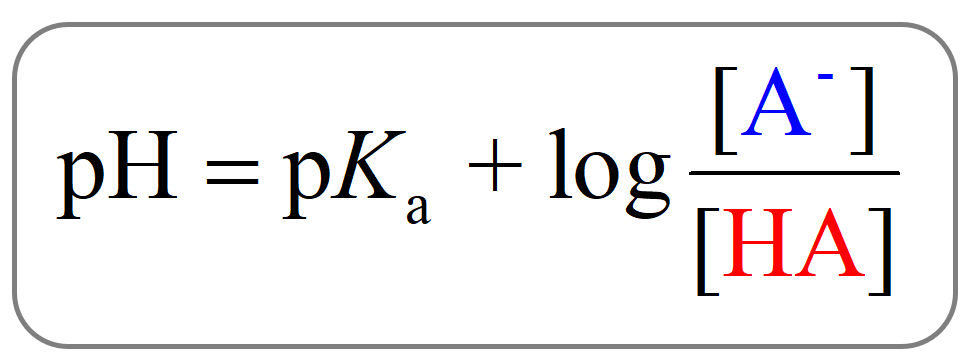
general rules for buffer solutions
0.10< cB/a < 10
concentration of each buffer component is at least 100x greater than the Ka
buffer capacity
the amount of acid or base that a buffer can neutralize (absorb) before its pH changes appreciatively
a/ha: 100:1
pH=pKa + 2
a/ha: 10:1
pH=pKa+1
a/ha: 1:1
pH=pKa
a/ha: 1:10
pH=pKa-1
a/ha: 1:100
pH=pKa-2
buffer range
the pH range over which the buffer effectively neutralizes added acids and bases
generally 2 pH units
it is best to choose an acid with a pKa
close to the desired pH
a good buffer will have
large amounts of conjugate acid base pairs in approximately equal amounts
pKa close to the pH
3 ways to prepare a buffer
Titrate a weak acid with a strong base: convert some HA to A
Mix weak acid (HA) and salt of a weak acid (NaA): mixture of A and HA
Titrate salt of weak acid (NaA) with strong acid (HCl): convert some A to HA
pH indicators
estimate the pH of a solution
phenolphthalein, pH mixer
natural pH indicators
red cabbage
beets
hydrangeas
curry power
acid base titration
a known concentration of base is slowly added to a solution of acid (or vice versa)
measuring pH or using color indicator
titrant
base or acid being added