Biology Exam 2 (CH:4, 9, 15, 16, 17)
 Call Kai
 Learn
 Practice Test
 Spaced Repetition
 Match
 Flashcards
 Knowt Play
1/184

There's no tags or description
Looks like no tags are added yet.
185 Terms
During glycolysis, when each molecule of glucose is catabolized to two molecules of pyruvate, most of the potential energy contained in glucose is ______.
retained in the two pyruvate
Why is glycolysis described as having an investment phase and a payoff phase?
It uses stored ATP and then forms a net increase in ATP
Which process of cellular respiration does not occur within a mitochondrion in a eukaryotic cell?
Glycolysis
During cellular respiration, acetyl CoA accumulates in which location?
Mitochondrial matrix
Why is the Citric Acid Cycle considered to be a cycle? because it…
Regenerates oxaloaxetate
What is the difference between a ribonucleotide and deoxyribonucleotide?
Ribonucleotides have a hydroxyl group on the 2 carbon of their sugar
Nucleic acids have definite polarity, or directionality. How are these ends described?
One end has an unlinked 3’ hydroxyl; the other end has an unlinked 5’ phosphate

The sequence of one strand of DNA is shown below. Which of the following is the reading sequence of its complementary strand?
5’ TAAACCGG 3’

In the Hershey and Chase Experiment, which radioisotope was found inside the E. coli cells after bacteriophage infection.
32P was inside, concluding that DNA is the genetic material
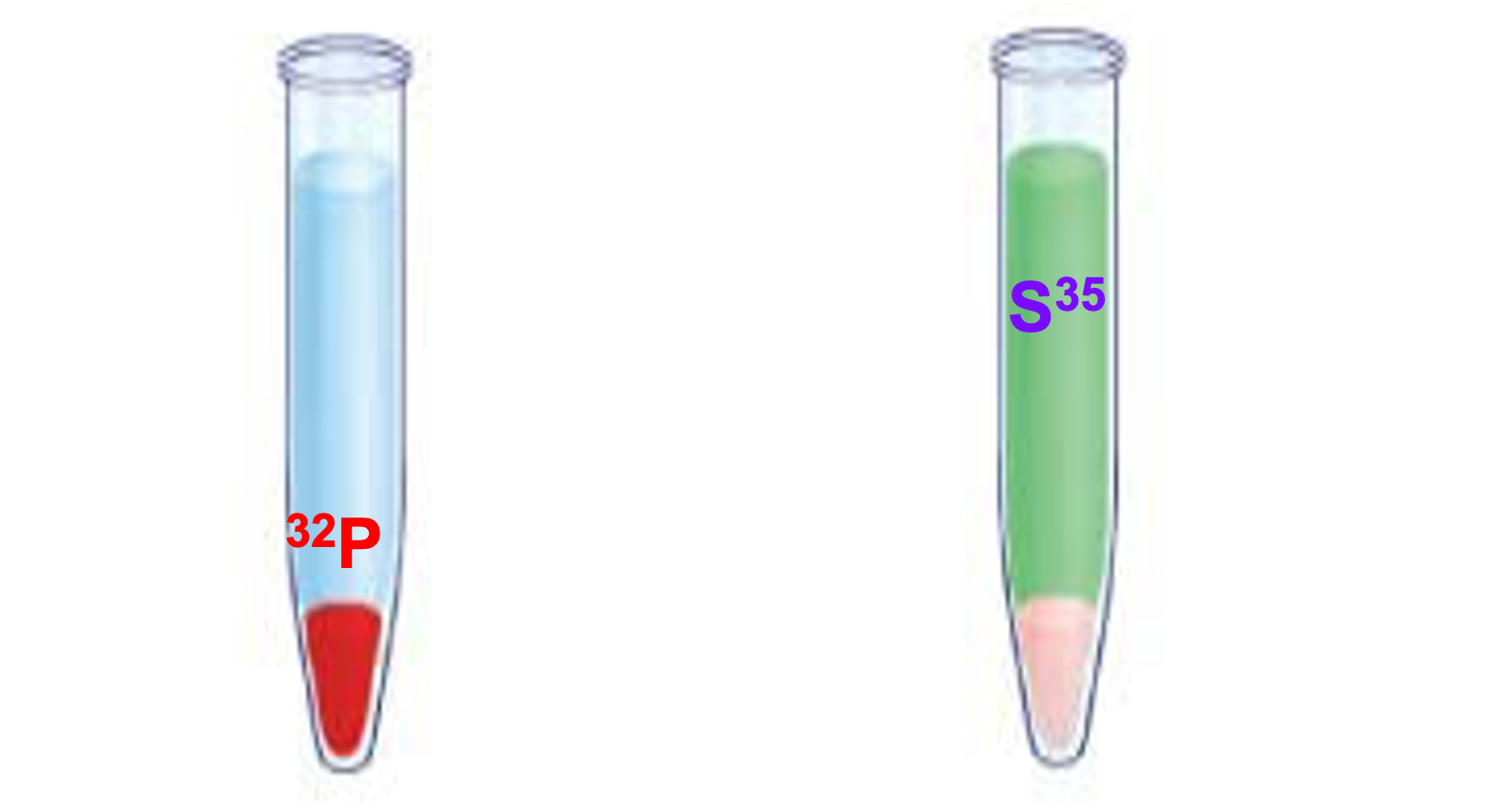
If E. coli cells are grown in a medium containing radioactive 32P-labeled phosphates, which of these molecules will be labeled?
Nucleic acids

What name/label is given to the ends of the strands at the position of the stars?
5’ ends

In the Meselson-Stahl Experiment, E. coli cells grown on 15N medium are transferred to 14N medium and allowed to grow for two more generations (two rounds of DNA replication). DNA extracted from these cells is centrifuged. What density distribution of DNA would you expect in this experiment?
One low-density and one intermidate-density band
Semiconservative replication involved a template. What it the template?
One strand of the DNA molecule
In polymerization of DNA, a phosphodiester bond is formed between a phosphate group of the nucleotide being added and ______ od the last nucleotide in the polymer.
the 3’ OH
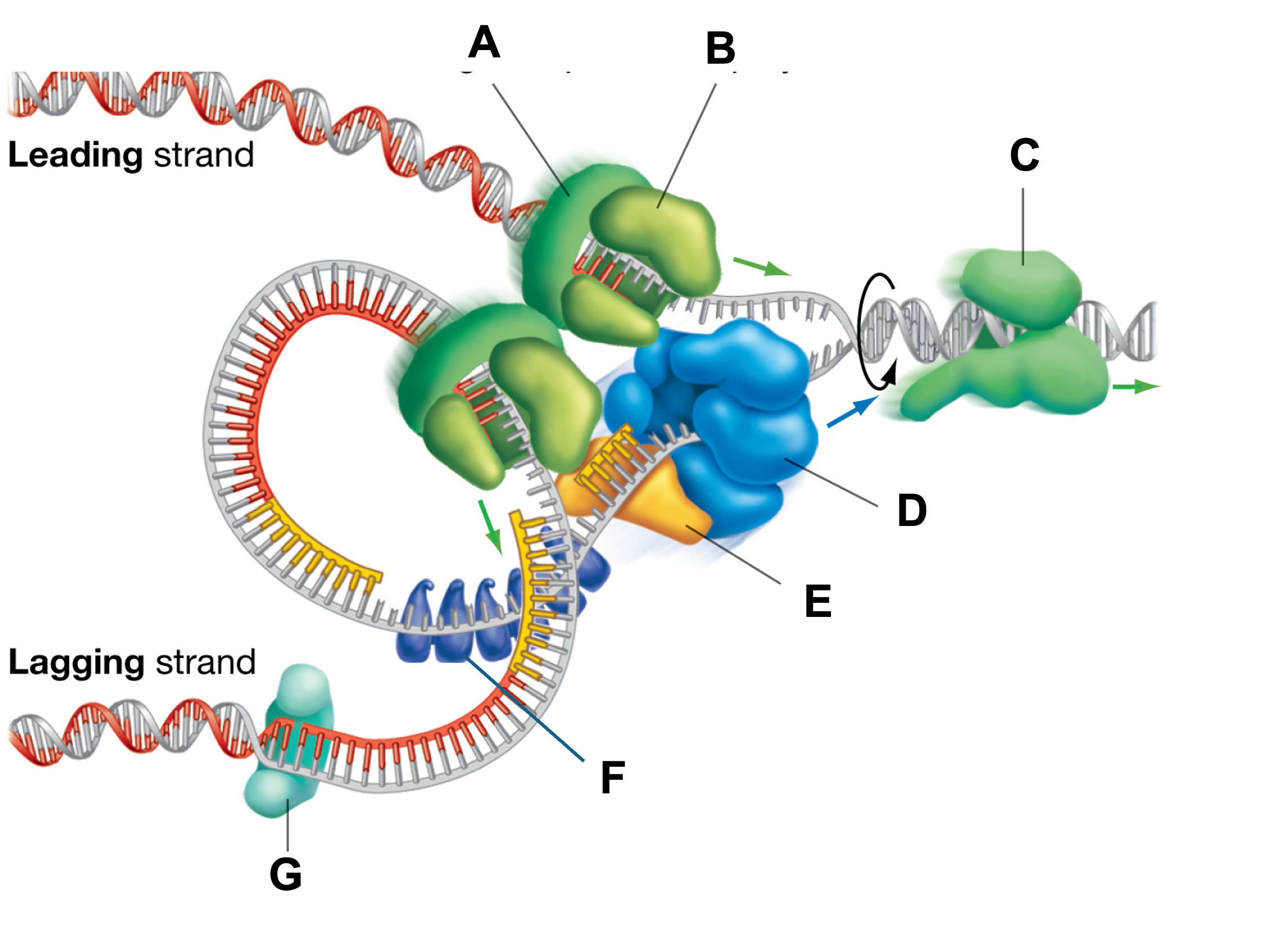
In the figure, which structure causes the two strands of DNA to separate?
D
Which of the following would you expect of a eukaryotic lacking telomerase?
A reduction in chromosome length in gametes
Sort out the steps and machinery used in DNA replication on the leading or continuous strand.
~The enzyme helicase opens the strands of DNA
~The single strands are stabilized by single-strand DNA binding protiens
~The enzyme primase lays down an RNA primer at the 5’ end of the strand
~The enzyme DNA polymerase III begins to add deoxynucleotides at the 3’ end of the primer by reading nucleotides on the complementary strand
~ DNA polymerase I replaces the RNA primer with DNA
~ DNA ligase then joins or seals the DNA gaps to form a continuous strand of DNA
The statements “DNA → RNA→ Proteins” is known as ________.
the central dogma
Suppose that you have the following DNA template: 3’ ATG-GGC-AAT-CGC 5’; what would be the sequence of the mRNA generated from the above DNA?
5’ UAC-CCG-UUT-GCG 3’
What does it mean when we say the genetic code is redundant?
More than one codon can specify the addition of the same amino acid

What type of mutation does this represent?
Missense
In RNA transcription Sigma….
~is a regulatory subunit of prokaryotic RNA polymerase
~makes the initial contact with the promoter during the initiation of transcription
~binds the -35 and -10 boxes in bacterial promoters

The promoter is the site to which RNA polymerase will bind. Identify the length of the promoter sequence where the RNA polymerase may bind.
TTG………AAT

Look at the picture carefully and think about which process you see. The figure shows the process of _______. The red molecule is _______ and the yellow molecule that is being synthesized is ________.
transcription; DNA; mRNA

Refer to the figure. In Eukaryotes and in some viruses, the final mRNA length is smaller than that of the DNA that codes for it because ______.
post transcriptional modification removes the introns from the pre transcription
What process occurs in structure H?
photosynthesis

What molecules belong in space A and B?
glucose and oxygen

What organelle is indicated by the letter C?
mitochondrion
What molecule belong in spaces E and F?
carbon dioxide and water
What is the correct sequence of steps in cellular respiration, starting with glucose?
Glycolysis, pyruvate processing, citric acid cycle, electron transport, oxidative phosphorylation
Where does the citric acid cycle occur in eukaryotes?
in the matrix of mitochondria
Which process does NOT occur within a mitochondrion in a eukaryotic cell?
Glycolysis
The glucose molecule haas a large quantity of energy is in its _______.
C-H bonds
Which process in eukaryotic cells will proceed normally whether oxygen (O2) is present or absent?
Glycolysis
For each glucose that enters glycolysis, ____ acetyl CoA enter the citric acid cycle.
2
For each glucose that enters glycolysis, ______ NADH + H+ are produced by the citric acid cycle.
6
In cellular respiration, most ATP molecules are produced by ______.
oxidative phosphorylation
The final electron acceptor of aerobic cellular respiration is _____.
oxygen
During electron transport, energy from _____ is used to pump hydrogen ions into the _____.
NADH and FADH2… inter membrane space
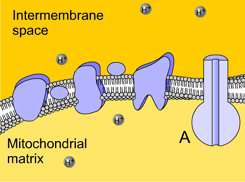
Structure A is _____.
ATP synthase
After glucose is fully oxidized by glycolysis, pyruvate processing, and the citric acid cycle, where is most of its energy stored?
NADH
What does chemiosmotic hypothesis claim?
ATP is generated using a proton-motive force that is produced by the electron transport chain
Early estimates suggested that the oxidation of glucose via aerobic respiration would produce 38 ATP. Why do biologists now think this amount of ATP per molecule of glucose is not achieved in cells?
The proton-motive force is used in other transport steps, and there is loss of energy due to inefficiency in the system, reducing the ATP yield
In eukaryotes, the components of the electron transport chain are located in the _______.
inner mitochondrial membrane
At the end of cellular respiration, protons flow through a protein called ATP synthase, which drives the formation of _____.
ATP from ADP and inorganic phosphate
Which mode of energy production produces the most ATP per glucose?
Aerobic respiration
______ us a product of glycolysis, pyruvate processing, and the citric acid cycle.
NADH
Which process does NOT occur within a mitochondrion in a eukaryotic cell?
glycolysis
The molecule that functions as the reducing agent (electron donor) in a redox or oxidation-reduction reaction _____.
loses electrons and loses potential energy
Which of the listed statements describes the results of the following reaction? C6H12O6 + 6 O2 → 6 CO2 + 6 H2O + Energy
C6H12O6 is oxidized and O2 is reduced.
When a glucose molecule loses a hydrogen atom as the result of an oxidation-reduction reaction, the molecule becomes _____.
oxidized
T/F: NAD+ is reduced to NADH during glycolysis, pyruvate oxidation, and the citric acid cycle.
true
How many oxygen molecules are required each time a molecule of glucose is completely oxidized to carbon dioxide and water via aerobic respiration?
6
What is the major adaptive advantage of cellular respiration?
To produce adenosine triphosphate (ATP)
What kind of molecules serve as electron acceptors in cellular respiration?
Molecules with low potential energy
Starting with one molecule of glucose, the energy-containing products of glycolysis are ____.
2 NADH, 2pyruvate, and 2 ATP
What are the end products of glycolysis?
2 NADH, 2 pyruvate, 2 ATP
If you were to expose cells that are undergoing aerobic respiration to a radioactive oxygen isotope in the form of O2, which of the following molecules would you expect to be radio labeled?
water
Why are fermentation reactions important for cells?
They regenerate NAD+ so that glycolysis can continue to operate.
Single strands of nucleic acids are directional, meaning that there are two different ends. What functional groups define the two different ends of a strand?
a free phosphate group on the 5’ carbon and a free hydroxyl on the 3’ carbon
When nucleotides polymerize to form a nucleic acid _____.
a covalent bond forms between the sugar or one nucleotide and the phosphate of a second
What feature of single nucleotides provides energy needed for polymerization earn nucleic acids are formed?
their phosphate groups

Identify the four basses in this RNA strand. What is the correct order of the base sequence starting at the 5’ end?
5’-UAGC-3’
What are the components of a nucleotide?
A sugar, a phosphate group, and a nitrogenous base
The condensation reaction that forms nucleic acid polymers occurs between a _____ group on one nucleotide and a ____ group on a second nucleotide.
phosphate; hydroxyl
Write the complementary sequence for the following DNA sequence, in order from 3’ to 5’: 5’-CGATATTGAGCTAAGCTT-3’
3’-GCTATAACTCGATTCGAA-5’

What is this?
Adinine
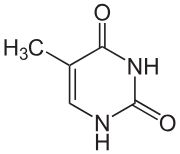
What is this?
Theamine

What is this?
Uracil

What is this?
guanine
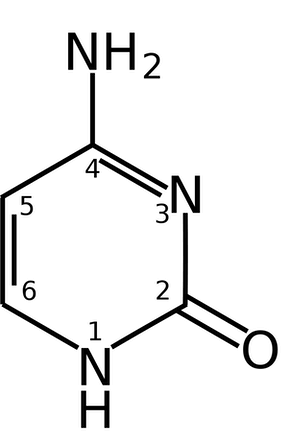
What is this?
cytosine
DNA is composed of building blocks called ____.
nucleotides
In eukaryotic cells DNA has the appearance of a _____.
double helix
What type of change occurs to a nucleotide when it is activated?
The potential energy of the molecule increases
If ADP (two phosphates) were hydrolyzed to AMP, how would you expect this reaction to compare with the hydrolysis of ATP to AMP?
The change in entropy would be less in the hydrolysis of ADP
T/F: The reaction occurs when weak bonds are broken and stronger bonds are formed?
True
T/F: Energy in the form of heat is released.
True
T/F: The amount of entropy decreases when products are formed.
False
T/F: There is a drop in potential energy when the reactants are converted into products.
True
T/F: ATP is always one of the reactants.
False
A bacterium is infected with an experimentally constructed bacteriophage composed of the T2 phage protein coat and T4 Phage DNA. The new Phages produced could have ___.
T4 protein and T4 DNA
In trying to determine whether DNA or protein is the genetic material, Hershey and Chase made use of which of the following facts?
DNA contains phosphorus, whereas protein does not
In analyzing the number of different basses in a DNA sample, which result would be consistent with the base-pairing rules?
A + G = C + T
In the polymerization of DNA, a phosphodiester bond is formed between a phosphate group of the nucleotide being added and _____ of the last nucleotide in the polymer.
the 3’ OH
Within a double-stranded DNA molecule, asinine forms hydrogen bonds with thymine and cytosine forms hydrogen bonds with guanine. This arrangement ____.
permits complementary base pairing
During the Hershey and Chase experiment, the T2 phage _____.
Injected 32P labeled DNA into the cells
What would the consequence of having two complementary DNA strands being held together by covalent bonds?
Covalent bonds are very strong bonds and to would be very hard to break them and replicate the DNA strands
In the Hershey-Chase experiment, the material that entered cells upon the infection by T2 virus was labeled with which radioactive isotope?
32P
Which of the following best describes the composition of DNA monomers?
All of the monomers contain a phosphate group and a nitrogenous group connected to a deoxyribose
The secondary structure of a double-stranded DNA helix molecule can best be described as a ____.
sugar-phosphate backbone with the bases of the complementary base pairs adenine-thymine and guanine-cytosine projecting toward the inside of the backbone
Who performed classic experiments that supported the semiconservative model of DNA replication?
Meson and Stahl
DNA is synthesized through a process known as ____.
semiconservative replication
Suppose you are provided with an actively dividing culture of E. coli bacteria to which radioactive thymine has been added. What would happen in a cell replicates once in the presence of this radioactive base?
DNA in Bothe daughter cells would be radioactive
E. coli cells grown on 14N medium are transferred to 14N medium and allowed to grow for two more generations (two rounds of DNA replication). DNA extracted from these cells is centrifuged. What density distribution of DNA would you expect to see in this experiment?
one low-density and one intermediate-density band
The primary difference between conservative and semiconservative DNA replication models is that ____.
parental strands are reunited in the conservative model but remain with newly synthesized daughter strands in the semiconservative model.
In the Meselson-Stahl experiment, after one round of DNA replication in the 14N concentration, what was true of yhr DNA in the cells?
half of the DNA strands contained only the light nitrogen isotope
How are Okazaki fragments synthesized?
by using the lagging-strand template, and synthesizing 5’→3’
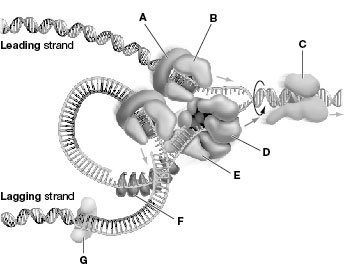
Refer to the figure. Which structure is responsible for stabilizing DNA in its single-stranded form?
F

Refer to the figure. What bases will be added to the primer as DNA replication proceeds? The bases should appear in the new strand in the order that they will be added starting at the 3’ end of the primer.
A, G, A, C, G, A, C

Identify the lagging strand during duplication of DNA starting from a double helix in the accompanying figure.
C