Kap. 10 - Reasoning and Problem Solving
 Call Kai
 Learn
Learn Practice Test
 Spaced Repetition
 Match
Match Flashcards
 Knowt Play
1/12

Earn XP
Description and Tags
Only part 10.1, 10.2, 10.5! pages 253-260; 265-271
Name | Mastery | Learn | Test | Matching | Spaced | Call with Kai | Chat |
|---|
No analytics yet
Send a link to your students to track their progress
13 Terms
Explain delay discounting and its connection to self-control.
Delay descounting
Aka “temporal discounting”
People diminish the value of future gains the longer they have to wait for them
.
Self-control
An executive function of the self that involves initiating, sustaining, and inhibiting behavior
.
Connection to each other
Bad self-control —> increased delay discounting
Immediate pleasure is chosen over future health and well-being
e.g. Ego depletion leads to more delay discounting
e.g. Patience as a form of self control - linked to addiction (lack of patience)
How does age affect self-control and decision-making?
Self-control vary with age:
Children and people over age 65 are worse at self-control
Although older adults are more patient
What is the difference between deductive and inductive reasoning?
Deductive reasoning
Moving from general knowledge and principles to more specific knowledge and examples
Syllogisms
(from Aristoteles!)
A logical system in which conclusion is drawn from two given positions (premises)
.
Inductive reasoning
Moving from specific to general
Use specific observations and real examples to infer general theories about the world
What is the common error in the Wason selection task?
What role do pragmatic reasoning schemas play in everyday reasoning?
Wason selection task
A logic puzzle (four-card problem) to test deductive reasoning
Common error:
80% choose A and 3 or just A
Correct answer:
A - correct - testing if the rule will be disproved if the other side doesn’t have a 3
7 - correct - testing if the rule will be disproved if the other side has an A
D - irrelevant
3 - irrelevant - the rule allows any letter on the other side of 3
Given the statement “If p is true, then q is true,” according to modus tollens, what else can you conclude?
What can you not conclude?
Modus ponens
In logical reasoning: the principle stating that when the antecedent holds true, the consequent can be treaded as true
i.e. Under conditions when the statement is accepted and the antecedent (p) holds as true, the consequent (q) can be treated as true.
Affirming the antecedent
e.g. Wason selection task: flipping A
.
Modus tollens
In logical reasoning: the principle stating that when the consequent is false, the antecedent is false
i.e. if consequent (q) is false, then antecedent (p) is false
Denying the consequent
Wason selection task: flipping 7
.
Fallacies (errors)
Denial of the antecedent (p)
i.e. “if p is false, then q is false“
e.g. Wason selection task: flipping D
Affirmation of the consequent (q)
i.e. “if q is true, then p is true“
e.g. Wason selection task: flipping 3
What is property induction, and what are the effects of premise typicality, premise diversity, premise monotonicity, and premise-conclusion similarity?
Property induction
How people generalize properties or features from one exemplar of a category to another
i.e. Making guesses based on past experiences
Premise typicality
If premises are more typical or representative of a category, they will lead to stronger inductions (perceived as stronger argument)
e.g.

Premise-conclusion simialrity
The more similar the premise and conclusion categories of a logical statement, the stronger the inductive argument will be
e.g.
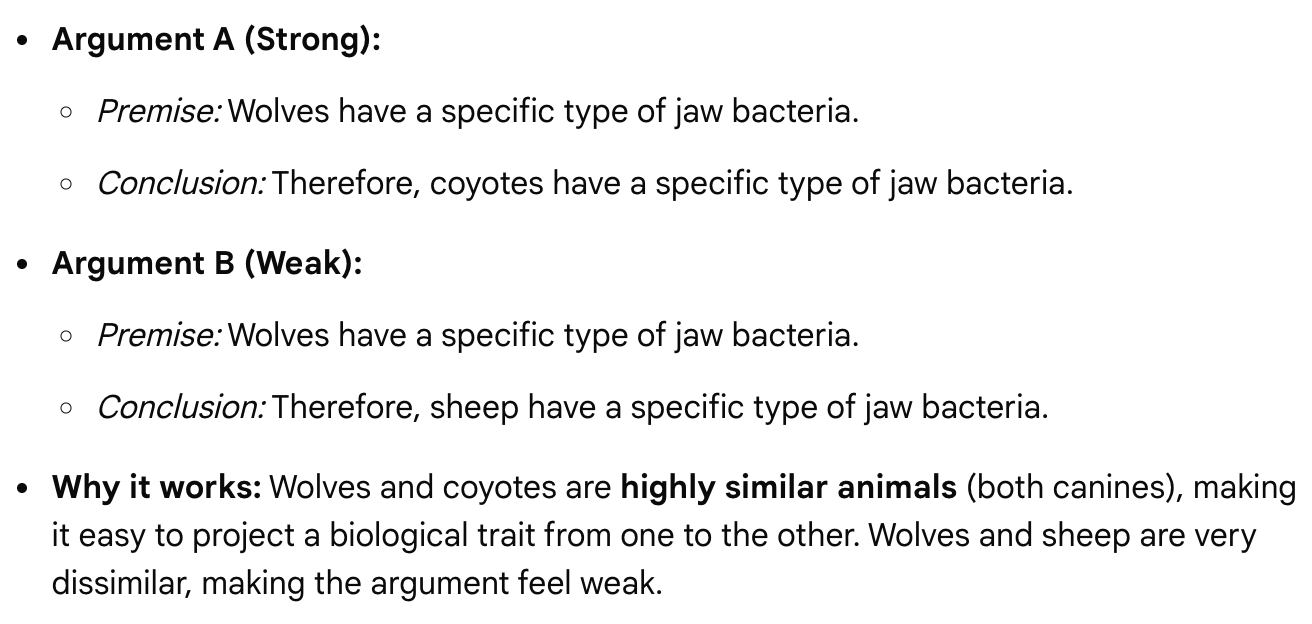
Premise diversity
Properties shared by diverse or dissimilar categories linked by a superordinate category are more likely to be generalized than properties shared by similar categories
e.g.

Premise monotonicity
The larger the number of premises that share a property, the more likely people will conclude that the property generalizes broadly
e.g.
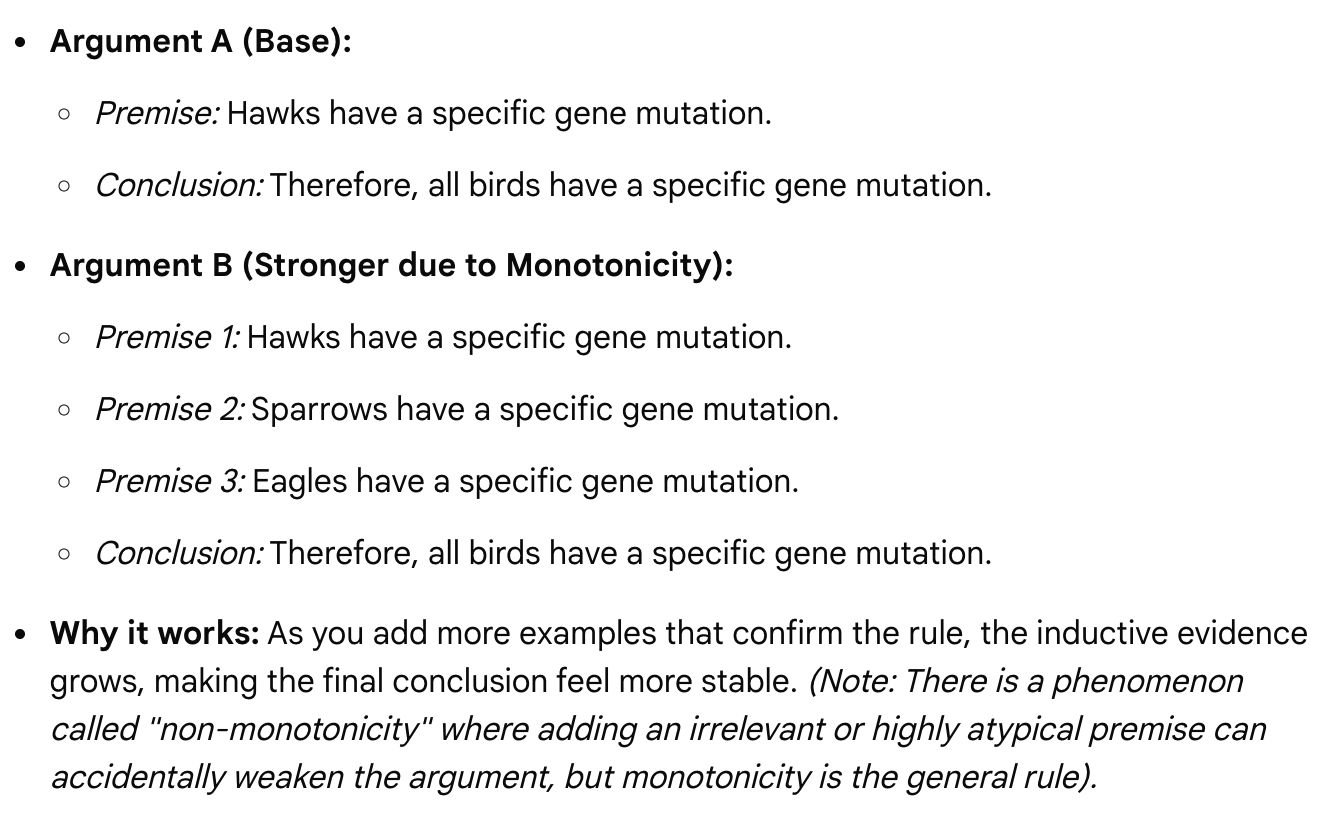
.
What is confirmation bias?
Suggest an example!
Confirmation bias
The favoring of evidence that supports one’s beliefs, expectations, or hypotheses
e.g.:
Wanting to chose card nr. 3 in Wason selection task
What are the three main parts of a problem?
Problem
A situation where someone has a goal but doesn’t know how to achieve it
Three main parts of a problem
The current situation
State where actions/operations are needed to achieve the goal state
The goal state
What roles do insight, transfer and heuristics play in problem solving?
Insight
The process of suddenly gaining a solution to a problem
“aha“ sensation
Common for creative solutions
e.g. the nine dot problem
e.g. problem of destroying tumor without destroying healthy tissue around
.
Transfer
To generalize a solution from one problem to another
Fundamental in education
Learning useful skills in one situation that you can use in other situations
.
Heuristics
Shortcuts/simple strategies used to solve problems
e.g. random trial and error
i.e. randomly selecting and applying different potential solutions until the problem is solved
What differentiates chess masters from novice chess players?
Specialists solve problems in their domain of expertise better than novices do
Noticing meaningful patterns
Organizing and remembering information in a way reflecting deeper understanding
More specific and contextualized knowledge
.
Chess masters vs. novices
Chess masters are better at remembering the layout of pieces on the board - only if pieces are arranged in legal way/not randomly
Do not have better general memory than novices, but have expertise for creating configurations (chunking them) and increasing the amount of information to remember
Situated cogntition
Thinking is shaped by its physical and social context
What is the remote associates test, and how does it differentiate creative individuals?
Creative cognition
The cognitive processes supporting creativity
Problem finding:
Finding new ways to frame questions and perceiving unrecognized needs and problems
Problem identification
Noticing a problem in need of a solution
Problem definition and redefinition
An approach that renders a problem tractable/manageable
.
Remote associates
Creative ideas that are remote from the original formulation of a problem
Remote associates test
A cognitive test in which participants must think of what links three specific words
In many cases the association is far from obvious
Flat associative hierarchies
Networks of mental associations in which the less obvious associations are nearly as accessible as the obvious one
May be linked with creativity
What is functional fixedness?
Functional fixedness
The tendency for our thinking to be boxed in by predefined uses and associations
What is divergent thinking?
Divergent thinking
The ability to generate a wide range of associations from a given starting point
Often associated with creative cognition
Can be tested with Torrance Test of Creative Thinking
Measures:
Fluency: number of ideas and images produced
Originality: number of unusual responses provided
Psychological openness
Degree of elaboration reflected in responses
Abstractness of the titles provided