acid base homeostasis
 Call Kai
 Learn
 Practice Test
 Spaced Repetition
 Match
 Flashcards
 Knowt Play
1/102

There's no tags or description
Looks like no tags are added yet.
103 Terms
Hyperventilation is the compensation for an acid-base imbalance known as __________.
Metabolic acidosis
What acid-base imbalance has an elevated blood pH and an elevated bicarbonate ion level?
Metabolic alkalosis
What is the most common cause for hypernatremia?
Dehydration
Angiotensin-II restores fluid homeostasis when dehydration occurs as a result of inadequate fluid intake. Which of the following actions are effects of angiotensin-II?
Stimulation of antidiuretic hormone (ADH) secretion; Stimulation of aldosterone secretion; Increase sodium ion reabsorption
What is the pH range resulting from a normal hydrogen ion concentration of body fluids?
7.35–7.45
Which of the following actions is a primary role of the phosphate buffer system?
Buffer intracellular fluid (ICF)
What is the appropriate respiratory compensation for alkalosis?
Decreased respiratory rate
Where are the majority of calcium ions stored in the body?
Osseous tissue
What is the biggest source of metabolic acids in the body?
Carbon dioxide
What is a major function of potassium ions in the body?
Maintaining resting potential of neurons and muscle cells
What product forms when a hydrogen ion from a strong acid is accepted by a bicarbonate ion?
Carbonic acid
Which of the following locations is a site of potassium ion secretion?
Distal tubule
Which of the following factors is a possible cause for respiratory alkalosis?
Brain tumor on the respiratory centers
What triggers the release of parathyroid hormone (PTH)?
Decreasing calcium ion concentration of the blood
Which of the following ions is an important component of osseous tissue?
Magnesium ions
Which of the following effects tend to be caused by hypernatremia?
Cellular crenation
What is the most abundant extracellular cation?
Sodium ion
Which ion imbalance causes the plateau phase of the cardiac muscle cell action potential to shorten, making the heart contractions shorter and weaker?
Hypercalcemia
Through what two organ systems are carbon dioxide eliminated from the body?
Respiratory and urinary systems
What effect will an increase in carbon dioxide (CO2) levels in the plasma have on the plasma pH?
The pH will decrease.
A patient is experiencing diabetic ketoacidosis, which causes metabolic acidosis. If that patient experienced damage to the kidneys from diabetes mellitus, predict how the body compensates to return blood pH to normal.
Hyperventilation will return blood pH to normal.
What leads to respiratory acidosis?
Hypoventilation
Which hormones have a role in potassium ion regulation?
Aldosterone; Epinephrine; Insulin
What ion concentration is linked to calcium ion concentration and regulated by vitamin D3 (calcitriol)?
Phosphate ions
How does the respiratory system work to decrease acidosis?
Carbonic acid is broken down into water and CO2; the CO2 is then exhaled.
Which of the following functions is associated with chloride ions in the body?
Involved in the secretion of newly formed bicarbonate ions from erythrocytes
What is the main buffer system of the extracellular fluid (ECF)?
Carbonic acid–bicarbonate ion buffer system
Which hormone influences the concentration of hydrogen ions in the filtrate formed by the kidneys?
Aldosterone
Which of the following side effects is most likely to develop if a patient is given aldosterone inhibitors?
Hyperkalemia
What is most abundant intracellular cation?
Potassium
An excess accumulation of interstitial fluid is called __________.
Edema
Which of the following functions are important roles of hydrogen ions?
Digestion of ingested food; Inactivation of bacteria; Intracellular digestion by lysosomes
What system is responsible for the most common route of water loss from the body?
Urinary system
What effect does an increase in antidiuretic hormone (ADH) have on the volume of extracellular fluid (ECF)?
ECF increases when ADH is present.
What is the main component of all body fluids?
Water
How much water does an average person need to drink per day?
1.5 liters
What determines the hydrostatic pressure of a solution?
The force that fluids exert.
Which of the following pH values is most acidic?
pH of 2
What would be the effect of a hypertonic extracellular fluid on a cell?
Water will move out of the cytosol and the cell shrinks.
Which of the following individuals has the highest total body water percentage?
Infants
Which of the following solutes has a higher concentration in the extracellular fluid (ECF)?
Calcium
Which of the following statements best describes the principle of mass balance?
What is gained by the body must equal what is lost by the body.
What is the most common base in the human body?
Bicarbonate ion
A patient with heart failure is administered an intravenous line containing a solution of hypertonic sodium chloride. For which of the following patients is this solution an appropriate choice?
A patient experiencing overhydration, or hypotonic hydration
Which of the following conditions is characterized by a decreased volume and increased concentration of the extracellular fluid (ECF)?
Dehydration
What part of the brain controls the thirst mechanism?
Hypothalamus
Which of the following pH values is considered basic, or alkaline?
pH of 10
Which of the following hormones functions to regulate fluid balance in the body?
Aldosterone
Which of the following solutes will dissociate into ions when placed in water?
Electrolyte
How much urine is lost through obligatory water loss each day?
500 ml
For which imbalance is the release of antidiuretic hormone (ADH) appropriate?
Fluid and electrolyte imbalance
Fluid balance in the human body is roughly equivalent to __________.
Water balance
What is the main difference in composition of plasma and interstitial fluid?
Protein content
Under what condition might it be beneficial to administer hypertonic sodium chloride to a patient?
Overhydration
Which of the following functions is not associated with water?
Acts as a nonpolar solvent
In what direction will water move when hypotonic fluids are present in the plasma?
Water is pulled out of the interstitial fluid and plasma into the cell.
What chemical dissociates in water to release a hydrogen ion (H+)?
Acid
What happens to the pH of a solution when hydrogen ions are added?
The pH decreases. 1
A patient who suffers from renal failure, producing less urine, increases his water intake to account for his low urine output. What will happen to his fluid balance?
His kidneys will not be able to excrete the excess water, so a water imbalance will exist.
A patient who suffers from renal failure, producing less urine, increases his water intake to account for his low urine output. What will happen to his electrolyte balance?
The excess water his kidneys cannot excrete will dilute body fluids and lead to an imbalance in electrolytes.
An electrolyte is a __________.
substance that dissociates into ions when placed in water
The principle of mass balance states that __________.
what is gained by the body must equal what is lost by the body
Substances that function to resist large swings in pH are called __________.
buffers
Which of the following substances is the most acidic?
Gastric juice with a pH of 2
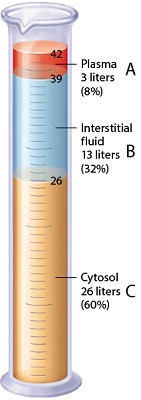
Which of the following is ICF?Which of the following is ICF?
C

Which of the following represents sodium ion distribution in the ECF and ICF?
A

Which of the following represents potassium ion distribution in the ECF and ICF?
B

Which of the following will result in the fluid movement depicted above?
dehydration

Which of the following corresponds to water loss through the skin?
B

The 250-milliliter water gain indicated by the question mark is __________.
metabolic water
Would protein-rich liver cells contain more or less water than lipid-rich adipose tissue?
Protein-rich liver cells will contain more water than lipid-rich adipose cells because the lipids are hydrophobic.
A nurse is asked to start an intravenous line of isotonic 0.9% sodium chloride. He accidentally grabs a bag of hypertonic 9% sodium chloride instead. What will happen to his patient?
The patient's cells will shrivel due to losing water by osmosis from the cytosol into the hypertonic extracellular fluid.
Under what conditions might it be beneficial to administer a hypertonic saline solution to a patient?
If the patient is overhydrated, then a hypertonic solution could be used to draw the water out of their cells.
Which of the following statements about the ECF is correct?
It is made up of fluids such as plasma and interstitial fluid.
Increased water volume causes the hydrostatic pressure in plasma to increase and the osmotic pressure to decrease; as a result, water will __________.
move from the ECF to the ICF
A child is brought to the ER after prolonged vomiting and diarrhea. Which of the following is one of the symptoms this child will present with?
decreased urine production
Which of the following is a response mechanism for overhydration?
increased levels of ANP
Which of the following ions is found primarily in the ECF?
HCO3−
Overhydration will cause __________.
cells to gain water

Beaker A and Beaker B contain solutions with __________.
the same total amount of Na+ but different concentration
What effect on sodium and chloride ions would a patient with Addison's disease (decrease in aldosterone secretion) experience?
The lack of aldosterone due to Addison's disease will decrease the reabsorption of sodium and chloride ions in the ECF.
Which of the following electrolytes is a component of hydroxyapatite crystals in bone matrix?
PO43−
Aldosterone inhibitors are prescribed to patients with advanced heart failure. A common side effect of these drugs is __________.
hyperkalemia
Calcium ion reabsorption in the kidneys is stimulated by the hormone __________.
PTH
The appropriate response to hyponatremia is __________.
increased reabsorption of sodium ions in the kidneys
The hormone PTH causes __________.
a decrease in the reabsorption of phosphate ions

The beaker containing the most acidic solution is __________.
A
The primary role of the phosphate buffer system is to __________.
buffer intracellular fluid (ICF)
CO2+ H2O↔ H2CO3↔__________
H++ HCO3−
A patient present with severe metabolic alkalosis. The appropriate respiratory compensation would be __________.
decreased respiratory rate
A drowning victim presents with combined respiratory and metabolic acidosis. The appropriate renal compensation would be __________.
secretion of hydrogen ions
Hyperventilation causes __________, and hypoventilation causes __________.
respiratory alkalosis; respiratory acidosis
Which of the following happens during compensation for alkalosis?
excretion of HCO3−
The normal range of blood pH is __________.
7.35 to 7.45
If the Pco2in the plasma increases, what effect will this have on plasma pH?
The pH will decrease.
Which of the following would have the greatest effect on the pH of a solution?
A strong acid
If the pH of a solution decreases, how will a buffer respond?
The base will remove H+to increase pH.
Plasma
8%
Cytosol
60%