UGA OCHEM Lab Final
 Call Kai
 Learn
 Practice Test
 Spaced Repetition
 Match
 Flashcards
 Knowt Play
1/88

There's no tags or description
Looks like no tags are added yet.
89 Terms
4 characteristics of a good solvent
1. target is soluble at high temps
2. impurities soluble at room temp or insoluble at high temps
3. chemically inert (won't react with target compound or impurities)
4. volatile
How to induce recrystallization?
-scratch the inner wall of the flask with a stirring rod
-introduce a pure crystal that matches your compound (seed crystal)
-ice bath
If crystals still don't form, what went wrong? How do you fix it?
too much solvent; boil it off and try to recrystallize it again
How do impurities affect melting point?
lowers and broadens the melting point
What is the eutectic point?
The Lowest possible melting point of a mixture of substances
What kind of MP did you conduct to verify the unknown?
50:50 mixed melting point
5 basic steps of recrystallization
1. Choose an appropriate solvent
2. Dissolve the impure mixture in the hot solvent
3. Remove the insoluble impurities from the hot solvent
4. Cool filtered solution, crystallize the solid
5. Isolate the pure compound
Distillation is separation based on difference in what?
boiling points
When would you use simple distillation?
when there is a boiling point difference of 100 or greater

When there is a boiling point difference of less than 100 what is the best method of distillation to use?
fractional distillation

What is a fractionating column?
glass tube filled with tightly packed steel wool or glass beads that causes the surface area of the column to increase, allowing for successive simple distillations
How is the fractionating column efficiency measured?
theoretical plates
What is a theoretical plate?
represents the overall efficiency of the fractionating column
- more plates = more efficient
- number of successive distillations
Azeotrope
when two miscible liquids behave as pure liquid (the mixture has one boiling point)
- cannot be separated by fractional distillation
- Example: Ethanol, which is a mixture of 95.63% ethanol and 4.37% water
The longer the fractionating column...
the greater number of theoretical plates
At 30C, the vapor pressure of cyclohexane is 0.260 atm and the vapor pressure of cyclopentane is 0.376 atm. What is the total vapor pressure for a 3:4 mixture of cyclohexane to cyclopentane at this temperature?
Pt =Pa (Xa) + Pb (Xb)
Pt = (0.260)(3/7) + (0.376)(4/7)
Pt = 0.326 atm
(Dalton's Law and Raoult's Law)
How would the boiling point of a liquid be affected if it were measured on top of Mt. Everest?
BP on Mt. Everest would be less than the boiling point at sea level
- atmospheric pressure decreases with increases in altitude
- with less pressure it will take less heat to bring water to a boil
Solid-liquid extraction
Extraction of a compound from a solid using a liquid media.
Separation depends on compound's solubility in the particular solvent.
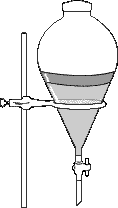
Liquid-liquid extraction
Requires two immiscible liquids (aqueous & organic phase) use separatory funnel; lower density on the bottom; like dissolves like; organic non-polar compounds will dissolve in organic phase
What was extracted from what?
Trimyristin extracted from nutmeg (20-25%)
What technique was used for nutmeg extraction?
solid-liquid extraction
What was used to wash the remaining soluble impurities from the crystals?
acetone
Structure of trimyristin

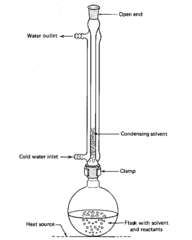
What is the purpose of this technique?
Heat mixtures for extended periods of time without solvent loss to extract compounds or carry out rxns
TLC is separation based on ?
stationary phase and mobile phase
TLC is used for what?
identifying individual components of a mixture (among other things)
What is used for the solid stationary phase?
silica gel or alumina
What is used for the mobile liquid phase?
low boiling point organic solvent (ethyl acetate containing 0.5% acetic acid)
What is the effect of polarity?
Polar compounds have strong interactions with the polar stationary phase, so they elute slower
- the solvent that travels the most is the least polar and the one that travels the least is the most polar
Rf value
Distance travelled by substance / distance travelled by solvent
(between 0-1)

Plate visualized with?
UV light
4 ingredients of TLC
acetaminophen, acetylsalicylic acid, caffeine, ibuprofen
Acid/Base extraction is based on?
varying solubility between two immiscible liquids
What was the solvent in the acid/base extraction?
methylene chloride (DCM)
What happens when organic acids/bases become ionized?
water soluble ionic salt forms
Characteristics of an extraction solvent
-immiscible with the original solution
-Component to be separated must be more soluble in the extraction solvent than the liquid part of the original solution
-extraction solvent should be more volatile than the liquid component of the original solution
-The extraction solvent should be non-toxic (if possible)
What happens to an amine in acidic conditions?
protonated to form ammonium salt
Carboxylic acid in basic conditions?
deprotonated to form carboxylate salt
Which layer is on the top/bottom? Based on what?
based on density; in our lab the bottom was DCM (organic) and the top was water (aqueous)
What were the 3 components?
Basic: benzocaine
Neutral: diphenylmethanol
Acidic: unknown (benzoic acid, 2-methoxybenzoic acid, or o-toluic acid)
What is hydrogenation?
addition of H2 to an alkene; decreases number of unsaturated carbon-carbon bonds, increases number of saturated bonds
Oxidation
Increase the number of bonds to more electronegative elements and/or reduce the number of bonds to hydrogen
Reduction
Increase the number of bonds to hydrogen and/or decrease the number of bonds to more electronegative elements
Catalyst in hydrogenation ?
Pd/C
What was the hydrogen donor?
cyclohexene
balanced equation for hydrogenation
2 mol olive oil; 3 mol cyclohexene -> 2 mol shortening, 3 mol benzene
Why does this reaction occur?
in order to make benzene; this is what pushes this reaction forward since benzene is the most stable product
In what state does the olive oil exist in prior to the hydrogenation experiment? What state is the olive oil in following the hydrogenation experiment? Why?
Prior to the experiment it was a liquid and after it was a solid, this is because of the way the double bonds stack on one another
How did we form the carbon-carbon triple bond?
Halogenation of an alkene, followed by double dehydrohalogenation
Reaction mechanism for diphenylacetylene

Reagents used in formation of diphenylacetylene
- Pyrdidinium hydrobromide perbromide (PHPB)
- Potassium Hydroxide (KOH)
Retention Time
Compounds with short retention times move faster within the column; long retention times=slower movement within column.
What gives better separation?
longer and wider columns
SN2 reaction vs. SN1 reaction
SN1: substitution nucleophilic unimolecular reaction
SN2: substitution nucleophilic bimolecular reaction
Why is the reaction SN1?
its tertiary
mechanism for gas chromatography

Why is bromide a better nucleophile than chloride?
when comparing nucleophiles within the same column the bigger one (in mass) will be the better nucleophile
purpose of gas chromatography lab?
To determine which is a better nucleophile, Br or Cl
diene must be _____ conformation to react
s-cis (must be conjugated)
S-cis
two opposing ends of the double bond are pointed in the same direction
Dienophiles are more reactive when?
electron withdrawing group is present adjacent to carbon-carbon double bond
Stereospecificity is?
conserved
Technique used in diels-alder?
reflux
Diels-Alder reaction is characterized by
4+2 cycloaddition
Ethanol and water form a(n) _____ when mixed in solution
azeotrope
Celite pipet filtration
used to isolate the product from palladium solid with minimal risk of fire

In the recrystallization experiment, the identity of the unknown was determined by
melting point
What is the purpose of refluxing?
it allows heating without the loss of solvent
Nutmeg contains ____% trimyristin by weight
20-25%
Basic overview of flow chart of acid/base extraction

Caffeine would show up where on a TLC plate?
near the bottom of the plate; it is very polar
Does the same Rf value for two substances indicate the same identity?
no
Basic and neutral components are ______ in NaOH
insoluble
What is the intermediate product in the formation of diphenylacetylene?
stilbene dibromide

4 Factors affect compound separation using gas chromatography
1. column length
2. column temperature
3. gas flow rate
4. stationary liquid phase
What were the 4 possible dienophiles?
- DMAD: Dimethyl acetylenedicarboxylate
- DEAD: Diethyl acetylenedicarboxylate
- DPAD: Dipropyl acetylenedicarboxylate
- DIAD: Diisopropyl acetylenedicarboxylate

You have a compound X (mp=123-125 C) and a compound Y (mp=96-99 C). What would be the most likely melting point range of a 1:1 mixture of X and Y?
190-193
A.123-125
B.96-99
C.85-91
D.105-115
C. 85-91
Reflux was used to extract ____ from nutmeg?
triglyceride
The analgesic mixtures for thin layer chromatography were dissolved in
methylene chloride/ethanol solution
In the acid/base extraction, benzoic acid was isolated from the aqueous layer using what?
aqueous hydrochloric acid
Vinegar is a carboxylic acid. In which aqueous solution would vinegar be the most soluble?
A. 1M H2SO4
B. 0.45 M NaCl
C. 1M NaOH
D. water
E. 3M NaBr
C. 1M of NaOH
Why are boiling chips used in distillation? What do they prevent?
they keep the solution temperature uniform; they prevent bumping and prevent hot spots from forming
When does reflux begin?
when the solution begins to boil
Why was pyridinium hydrobromide perbromide used instead of Br2?
liquid Br2 is highly toxic and dangerous; PHPB is safer and easier to work with
What solvent was used for recrystallization?
water
What was the diene in the Diels-Alder reaction?
cyclopentadiene
Microwave distillation was used to crack ___________ from the dimer it exists at room temperature
dicyclopentadiene
In gas chromatography, the stationary phase is
a nonvolatile liquid
Diels-Alder Mechanism
