physics: #21
 Call Kai
 Learn
 Practice Test
 Spaced Repetition
 Match
 Flashcards
 Knowt Play
1/30

Earn XP
Description and Tags
the earth & the solar system
31 Terms
Earth
a planet that rotates about its tilted axis (23.5º) once every approximately 24 hours
apparent daily motion of the Sun
Sun appears to move across the sky from east → west
as an effect of Earth’s rotation
day
experienced by the side of Earth facing the Sun
night
experienced by the side of Earth facing away from the Sun
Earth’s revolution
orbits around the Sun once every approximately 365 days/1 year
seasons
caused by Earth’s tilted axis & revolution around the Sun
summer
hemisphere tilted towards Sun
daylight hours > dark hours
winter
hemisphere tilted away from Sun
daylight hours < dark hours
spring/autumn
Northern Hemisphere tilted in direction of travell
the Moon’s orbit
orbits Earth once every approximately 1 month/27.3 days
phases of the Moon
new moon
waxing crescent
first quarter
waxing gibbous
full moon
waning gibbous
third quarter
waning crescent
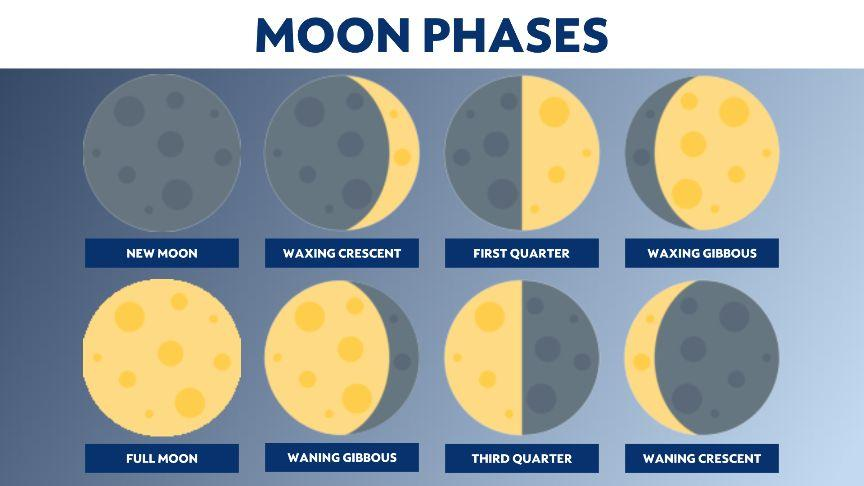
waxing
the illuminated portion of the Moon we see increases
waning
the illuminated portion of the Moon we see decreases
average orbital speed
average distance travelled by an object in one orbit divided by the time taken to complete one orbit
formula of average orbital speed
v = 2πr/T
Solar System
consists of the Sun & all the objects that orbit it
contents of the Solar System
Sun
8 planets
minor planets
moons
smaller solar system bodies
Sun
only star that contains most mass of our Solar System
Sun’s gravitational attraction
keeps planets in orbit around it
8 planets
Mercury
Venus
Earth
Mars
Jupiter
Saturn
Uranus
Neptune
minor planets
smaller bodies that orbit the Sun including dwarf planets & asteroids
Pluto
a dwarf planet
asteroids
found in the asteroid belt between Mars & Jupiter
moons
natural satellites orbiting planets that don’t produce their own light, instead reflecting light from the Sun
smaller solar system bodies
includes comets & natural satellites
comets
bodies mainly made of ice, dust & rock that orbit the Sun
form tails when approaching the Sun
natural satellites
naturally occuring objects that orbit planets/larger bodies
inner planets
Mercury
Venus
Earth
Mars
characteristics of inner planets
small
rocky
high density
outer planets
Jupiter
Saturn
Uranus
Neptune
characteristics of outer planets
large
mainly gaseous
generally lower density