chapter 19: gas exchange and transport
 Call Kai
 Learn
 Practice Test
 Spaced Repetition
 Match
 Flashcards
 Knowt Play
1/22

There's no tags or description
Looks like no tags are added yet.
23 Terms
hypoxia
If the diffusion of gases between alveoli and blood is significantly impaired, or if oxygen transport in the blood is inadequate
hyper/hypocapnia
hypercapnia: elevated concentrations of carbon dioxide
hypocapnia: low concentrations of carbon dioxide
erythrocyte
The red blood cells, or erythrocytes, have a critical role in ensuring that gas transport between lung and cells is adequate to meet cell needs.
hemoglobin
Without hemoglobin in the red blood cells, the blood would be unable to transport sufficient oxygen to sustain life
oxygenated/deoxygenated
If all binding sites on all hemoglobin molecules are occupied by oxygen molecules, the blood is 100% oxygenated
affinity (of hemoglobin for O2)
In humans, physiological changes in plasma pH, temperature, and PCO2 all alter the oxygen-binding affinity of hemoglobin. Changes in binding affinity are reflected by changes in the shape of the Hb saturation curve.
Decreased pH, increased temperature, or increased PCO2, decrease the affinity of hemoglobin for oxygen and shift the oxygen-hemoglobin saturation curve to the right
When these factors change in the opposite direction, binding affinity increases, and the curve shifts to the left
oxyhemoglobin saturation curve
Oxyhemoglobin saturation curves, such as the ones shown in FIGURE 19.9, are the result of these in vitro binding studies.

saturated (as for hemoglobin)
If all binding sites on all hemoglobin molecules are occupied by oxygen molecules, the blood is 100% oxygenated, or saturated with oxygen. If half the available binding sites are carrying oxygen, the hemoglobin is 50% saturated, and so on.
Remember that O2 and CO2 move only by simple diffusion in the body (though
bicarbonate, HCO3-, can be actively transported and is essentially a form of CO2)
ok
Apply your understanding of the factors that affect diffusion to evaluate how
changes in these factors will affect the rate of diffusion of O2 and CO2 (see Fig
19.3c for examples)

Explain the difference between concentration and partial pressure; explain how
O2 and CO2 could possibly diffuse “up” their concentration gradients
chat/textbook
Concentration: The total amount of a gas in a given volume (includes both free dissolved molecules and bound molecules like oxygen attached to hemoglobin).
Partial Pressure: The pressure exerted by only the free, dissolved gas molecules in a liquid or gas phase.
How O2 and CO2 can diffuse "up" their total concentration gradients:
Gases do not diffuse based on total concentration; they always diffuse down their partial pressure (free gas) gradient.
Hemoglobin acts like a sponge that quickly binds and locks away dissolved oxygen.
Because hemoglobin traps the oxygen, the actual amount of free, dissolved oxygen in the blood stays very low.
This allows oxygen to keep continuously diffusing into the blood from the lungs down its partial pressure gradient, even though the total concentration of oxygen in the blood is already much higher than in the plasma alone.
Explain why hemoglobin exists; how does it increase the oxygen-carrying
capacity of blood?
Without hemoglobin in the red blood cells, the blood would be unable to transport sufficient oxygen to sustain life
why is hemoglobin an effective oxygen carrier? The answer lies in its molecular structure. Hemoglobin (Hb) is a tetramer with four globular protein chains (globins), each centered around an iron-containing heme group [Fig. 17.6]. The central iron atom of each heme group can bind reversibly with one oxygen molecule. The iron-oxygen interaction is a weak bond that can be easily broken without altering either the hemoglobin or the oxygen.
With four heme groups per hemoglobin molecule, one hemoglobin molecule has the potential to bind four oxygen molecules. Hemoglobin bound to oxygen is known as oxyhemoglobin, abbreviated.
Identify or explain the relationship between a tissue’s rate of use of O2 and
“where it is” on the oxyhemoglobin saturation curve (Fig 19.9a), and therefore,
the effect of exercise on O2 delivery to a tissue
If you look at the curve, you find that at normal alveolar and arterial PO2 (100mm Hg), 98% of the hemoglobin is bound to oxygen (Fig. 19.9a). In other words, as blood passes through the lungs under typical conditions, hemoglobin picks up nearly the maximum amount of oxygen that it can carry.

Explain the Bohr effect (what it is and how it happens)
A shift in the hemoglobin saturation curve that results from a change in pH is called the Bohr effect.
When does the body undergo shifts in blood pH? One situation is with maximal exertion that pushes cells into anaerobic metabolism. Anaerobic metabolism in exercising muscle fibers releases H+ into the cytoplasm and extracellular fluid. As H+ concentrations increase, pH falls, the affinity of hemoglobin for oxygen decreases, and the HbO2 saturation curve shifts to the right. More oxygen is released at the tissues as the blood becomes more acidic (pH decreases)
Identify and explain the effect of changes in O2 partial pressure, CO2 partial
pressure, pH, and temperature on the percent saturation of hemoglobin in that
tissue
chat/textbook
Oxygen Partial Pressure (P_O2): Plasma P_O2 is the primary factor determining hemoglobin's percent saturation. As cellular P_O2 decreases in metabolically active tissues, the binding equilibrium shifts, causing hemoglobin to release more oxygen.
Carbon Dioxide Partial Pressure (P_CO2) & pH: Increased P_CO2 or decreased pH (acidity) decreases hemoglobin's affinity for oxygen and shifts the oxygen-hemoglobin saturation curve to the right (known as the Bohr effect), causing hemoglobin to release additional oxygen to active tissues.
Temperature: Increased temperature decreases hemoglobin's affinity for oxygen and shifts the saturation curve to the right, causing warmer, active tissues (like exercising muscle) to release more oxygen.
Identify or explain how CO2 is transported in the blood (general % breakdown,
no fancy details)

Explain the importance of the chemical equation: CO2 + H2O < -- > H+ + HCO3-;
explain why the equation tends to run “forward” (to the right) in systemic tissues
and “backward” (to the left) in the lungs
This reaction is reversible and obeys the law of mass action. We used to believe that carbonic acid was formed as an intermediate step, but studies of carbonic anhydrase function now indicate that the enzyme combines OH- directly with CO2 to form bicarbonate.

Use your understanding of the above equation to evaluate the effect of changes
in breathing rate, kidney reabsorption of bicarbonate, and metabolic rate on
blood pH
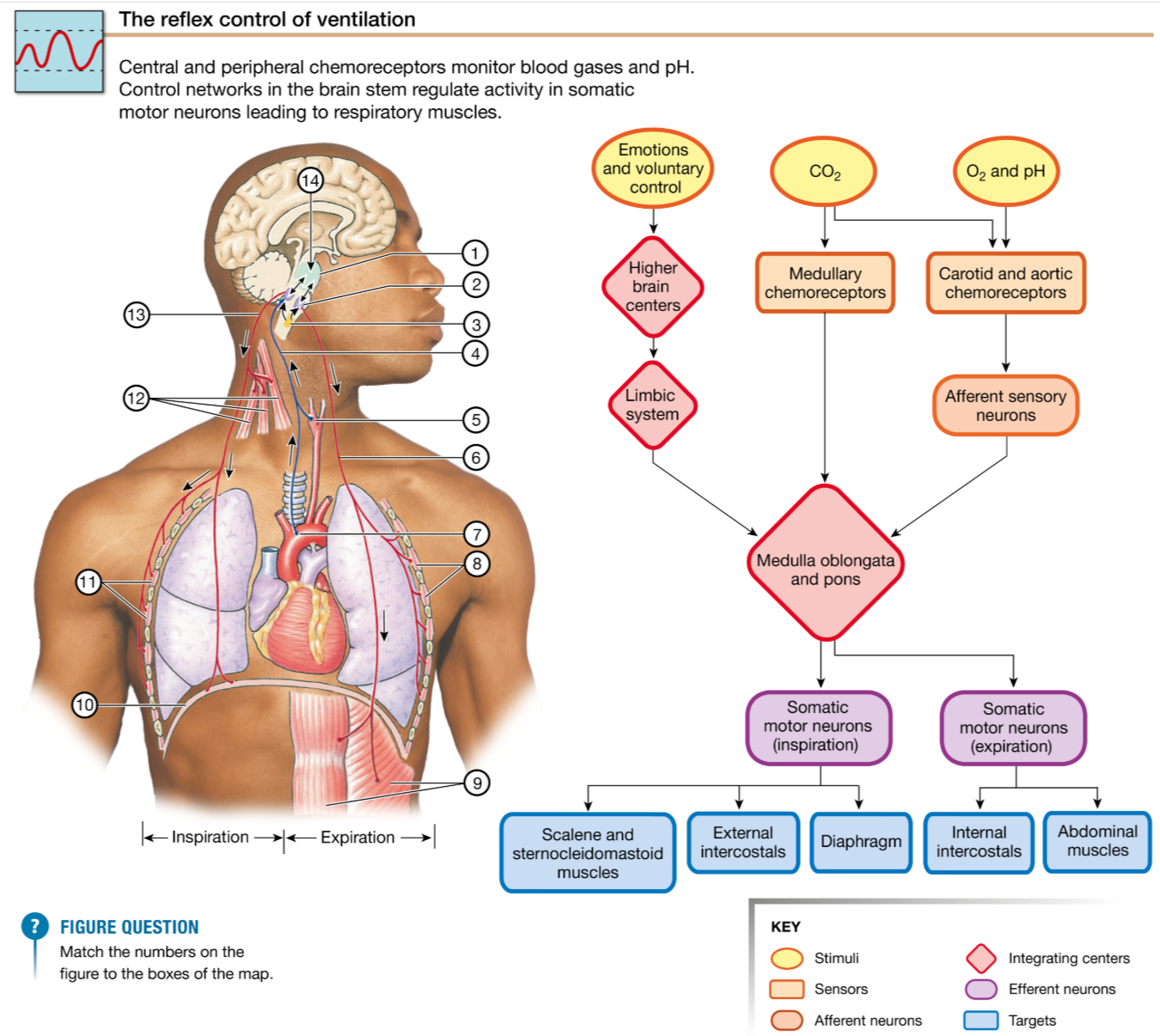
Predict the effect of changes in breathing rate on blood O2, CO2, and pH levels
If too little oxygen is present in arterial blood destined for the brain and other tissues, the rate and depth of breathing increase.
If the rate of CO2 production by the cells exceeds the rate of co2 removal by the lungs, arterial increases, and ventilation is intensified to match CO2 removal to production.
Lower pH —> Faster breathing (removes CO2, which acts as an acid).
Higher pH —> lower breathing (retains CO2 to bring pH back down).
Identify the location of the motor neurons that control (involuntary) breathing
Identify the major controllers of breathing rate, including the direction (e.g.
lower pH → faster breathing)
CO2, oxygen, pH
If too little oxygen is present in arterial blood destined for the brain and other tissues, the rate and depth of breathing increase.
If the rate of CO2 production by the cells exceeds the rate of co2 removal by the lungs, arterial increases, and ventilation is intensified to match CO2 removal to production.
Lower pH —> Faster breathing (removes CO2, which acts as an acid).
Higher pH —> lower breathing (retains CO2 to bring pH back down).
Identify how kidney reabsorption of bicarbonate changes in response to changes
in blood pH
chat:
Acidosis (low blood pH): The kidneys reabsorb more bicarbonate and create new bicarbonate to put into the blood, raising the pH.
Alkalosis (high blood pH): The kidneys reabsorb less bicarbonate and excrete the excess in the urine, lowering the pH.

Describe the pathway by which a change in the partial pressure of CO2 in the
blood leads to a change in breathing rate & depth (Fig 19.12)