Perfect competition
 Call Kai
 Learn
 Practice Test
 Spaced Repetition
 Match
 Flashcards
 Knowt Play
1/39

There's no tags or description
Looks like no tags are added yet.
40 Terms
Structure-Conduct-Performance
a model in microeconomics which offers a causal theoretical explanation for firm performance
through economic conduct in a particular market structure
market structure conditions the firm's economic conduct (decision-making), which in turn affects its market performance
external factors such as legal or political interventions affect the market framework and, by extension, the structure, conduct and performance of the
market
Structure
Market structure influences the nature of competition and the method of fixing the price of goods or products exchanged in a strategic way. The structure of the market as part of the S-C-P model therefore consists of the numbers of buyer and sellers, barriers to entry, product differentiation and the vertical integration of firms. The structure of the market is also influenced by the nature of the product and the technology available.
Conduct
The behaviour of firms in the market concerns the strategy of fixing prices and the volumes produced, investment in marketing and advertising, internal growth (R&D, innovation strategy, investment), and external growth (merger/acquisition, agreement, cooperation)
Performance
The criteria of evaluation of market performance are, therefore, prices, costs of commercialisation and commercial margins. We can add the quality of products, the efficiency of production, the allocative efficiency of resources, technical progress and the evolution of the market shares of firms.
Three Market Structures Compared

Perfect Competition
Perfect competition is a market structure characterised by a complete absence
of rivalry or competition.
Perfect Competition Assumptions
(very) large numbers of sellers and buyers
homogenous (identical) product
same technology
profit maximization
Free (costless) entry and exit of firms
Perfect knowledge, full transparency and complete information
marginal revenue
the extra revenue the firm obtains by producing and selling one additional unit of output
marginal cost
additional cost the firm incurs to produce one extra unit of output
pure price-taker
it can sell any
amount of its output at the prevailing market price
Where does the (prevailing) market price come from (in perfect competition)?
the market price is determined by market demand (coming from buyers) and market supply
(which is the supply of all firms combined)
prevailing market price
price which clears the market, i.e. the price at which the quantity demanded in
the market is equal to the quantity supplied
excess demand
demand will exceed supply , this will push up the price, due to which
demand will decline and supply will rise – until the market price is equal to P
excess supply
supply will be higher than demand, this will push down the price, with the result that market
demand will rise and market supply will decline – until the market price is equal
to the equilibrium price P
total fixed costs
include the
annualized investment expenses (on machines & equipment, buildings and land)
and depreciation (wear and tear) of machinery
the firm has to pay these costs also when it is not producing
anything
normal profit
fixed return
on fixed capital plus an allowance for risk
total variable costs
include the cost of raw materials and intermediate inputs as well as the
cost of direct (production) labour. The key feature of TVC is that it is zero when
the firm is not producing
Why doesn’t the short-run equilibrium last?
each firm is making excess profits Π𝑖 = (𝑃 − 𝐴𝐶𝑖∗) × 𝑥𝑖∗ at the prevailing market price P which is higher than 𝐴𝐶𝑖
=> excess or supernormal profits attract new firms (profit-seeking entrants) in the market
What happens as the MR-curve goes down
the profit-maximizing level of output will go down
the area of supernormal profits will be reduced
he condition
for long-run equilibrium in perfect competition
𝑃 = 𝑀𝐶𝑖 = 𝐴𝐶𝑖
The long-run outcome of a perfectly competitive market is argued to feature the following economically desirable properties
The output is produced at the minimum feasible cost of production, since 𝑃 = 𝐴𝐶𝑖 for each firm. Consumers therefore pay the lowest possible price – and consumer welfare is highest.
Production plants are used at full capacity (in the long run), so that there is no waste of resources or slack in the system. Firms only earn normal profits (and not excess or supernormal profits).
super-normal profits
𝑃 > 𝐴𝐶𝑖
Limitations of the Theory of Perfect Competition
The assumptions defining ‘perfect competition’ are restrictive and unlikely to be satisfied in reality.
Perfect competition is a market structure characterised by a complete absence of competition
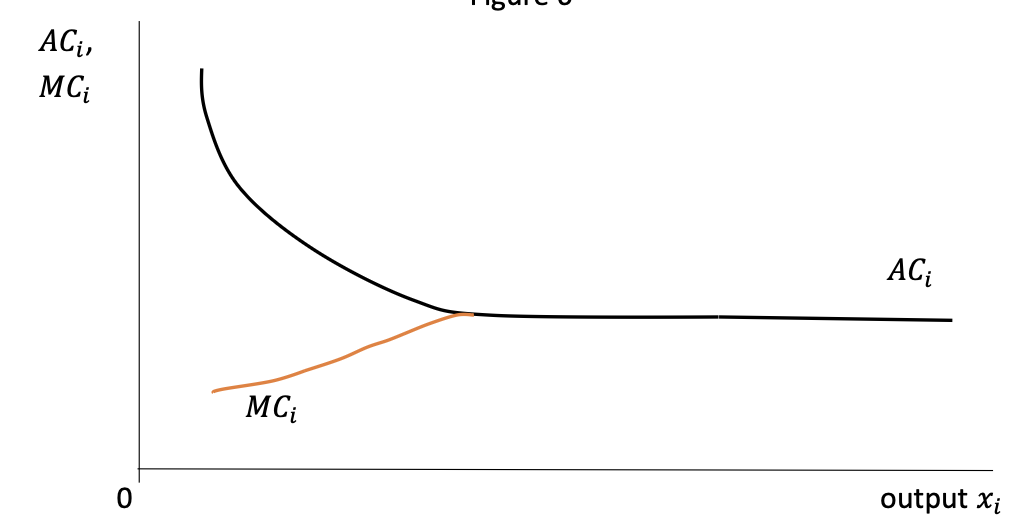
Empirical evidence suggests that cost curves are L-shaped , not U shaped
Realistic MC curve
Where the (perfect) market fails
Information problems: asymmetric information and ignorance
Market instability: expectations, cobwebs and speculation
Market power: monopoly & oligopoly
Externalities
Public goods (including knowledge)
Information problems: ignorance
a certain amount of ignorance always remains in all markets – which
causes equilibrium prices and quantities to deviate from what they would be if
we had complete information
asymmetric information
Asymmetric information arises when one market actor has more knowledge about the quality or cost
of the product than the buyer of the product. The seller can rig the market process by understating the riskiness
of the financial derivative in order to persuade prospective buyers to purchase the financial instrument.
moral hazzard
the possibility that the actor with the information advantage will use this for his/her own benefit
cobweb
Core Assumptions & Causes
Production Time Lags: Products (such as agricultural commodities or natural resources like oil) require a substantial time delay between the decision to produce and final sale, preventing suppliers from making immediate output adjustments in response to demand changes3.
Naïve Expectations: Producers base their future production choices on current prevailing market prices, assuming that today's price will persist in the next production cycle3.
2. Mechanics of the Cobweb Cycle
Initial High Price: Producers initially place a relatively small quantity (OA) on the market, which sells at a high market price (P0)3.
Overproduction: Expecting P0 to hold for the next period, producers expand output to $OB$3.
Price Crash: When quantity OB reaches the market in the following period, excess supply forces the price down to $P_1$3.
Underproduction & Price Spike: Expecting P1 to continue, producers cut output severely to OC. This creates a market shortage (excess demand), driving prices back up23.
3. Market Outcome: The "Explosive" Cobweb
Rather than smoothly gravitating toward the market-clearing equilibrium price, the market gyrates back and forth. Depending on the relative elasticities/slopes of the market supply and market demand curves, this cycle can produce an explosive cobweb, where price volatility and output swings become progressively larger over time

Externalities
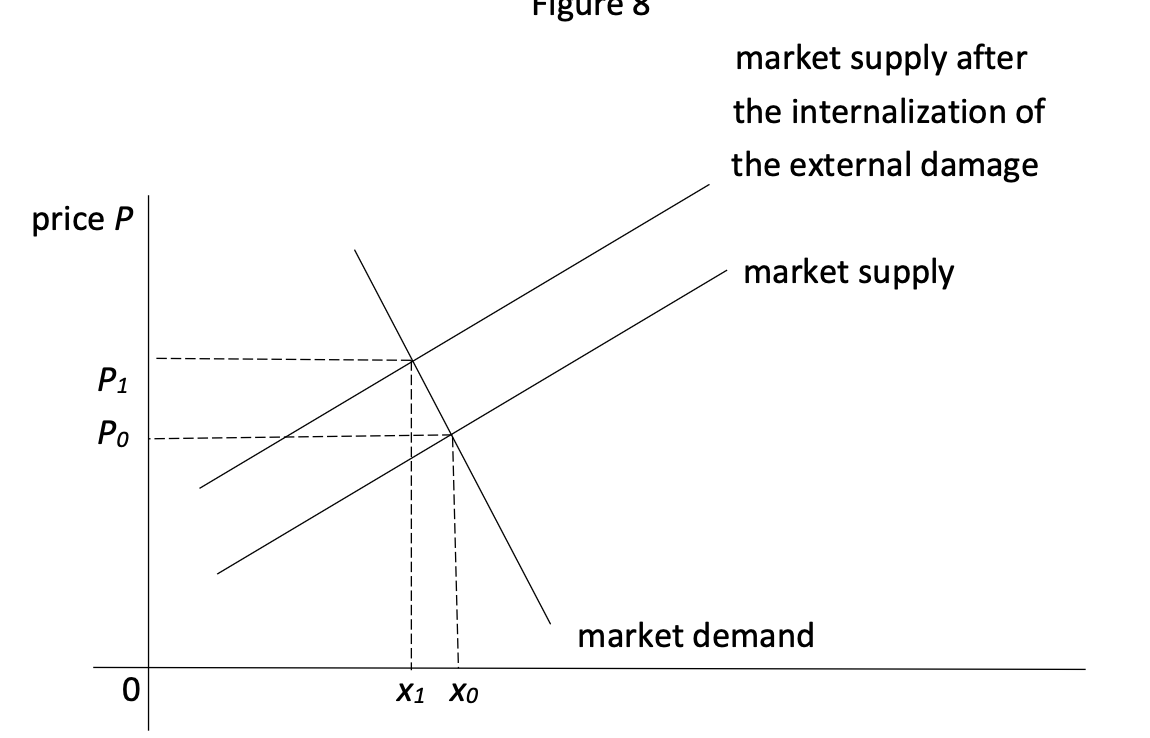
an externality is any uncompensated (unpaid-for) side effect that an economic transaction imposes on third parties who are not directly involved as buyers or sellers
can be positive or negative
Negative Externalities: Cause harm or uncompensated costs to third parties
Positive Externalities: Create uncompensated benefits for third parties
public goods
Goods or services bestow collective benefits on members, while generally no one can be excluded from
enjoying their benefits, not just those who pay for them
Public goods never enter the market system in the first place
Cause free-riding
pure public good
non-exclusivity: a public good is ‘non-excusive’, which means that no one
can be excluded from consuming the good, once it has been produced –
including consumers who do not pay for the good
non-rivalry: a public good is ‘non-rival’, meaning that the consumption of
a public good by one extra user does not require additional scare
resources and/or does not interfere with its consumption by other users
free-riding
the economic behavior where consumers attempt to enjoy and benefit from a good or service without paying for it
Root Cause (Non-Exclusivity): Public goods are non-exclusive, meaning once a good is produced, suppliers cannot easily exclude non-paying individuals from consuming or benefiting from it