chemistry unit 3 aos 2
 Call Kai
 Learn
 Practice Test
 Spaced Repetition
 Match
 Flashcards
 Knowt Play
1/33

There's no tags or description
Looks like no tags are added yet.
34 Terms
6.1 - rate of reaction
rate of reaction - the change in concentration of a reactant or product per unit time, usually measured in mol/L/s. ROR is not constant, so must take multiple measurements at regular time intervals
chemical equations give no indication of rate of reaction
to measure ROR, must measure how much reactant is being used or how much product is being formed in a given time period. there are many methods. ex in a reaction where gas is produced:
rate at which volume of gas product is produced (by collecting in a gas synringe)
rate at which mass is lost (by placing flask on a scale + letting gas escape)
6.1 - collision theory
reactions happen when particles collide. if reactant particles collide successfully, (according to laws below), they will rearrange to form product particles.
laws of collision theory: in order for a reaction to occur, reactant particles must…
collide with each other
collide with sufficient energy to break the bonds within the reactants (see activation energy flashcard)
collide with the correct orientation to break the bonds within the reactants and to allow the formation of new products.
6.1 - activation energy
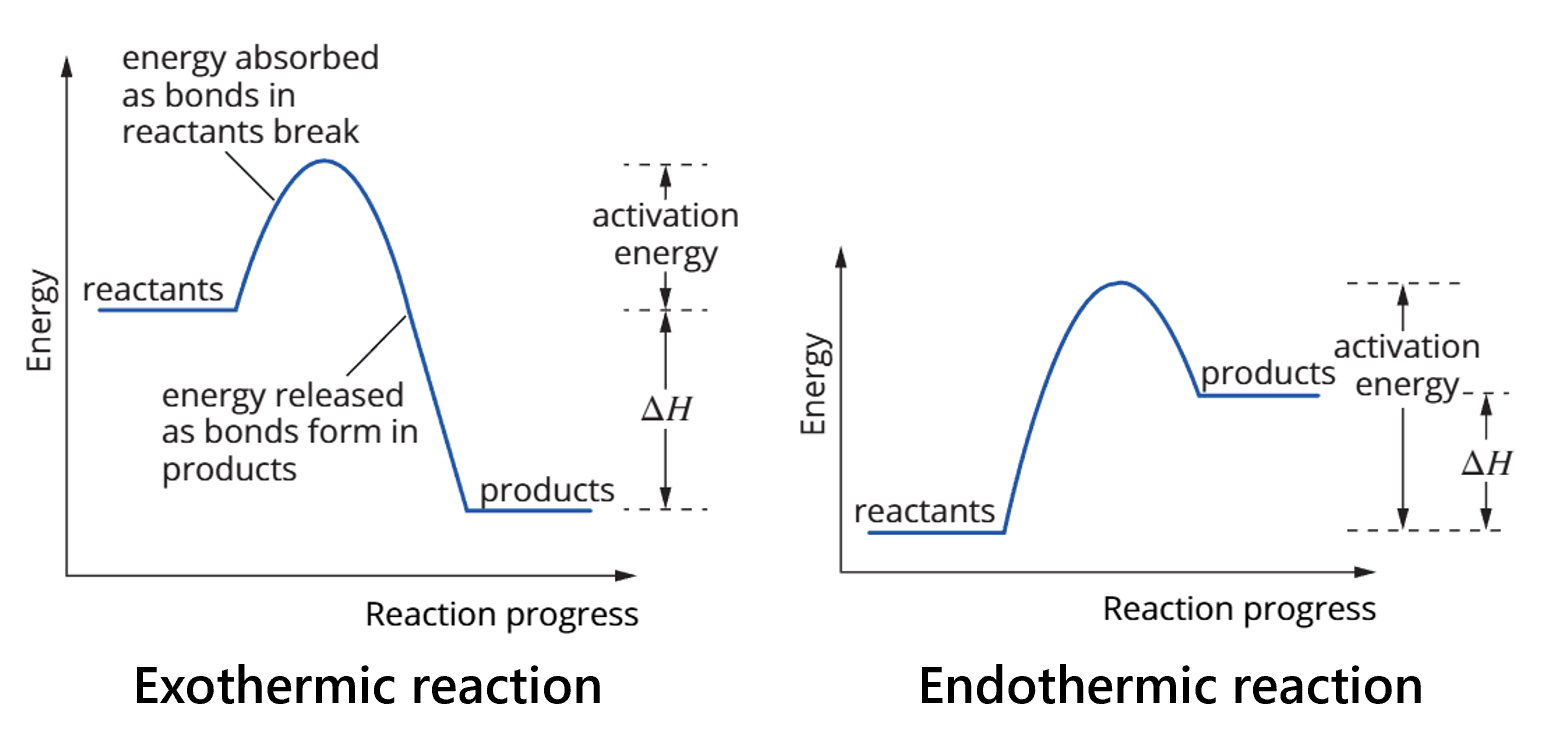
for a reaction to occur, particles must collide with a certain minimum amount of energy known as activation energy (Ea), because energy is required + consumed to break bonds between reactant particles
activation energy can be represented on an energy profile diagram
if activation energy is not met, colliding particles will rebound and move away from each other without reacting
the size of the activation energy determines how easy it is for a reaction to occur + therefore what proportion of collisions result in a successful reaction → activation energy is one of the main factors that affects ROR
low Ea = higher proportion of particles have enough energy → faster ROR
higher Ea = lower proportion of particles have enough energy → slower ROR
6.1 - transition stage
an arrangement of atoms that occurs at the stage of maximum potential energy in a reaction, when all the activation energy has been absorbed
bond-breaking of the reactants and bond-forming into the products occurs simultaneously → unstable state

6.2 - factors that affect ROR
factors that affect ROR
surface area of solid reactants (↑ frequency of collisions)
concentration of reactants in a solution/pressure of gaseous reactants (↑ frequency of collisions)
temperature of reaction (↑ proportion of collisions with sufficient energy + ↑ frequency of collisions)
presence of a catalyst (↑ proportion of collisions with sufficient energy)
to increase ROR:
increase the proportion of collisions that have sufficient energy to break the bonds within the reactants (greater than or equal to the activation energy) by increasing the energy of all the collisions = increases the proportion of collisions that are successful
can increase the frequency of successful collisions by increasing the frequency of collisions that can occur in a given time
6.2 - surface area of solid reactants
↑ frequency of collisions
only the particles at the surface of a solid participate in a reaction. this depends on the surface area of the reactant.
increasing the surface area → increases the particles at the surface available to react → increases frequency of collisions → increases ROR

6.2 - concentration of reactants in a solution/pressure of gaseous reactants
↑ frequency of collisions
increasing the concentration of particles in a solution means there are more solute particles per unit volume of the solution.
increasing the pressure of a gas (by either decreasing the volume or adding more gas particles) increases concentration/means there are more gas particles per unit volume of the gas.
increasing number of particles moving randomly in a volume → increases frequency of collisions → increases ROR

6.2 - temperature of reaction
↑ proportion of collisions with sufficient energy + ↑ frequency of collisions (2 ways in which ROR is increased, but sufficient energy is mainly responsible)
increasing the temperature of a reaction system increases the average kinetic energy of the particles, meaning the particles have an average increased speed at which they move
increasing temperature → increases kinetic energy of particles/speed particles move at → increases frequency of collisions
increasing temperature → increases energy (due to increased kinetic energy) → increases proportion of collisions with sufficient energy greater than or equal to the activation energy
distribution of energy in particles
as stated above, it is only the average kenetic energy that increases. because the individual particles in a sample don’t each have the same energy. some are moving faster, and some are moving slower (ex. most particles in petrol have the energy that keeps them a liquid, but some have more energy and move faster meaning they’re a gas → explains why you can smell petrol at a petrol station)
when temperature is increased
less particles have low energy and more particles’ energy is increased???… a higher proportion of particles have the energy that is higher than or meets the activation energy
when catalyst is added
6.3 - presence of a catalyst
↑ proportion of collisions with sufficient energy
catalysts - when in contact with reactants, provide an alternate reaction pathway, which reduces the activation energy of the reaction. catalysts aren’t consumed during the reaction, so don’t appear as reactants or products in the equation.
decreasing activation energy → increases proportion of collisions that meet the activation energy → increases proportion of collisions with sufficient energy

6.3 - types of catalysts
homogenous catalysts - in the same physical state as the reactants and products
heterogenous catalysts - are in a different physical state to the reactants and products. these are preferred for use in industrial processes as they are more easily seperated from the products of a reaction, are much easier to reuse and are able to be used at high temperatures
to increase the impact of the catalyst, it’s surface area can be increased - solid catalysts are often powdered or in a sponge-like form, to further increase ROR.
other factors that increase ROR
pH
x
agitation
x
7.1 - open + closed systems
open systems - matter + energy can be exchanged with the environment
closed systems - only energy can be exchanged with environment

7.1 - reversible + irreversable reactions
reversible reactions
reactions which can go forwards and backwards. reactants can form products and products can form reactants.
represented with double arrow ⇌
can reach dynamic equilibrium
irreversible reactions
reactions which only go in one direction, where reactants form products.
represented with single arrow →
reaction goes until completion, cannot reach dynamic equilibrium
ex. combustion reactions
can tell on a graph because reactants will completely disappear
7.1 - dynamic equilibrium
dynamic equilibrium - dynamic equilibrium of a reversible reaction in a closed system is achieved when forward and back reactions occur at the same rate. this is known as the point of equilibrium.
7.2 - Q / reaction quotient
Q - the ratio of the concentration of reactants to products. can be calculated at any point in a reaction, regardless of whether or not it’s at equilibrium. the differing concentrations of reactants to products correspond to the extent of the reaction.
if Q is higher it is closer to the product side, meaning there is a higher concentration of products. if Q is lower, it is closer to the reactant side, meaning there is a higher concentration of reactants.
Q is where the system is now, while K is where the system is when at equilibrium. at equilibrium, Q = K.
to calculate Q:
[products]coefficients / [reactants]coefficients
if there is more than one product/reactant, multiply terms
Q is only a constant value at equilibrium (when Q = K). If Q ≠ K, it will shift to be equal.
Q<Kc → Q wants to increase → the system moves to the right/product side, meaning more forward reactions happen.
Q>Kc → Q wants to decrease → the system moves to the left/reactant side, meaning more back reactions happen.

7.2 - Kc/ equilibrium constant
Kc - the quantitative value which shows how far a reaction proceeds/extent of a reaction until equilibrium is reached (forward and back reactions occuring at same rate), and the relative ratio of concentration of reactants to products at that point.
Kc is a fixed, constant value for a specific equation at a given temperature. at equilibrium, it will always have this ratio of reactants to products. the Kc value only changes when the equation or temperature change.
to calculate Kc:
same as Q, but concentrations must be when at equilibrium
[products]coefficients / [reactants]coefficients - known as equilibrium law
if there is more than one product/reactant, multiply terms
the unit for an equilibrium constant depends on the equilibrium equation/law:
substitute M for each concentration in the equilibrium law, and simplify to one term. ex:
[NH3]2 / [N2] x [H2]3 → M2 / M x M3 → M-2
if the value of Kc is:
between 10-4 and 104 → appreciable concentrations of both the reactants and products are present at equilibrium
above 104 → almost complete reaction occurs
below 10-4 → negligible reaction occurs
7.3 - calculating K using stoichiometry
I - initial amount in moles of each reactant and product
C - change in amount of moles of each reactant and product
E - amount in moles of each reactant and product at equilibrium
Cube - concentration (in M) of each reactant and product at equilbrium. C = n/v

7.3 - Kc calculation shortcuts
when one equation is the reverse of another → Kc is inversed (1/Kc )
when the coefficients of an equation are doubled → Kc is squared
when the coefficients of an equation are halved → Kc is square rooted
7.4 - Le Châtelier’s principle
le chateliers principle - if a system’s equilibrium is disturbed (Q ≠ Kc) by changing conditions, the system shifts to partially counteract the change, and re-establish equilibrium (where Q = Kc). when equilibrium is re-established after a disturbance, the rates of the forward and back reactions become equal again, but not at the same rate they were at before.
at a constant temperature, Kc value always stays the same. when Q reaches Kc again meaning equilibrium is re-established, there will be the same ratio of products to reactants as before, but a difference in the yield of products or reactants.
equilibrium can be disturbed by:
adding or removing reactant or product
changing pressure by changing volume (in gases)
dilution/changing overall concentration (in solution)
changing temperature
moving system to the right = more forward reactions = more products formed
moving system to the left = more back reactions = less products formed
careful control of the reaction conditions allows chemists to maximise the
equilibrium yield of a desired product by moving the position of equilibrium ‘to the
right’ (and therefore increasing the amount of products formed).

7.4 - adding or removing reactant or product
add reactants: more forward reactions →
add products: more back reactions ←
remove reactant: more back reactions ←
remove products: more forward reactions →
can see on graph if reactant/product is added because it is a sharp increase
the rate at which the concentration of reactants/products decrease/increase aligns with it’s molar amount and also initial concentration.
example: N2 + 3H2 ⇌ 2NH3
aligns with its molar amount - if ex. reactant is added and equilibrium shifts to the right, more forward reactions are happening, and this means the 3H2 is used up 3x more than the N2.
aligns with each reactant/product’s initial concentration - if say there was 1 mol of N2 and 1 mol of H2 but they were at different concentrations to begin with, they both would decrease to ex. half their initial concentration, but one would decrease more than the other
removing reactants/products can be done by (some examples):
adding another ion that forms a precipitate with a dissolved species
letting a gas escape

7.4 - changing pressure by changing volume (in gases)
c = n/v
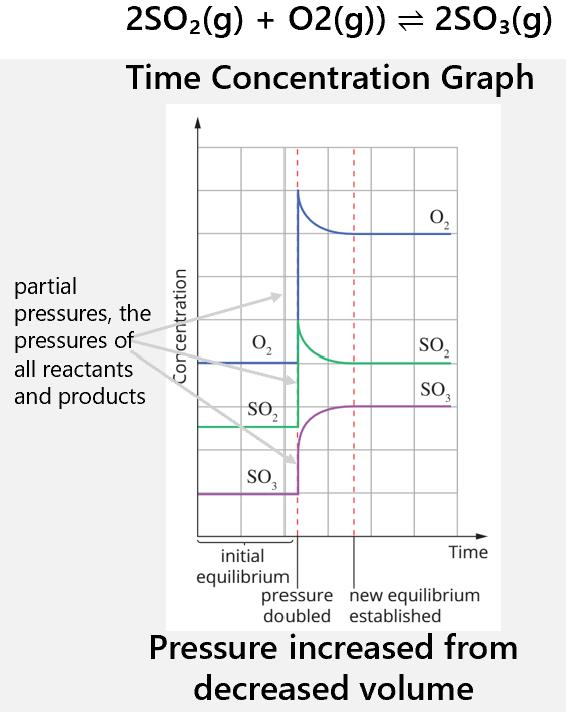
the pressure of a gaseous system can be increased by changing the volume of the container while keeping the temperature constant.
decreasing volume → increasing pressure
increasing volume → decreasing pressure
changing the pressure changes the partial pressures of all reactants and products, and using the reaction quotient, this makes Q ≠ K. ex:
for A + B < - > C
at equilibrium, PA=1, PB=1, PC=1 → Q (Kc) = 1/1 × 1 = 1.
pressure increased, increasing all partial pressures. PA=2, PB=2, PC=2 → Q = 2/2 × 2 = 0.5
when partial pressures are changed, the reaction quotient changes, meaning Q ≠ Kc (unless there are equal reactant and product molecules in the equation → pressure change doesn’t change reaction quotient → equilibrium is not disrupted)
pressure changes do not affect the equilibrium position of systems in the liquid or solid phases. particles in these systems are too tightly packed for an increase in pressure to have a noticeable effect on volume. this means that there is negligible change in the concentrations of the species involved and no effect on the concentration fraction.
increased pressure: to reduce pressure, more reactions that produce most moles
decreased pressure: to increase pressure, more reactions that produce least moles
7.4 - changing pressure by adding an inert gas (in gases)
the pressure of a gaseous system can also be increased by adding an inert (non-reacting) gas. this doesn’t change the partial pressure of the reactants and products → does not disrupt equilibrium
7.4 - changing overall concentration (in solution)
c = n/v
in a system in solution, the overrall concentration can be decreased by diluting the solution with water, decreasing the number of particles per volume of solvent
similarly to gases, an overall change in concentration changes the individual concentration of all reactants and products, and by looking at the reaction quotient, we can see this makes Q ≠ Kc
concentration of system decreased (from dilution): to increase concentration, more reactions that produce least moles
concentration of system increased (from evaporation?): to decrease concentration, more reactions that produce most moles

7.4 - changing temperature
changing the temperature of a system changes both the position of equilibrium (Q) and the equilibrium constant value (Kc). increasing the temperature increases the energy of the substances
if struggling, can write heat as a product in exothermic reactions or a reactant in endothermic reactions
change in Kc - the equilibrium constant of a system settles at the most thermodynamically stable composition, and this changes with temperature. when temperature is increased, Kc is decreased, and when temperature is decreased, Kc is increased.
change in Q
in exothermic reactions (-∆H)
temperature increased: to decrease temperature, more back (endothermic) reactions.
temperature decreased: to increase temperature, more forward (exothermic) reactions.
in endothermic reactions (+∆H)
temperature increased: to decrease temperature, more forward (endothermic) reactions.
temperature decreased: to increase temperature, more back (exothermic) reactions.

8.1 - how to do electrolytic cells
identify all reactants present, there can be many.
if aqueous/in solution - H2O present
if in brine - H2O, Na+ and Cl- present
if molten electrolyte - same as aqueous half equations but (l) instead of (aq)
if reactive electrodes, they count. solid half equation
if compound: ex. KCl, K and Cl ions present. if CuSO4, Cu present. SO4 non-reactive. (but might undergo other non-redox reactions)
using all reactants, look at electrochemical series. strongest oxidant will reduce and strongest reductant will oxidise. (lowest on left and highest on right)
voltage required is top voltage - bottom voltage. write as minimum voltage required >x V
8.1 - electrolytic cells
electrolysis - when an electric current is passed through an electrolytic cell, forcing a non-spontaneous redox reaction to occur. an electrolytic cell involves two electrodes in a conductive electrolyte. ENDOTHERMIC!
electrical energy → chemical energy.
there is a minimum electrical energy required which must be provided by the power supply. (calculated same as galvanic cells using electrochemical series).
the products must be kept separate. otherwise, they would spontaneously react with each other to re-form the original reactants.
the negative terminal of the power supply connects to the negative electrode, and the positive terminal connects to the positive electrode.
how it works
reactants do not react spontaneously → reaction is forced using external voltage (power supply)
electrolytic cell
the power supply pulls electrons through an external circuit from the anode and pushes them to the cathode
this would create charge imbalance at the electrodes:
at anode(+) - electrons are lost, oxidation → becomes more positively charged
at cathode (-) - electrons are gained, reduction → becomes more negatively charged
= the electrolyte acts as an internal circuit, balancing the charges. anions (-) migrate to the anode, and cations (+) migrate to the cathode.
both the external circuit and internal circuit carry electric current. external circuit = electron current. internal circuit = ionic current. this means circuit is complete.
similarities with galvanic cells
use redox reactions
reduction at the cathode + oxidation at the anode
strongest reductant reacts with strongest oxidant
electrons flow anode → cathode
the migration of ions in the electrolyte: cations migrate to the cathode + anions migrate to the anode
can use inert or reactive electrodes
can use oxidation numbers to see what oxidised and reduced
differences to galvanic cells
forces a non-spontaneous reaction
polarity of electrodes: cathode is negative electrode + anode is positive electrode
electrical energy → chemical energy transformation
requires power supply to input electricity
involves two electrodes in an electrolyte
products must be kept seperate
e0 value calculates minimum voltage required (not produced)
8.1 - types of electrolytes
in all cells, electrolytes must contain free-moving ions, so the ions can migrate + balance charges, allowing for the electric current to flow through the internal circuit, completing the circuit.
aqueous electrolyte - a solution containing free-moving ions dissolved in liquid water (must be at room temperature)
aqueous electrolytes mean that many different reactants are present, including water, so it is important to check the electrochemical series for the strongest oxidant and reductant
molten ionic compound electrolyte (pictured) - when an ionic compound is heated to above it’s boiling point, it becomes liquid (molten). this means the ions are free to move, so can carry electric charge through the liquid.
non-conductive electrodes such as platinum or graphite are used
water is not present in this type of electrolysis. → this is intentionally done sometimes to create desired reactions (because water as a reactant can be the strongest reductant/oxidant) however, creating molten ionic compounds requires a lot of heat energy

8.1 - types of electrodes
inert/non-reactive -
reactive -
8.2 - commercial electrolytic cells
electrolytic cells aren’t commonly used to manufacture chemicals as they require a lot of electrical energy, but there are still some examples.
design features + operating principles
seperation + continuous removal of products - products formed are often strong oxidants and reductants that would react spontaneously if they came into contact with each other. → products must be separated, while still allowing internal circuit. ex. using a membrane
inert or reactive electrode materials - inert electrodes are not consumed during the reaction, so the cells can last for longer. but sometimes reactive electrodes are required to get desired reactions. the type of inert electrode can vary depending on cost + ability to withstand cell operating conditions. cathode is always inert.
molten or aqueous electrolyte - molten electrolytes mean water can’t interfere with redox reactions. sometimes this is necessary as water can be a stronger oxidant/reductant → leads to undesired reactions. however, molten electrolytes require a lot of energy to maintain the heat. → aqueous electrolytes are more cost effective.
chemical additives to electrolyte - can lower melting point of a molten electrolyte. can act as a solvent for a compound that is electrolysed.
8.2
a rechargeable battery is a secondary cell
polarities don’t change when it goes from discharge to recharge
discharge
galvanic
the products of discharge have to stay in contact with the electrode.
recharge
electrolytic
8.3 - faraday’s laws
Faraday’s laws are used to find the relationship between the mass of metal produced at the cathode and the operating time or size of the electric current in the cell
Q = I ∙ t
Q = energy, in coulombs/C
I = current, in amps/A
t = time, in seconds
Q = n(e-) ∙ F
n(e-) = moles of electrons in half equation, determined by charge of ion
F = 96,500 C (charge on 1 mol of electrons)
application (not necessarily this order)
calculate the number of moles of metal using n = m/M
using the half equation or the charge of the ion, find the electron:product ratio. → find the number of moles of electrons
find the charge using Q = n(e-) ∙ F
find the time using Q = I ∙ t
8.3 - electroplating
electroplating - an electrolytic process in which a thin surface coating of metal is applied over another surface.
example - cans made of iron are plated with a thin layer of tin. tin corrodes very slowly + prevents contact between iron, moisture + air, preventing it from rusting.
electroplating relies on Faraday’s laws to find the target mass to plate + prevent too much or too little metal being deposited.
electroplating cells
the object to be plated is at the cathode → must be connected to the negative terminal of the power supply. metal solid is formed on the cathode through reduction
the electrolyte provides ions to the cathode, but must be supplied ions of the same metal from the anode, so the anode is oxidising the same metal, producing metal ions to the electrolyte at the same rate that the cathode is reducing, accepting ions from the electrolyte.
the object is immersed in an electrolyte solution containing ions of the metal to be plated. the concentration of these ions should remain constant → to replenish ions in the electrolyte, oxidation into these ions must be occurring at the anode at the same rate that they are reduced/consumed at the cathode.
the mass deposited only changes if a different reaction occurs at the cathode or if the ions going to it are no longer supplied properly
9.2 - secondary cells
primary cells - galvanic cells that are discarded after use → not sustainable
secondary cells - rechargeable cells that reverse the discharge reactions in a recharge reaction using electrolysis. ex. lithium ion battery
involves a discharge reaction where the cell acts as a galvanic cell and produces energy, and a recharge reaction where the cell acts as an electrolytic cell. the recharge reaction is the opposite of the discharge.
requirements
energy input
products of discharge reaction remain in contact with the electrodes
benefit - they are reusable, and thus more sustainable