Lecture 4: Dispersal, Dispersion, and Distribution
 Call Kai
 Learn
Learn Practice Test
 Spaced Repetition
 Match
Match Flashcards
 Knowt Play
1/12

There's no tags or description
Looks like no tags are added yet.
Name | Mastery | Learn | Test | Matching | Spaced | Call with Kai | Chat |
|---|
No analytics yet
Send a link to your students to track their progress
13 Terms
Dispersal
the movement of an individual animal makes from its place of birth to the place where it reproduces. The animal can stay within its home range. Just the option of choosing whether it stays in its maternal home range or not. Exposed to more risks, lower survival rate. Eg. Western Tiger Salamander
What are the categories/causes of dispersal?
Competition for mates → reduces risk of inbreeding
Avoidance of inbreeding
Competition for resources
Mechanisms of Dispersal
Influence of parents
Influence of “Free will”
2 forms of dispersal
Presaturation dispersal → more common in small mammals, juvenile disperse before population reaches saturation
Saturation dispersal → more common in large mammals, dipersal occurs when population has reaches a threshold density determined by food limitation, density-dependent.
Likelihood of dispersal
1) Role of sex → one sex is more likely to disperse (usually the male to find a mate)
2) Mating system → monogomaus species = both sexes disperse
3) Role of age → can vary a-lot
Migration
movement backwards and forwards between summer and winter. Eg. Wildabeast, bird, Tiger Salamander
Local Movement
animals movement within the home range. Eg. Gray Wolf
Dispersion
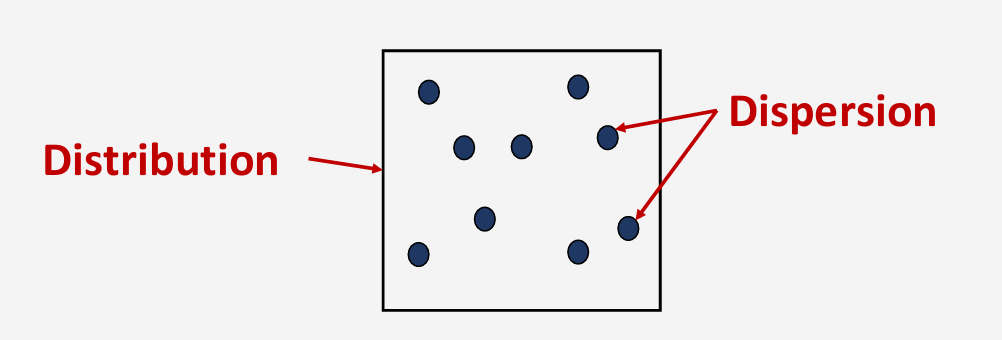
Patterns of spatial distribution taken up by the animals of an area, why are organisms of a particular species present in some areas and absent in others. May be fixed, but often changes with with time under the influence of a changing dispersion of resources.
Types of dispersion
Clumped dispersion → most common due to animals moving in groups (eg. herds) variance > mean
Random dispersion → variance < mean
uniform/individual dispersion → variance = mean

Distribution
area that is occupied by a population or species
What is the difference between distribution and dispersion?
Distribution is that area in which individuals exist, and dispersion is the patterns in which they are distributed.
Range limitations
Temperature → by affecting their physiology and indirectly by affecting their resources. Movements of large mammals, such as mountain goats, whether they move higher/lower on the mountain according to temperature.
Water loss and heat stress → high solar radiation and restricted water supplies. behavioural responses can be affected.
Day length and seasonality → eg. number of days available for breeding above a certain temperature. number of hours/day available for feeding their young and themselves.
Biotic Factors → predation and competition
Range Collapse → locally abundant species have wide ranges and rare species have narrow ranges.
Rapoport’s Rule → the latitudinal extent of a species’ range increasing towards the poles. Higher latitudes species will occupy a bigger range, closer to the equator, more abundant resources. Lower latitudes will have smaller ranges.
Invasive Species
How does scale change the interpretation of findings?
The larger the scale, the more animals you’ll find in the area, the more variance in numbers. Range will be higher in a larger scale