Guest speaker final
 Call Kai
 Learn
 Practice Test
 Spaced Repetition
 Match
 Flashcards
 Knowt Play
1/7

There's no tags or description
Looks like no tags are added yet.
8 Terms
2 main takeaways
1. No firm is ideologically neutral (Firm has their own belief)
Every company has its own beliefs, values, and opinions that influence how it operates.
Example: A company may prioritize making money over protecting the environment.
2. Firm ideology shapes our lives as business professionals and members of society. (Firm ideology shapes people)
A company's beliefs and values affect its employees, customers, and society.
Example: A company that values profits over employee well-being may pay workers less to save money.
What are the 3 differences between Right (Conservative) and Left (Liberal) political ideology?
Right (Conservative):
Prefer the status quo – Keep things the same; prefer gradual change.
System justification – Earn through individual effort (agency).
Adhere to traditional norms – Follow traditions and values.
Left (Liberal):Challenge the status quo – Change unfair systems
Structural explanation – Success depends on starting opportunities
Questioning traditional norms – Challenge old traditions and values.
How can the 2 companies reflect political ideologies?
Chick-fil-A (Conservative/Right): Supports traditional values.
Patagonia (Liberal/Left): Supports environmental protection and social change.
How do firms develop a different political ideology? And what happens after? (SASA)
Society – People have different political beliefs.
Attraction – People apply to companies that share their beliefs.
Selection – Companies hire people who fit their values and culture.
Attrition – People who don't fit may leave; those who fit tend to stay.
Over time, companies end up with employees who share similar beliefs and values.
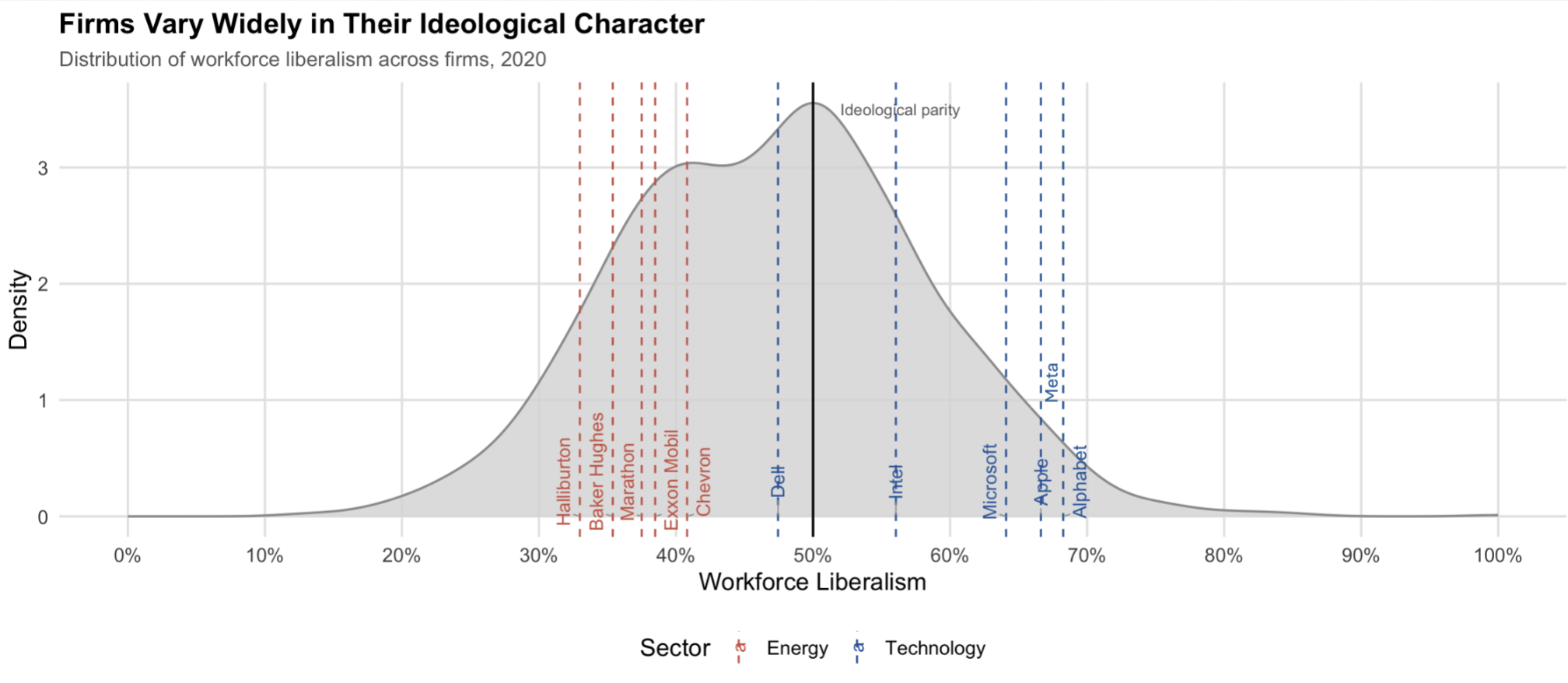
How do firms vary in their ideological character? The graph
Companies have different political beliefs among their employees.
Energy firms: Tend to be more conservative.
Technology firms: Tend to be more liberal.
Most firms: Fall somewhere in between.
Why does firm ideology matter? (3 reasons)
Time at work – We spend 1/3 of our waking hours at work.
Firm strategy – A company's beliefs influence its business decisions:
- Advertising – Choosing what messages to promote.CSR – Helping society and the environment.
Tax avoidance – Legally reducing taxes.
Workforce reductions – Laying off employees.
Social movements – Facing protests or boycotts.
Pay egalitarianism – Promoting fairer or more equal pay and benefits.
Offshoring – Moving jobs or operations overseas.
Elections – Corporate political donations can influence elections.

How can companies influence elections? (Microsoft example)
Through political donations.
Microsoft (2022): $3.15 million total.
Republicans: $1.56 million.
Democrats: $1.59 million.
How did Uber's political donations differ from Microsoft's in 2022?
Microsoft: Donations were almost equally split between Republicans and Democrats.
Uber: Almost all donations went to Republicans.