tech and society midterm 2025
 Call Kai
 Learn
Learn Practice Test
 Spaced Repetition
 Match
Match Flashcards
 Knowt Play
1/34

There's no tags or description
Looks like no tags are added yet.
Name | Mastery | Learn | Test | Matching | Spaced | Call with Kai | Chat |
|---|
No analytics yet
Send a link to your students to track their progress
35 Terms
The Marxist tradition
around 1850, its focus on inequality spurred interest in understanding how machines affect labour
ex: textile industry introduced machines to simplify/speed up processes, resulting in employment of non-skilled workers at lower wages
The Technological Society (Ellul)
believes that modern society is fundamentally shaped and governed by the pervasive influence of technology
tech is autonomous - operates independently of human control, shapes world and society
prioritizes efficiency at cost of critical thinking and creativity
the impact: alienation and less freedom/autonomy in humans
technology as material substance
until 19th century: research on tech was conducted primarily by those in technical/applied science fields
passive object → tools created by humans and used under our control
problem: Marx → doesn’t lead us to think about tech’s implications on social change/society
technology as knowledge (Layton)
technological knowledge - understanding how to create, use, or transform objects
Layton’s Model of Technology:
tech isn’t a single entity, embodies 3 main entities:
ideas → thought processes
design → bridging gaps
techniques → actual artifacts (objects that have been produced according to a set of humanly imposed attributes (ex: weapons, utensils, tools))
limit: disregards sociotechnical context
technology as practice (Ursula Franklin)
tech is both artifact and complex practices embedded in everyday life
emphasizes how it was normalized within society and how it structures/isolates people
determines how we relate/connect
creates power structures (benefits creators of tech in expense of the users)
tech was made to liberate us and increase efficiency, but it’s ended up enslaving us to it
limitation: pessimistic and deterministic
technology as technique (Heidegger)
distinguishes tech from technique
technique:
1) goal - what humans want to achieve (ex: building a house)
2) mechanism - means to realize the goal (ex: materials, procedures like wood and blueprints)
Habermas - tech is a strategic action meant to provide a means for the realization of human goals
technology as society
technology encompasses knowledge, mechanisms, skills, and apparatus that are geared toward controlling and transforming society
tech is an agent of change that can control and alter humanity
new definition of technology
tech is a collection of material objects, embodying and reflecting societal elements, such as knowledge, norms, and attitudes that have been shaped and structured to serve social, political, cultural, and existential purposes
technological singularity
a hypothetical point in the future where AI and tech grow so fast and become so smart that they surpass human intelligence
simulation
the attempt to recreate human intelligence, cognitive processes, and emotionality in non-human activities
Alan Turing (1950) proposed that AI could be achieved through computation rather than building physical, human-like machines
although, computers excel at algorithmic tasks but they lack basic human cognitive flexibility
augmentation
merges humans and tech to intensify or enhance human abilities through connection
wearable computing (ex: smartphones act as extensions of ourselves), cyborgs (ex: modern prosthetics)
transhumanism: uses tech to upgrade body/mind beyond natural biological limits
automation
involves designing machinery/software to execute processes with minimal human intervention
shifts workflows
the management vs labour conflict: sees automation as consistent and cost-effective (no sick days, vacations, union demands)
disruptive tech (ex: driverless cars → when an autonomous system fails/causes an accident, determining liability is difficult)
tech is evolutionary, not revolutionary
new inventions build on existing knowledge
ex: Windows 95 combined earlier ideas such as the mouse, icons, and graphical interfaces into a more accessible system
Hero’s engine (the aeolipile)
first engine ever made, it represents the initial invention that, through technological evolution, led to the development of the automobile
The Stone Age (2.6 million years ago)
developed primitive tools aiding in hunting, gathering, and basic survival
shows early human problem-solving and the beginning of material culture
hunter-gatherer societies began to form nomadic communities
Neolithic revolution (agricultural revolution):
cultivate crops and domesticate animals (farm animals but also human beings)
social turning point → humans began to establish settlement → society is more orderly
new roles (merchants, craftsmen, political leaders) and power dynamics (gender inequality)
Ancient Technology (500 BCE to 195 CE)
iron smelting, screws, levers, construction techniques, and the beginnings of systematic scientific inquiry
Ancient Greeks and Romans demonstrated that ideas and scientific knowledge can lead to practical technological innovations
Pont du Gard aqueduct - ancient Romans used it to move water 19 km to homes in Nimes
Renaissance (14th to 17th century)
Gutenberg’s printing press increased the production and spread of information and helped society shift from oral to print culture
commodified info and its preservation
accelerated levels of literacy
influence depended on the cultural and social conditions of different regions
Enlightenment and French Revolution (1715-1789)
characterized by phrase “systematic knowledge in action”
the Encyclopedia valued practical and technological knowledge alongside academic knowledge and encouraged tech transfer
military tech advanced (ex: armed drones)
Industrial Revolution (1760-1840)
machinery, steam power, textiles, and steel transformed production, work, wages, and worker-employer relationships
machine breaking - workers destroy machines they believed threatened their livelihoods
Electronic Times (1880-1970)
radio, cinema, and TV created mass media and new forms of communication, entertainment, and social connection
McLuhan - “the medium is the message”: the form of communication itself influences how people think and interact
hot media (books, radio, photographs): engage a single sense, requiring less sensory effort to interpret meaning; high-definition (lots of data → requires little active completion from audience)
cool media (TV, comics): engages multiple senses, requires greater effort to understand meaning; low-definition (less data)
global village: electronic media compresses space and time, connecting people globally
Information Society
computers, phones, internet, big data, AI, and predictive analytics create a highly connected, data driven society
phones demonstrate key features of modern tech (mobility, speed, customization, interactivity, multiple functions)
created field of data science
big data
characterized by:
volume - huge quantities of data
variety
velocity - data is produced rapidly and continuously
veracity - accuracy and reliability
virtue - ethical use
value - useful insights from data
example: Google, Netflix, Spotify, Amazon
helps with real-time analysis, evidence-based policy, and predictive analytics but also creates concerns about privacy, bias, accountability, and regulations
time acceleration
tech development is happening faster than ever
humans took millions of years to develop increasingly sophisticted stone tools → modern tech such as Internet and data storage have advanced significantly within decades
faster innovation creates difficulties to keep up with its variety of consequences
why study theoretical perspectives on tech?
theories help us assess:
impact of tech on society
how tech and society shape one another
tech progress through a critical lens
ethical use/development
no single approach does this adequately
utopian views
embracing tech as new means to achieving progress/efficiency → creates better society
advances produce new societal achievements (improved communication) and societal goals (better security)
dystopian views
tech causes harm to society (environmental damage, social isolation, distractions)
can make inequality worse
those who don’t have access to tech are at a disadvantage
Feenberg’s categorization of theories
neutrality: tech is separate from human activity, no effect on natural ends (such as ethics and morality)
value-laden: tech inherently embodies values, believes, and priorities of society/individuals who design/use it
autonomous: humans have little choice in deciding how tech will evolve and diffuse in society
human-controlled: tech is controlled by humans and is a socially constructed entity whose meaning/use are determined by human action
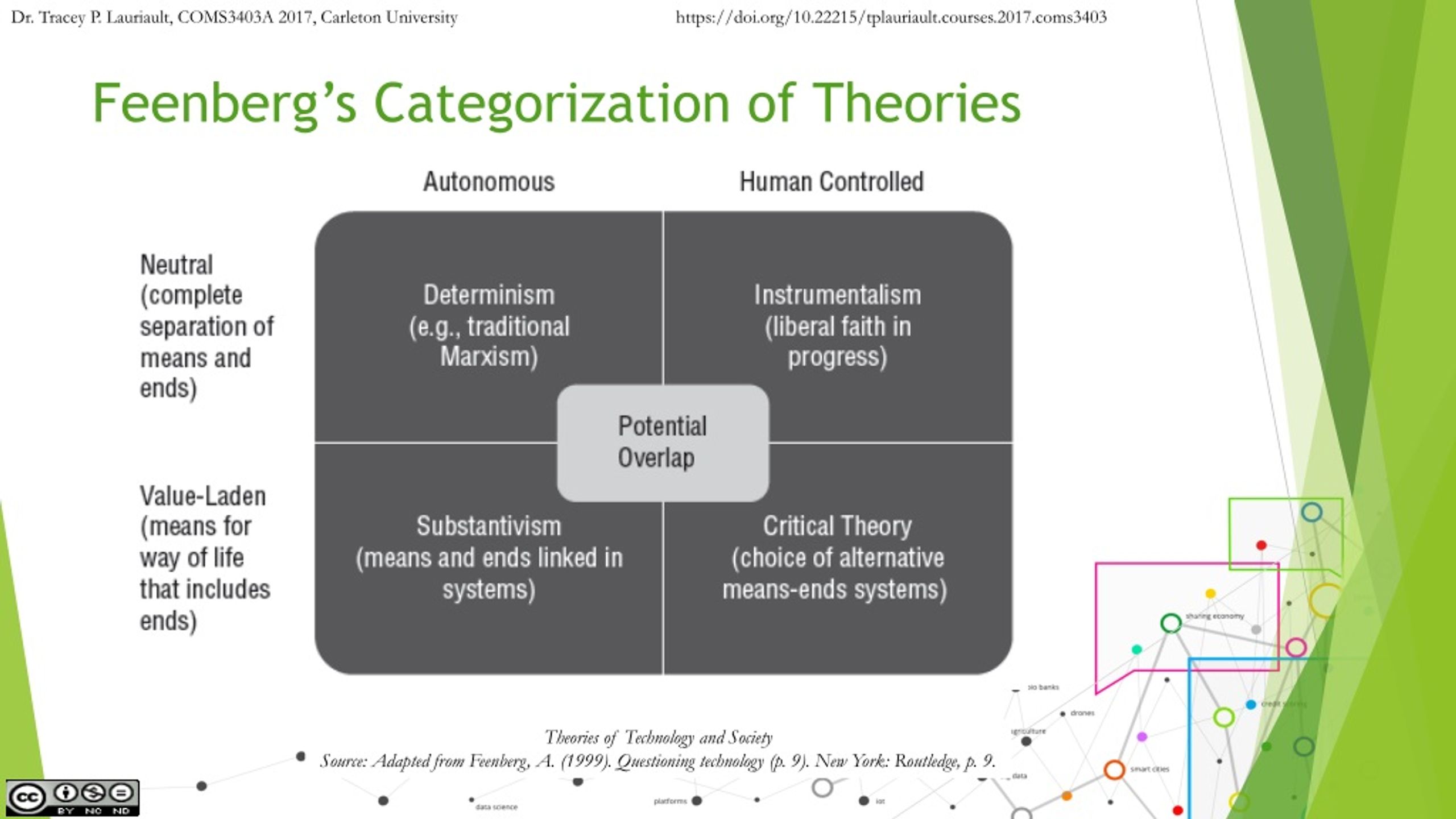
determinism
technological determinism: tech drives social change
develop autonomously, independent of human control (ex: TV shaping family life)
social determinism: society shapes how innovations are used
humans adapt tech for their specific needs based on culture (ex: Amish society shunning cellphones - the individual lacks the choice)
neutral and autonomous
instrumentalism
tech is a neutral tool that fulfils users’ specific tasks
used for positive or negative reasons depending on moral intentions of human agents using them
up to individual actors, not the whole society
neutral and human-controlled
substantivism
tech works under its own inherent logic and reshapes society
tech has goals and impacts that go beyond human control
the nature (either liberating or destructive) of the tech predetermines how it will be utilized and its subsequent impacts on society
autonomous and value-laden
critical theory
tech isn’t neutral → reflects values and interests of elites
in a technocracy (system comprising individuals from scientific and technological fields, whose knowledge influences decisions regarding technical/scientific development), hegemonic elites (a dominant group that exerts power/influence over members of society) use tech to maintain power
Science and Technology Studies (STS)
STS is an interdisciplinary field that studies how scientific and technological changes intersect with society
confronts 2 major challenges:
conducting meaningful research at the micro and macro levels
embraces neither utopian or dystopian perspectives
characteristic:
rejects technological and social determinism → they work together
holistic approach
qualitative methods → case studies, ethnography, observational studies
SCOT and ANT are within this field
Social Construction of Technology (SCOT)
human action shapes tech → meaning is socially constructed
tech gathers meaning through social norms
perspective employed to understand:
technical change
the design of tools
the technological-societal relationship
concepts:
relevant social groups: (developers, engineers, investors) shape meaning of tech through their visions and values
interpretive flexibility: wide range of applications of tech
closure and stablization: through negotiation among key groups/users, overtime an artifact is given a specific meaning and use
wider context
example: the Commodore 64 was a popular home computer, it became a toy for hobbyists, a productivity device for businesspeople, and an educational tool for students
Actor Network Theory (ANT)
the social and natural worlds consist of constantly shifting networks where human and nonhuman entities hold equal importance
actors or actants can emerge in a variety of forms ranging from human begins to concept or ideas, technologies, institutions, etc
actor/agent: a person or entity with the capacity to (inter)act independently within society
actant: a non-human actor who engages in relationships with human and non-human actors
humans and objects play roles in shaping society
speed bump example: anything that causes an action or makes a difference in the network - both humans (drivers) and non-humans (the speed bump)
technological affordances
the action possibilities provided by a tech based on its design → shaped by interaction between user and environment
digital affordances, such as the like button, encourage certain types of user interactions