Rutger Functional Human Anatomy Lab 5 (Abdominal Musculature, Digestive System, Abdominal Structures)
 Call Kai
 Learn
Learn Practice Test
 Spaced Repetition
 Match
Match Flashcards
 Knowt Play
1/41

There's no tags or description
Looks like no tags are added yet.
Name | Mastery | Learn | Test | Matching | Spaced | Call with Kai | Chat |
|---|
No analytics yet
Send a link to your students to track their progress
42 Terms
aponeurosis of external oblique
sheetlike tendon

External Abdominal Oblique
fibers fun medially
unilateral: same side lateral flexion, opposite side lateral rotation
bilateral: flexion of lumbar spine

Internal Abdominal Oblique
fibers run laterally
unilateral: same side lateral flexion, same side lateral rotation
bilateral: flexion of lumbar spine

Transverse Abdominus
fibers run transversely
bilateral: compression of abdominal cavity

Rectus Abdominus
muscle bisected with tendinous insertions (segmented)

rectus sheath
pocket formed by tendons that rectus abdominus travels
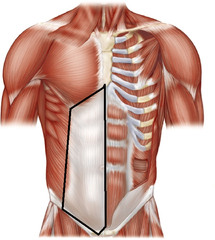
semilunar line
lateral border of rectus abdominis

linea alba
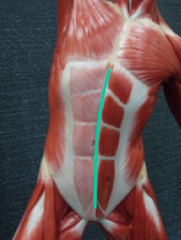
tendinous intersection ligament

Pyramidales
- tenses the linea alba

foreamen magnum
Spinal cord passes through an opening in the occipital bone
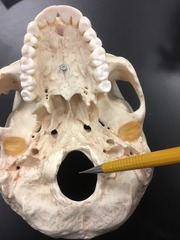
occipital condyles
articulate with first cervical vertebra C1 the atlas

soft palate

uvula

root of tongue

epiglottis
A flap of tissue that seals off the windpipe and prevents food from entering (cartilage)

aditus
inlet of larynx
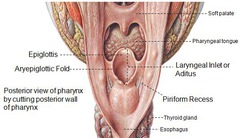
vocal folds
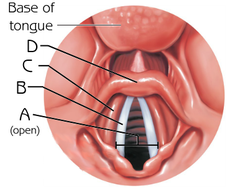
Pharynx 3 regions
nasopharynx, oropharynx, laryngopharynx

esophagus
seen in coronal section, and travels thru thoracic cavity and behind the pericardium

Diaphragm
where esophagus ends and stomach begins

falciform ligament
attaches liver to anterior abdominal wall and diaphragm

spleen
B in the picture near the stomach

regions of the stomach
- cardiac region (from esophagus)
- body
- pyloric region (attaches to descending duodenum by pyloric sphincter)

small intestine structure
descending duodenum , horizontal duodenum in retroperitoneal, ascending duodenum, jejunum (left), ileum (right)

flexure
where intestine anchor to abdominal wall
flexure between duodenum and jejunum
duodenojejunal flexure
ileo-cecal sphincter
located between the ileum and the cecum
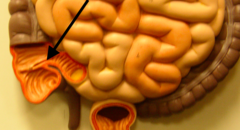
cecum
first part of the large intestine

vermiform appendix
hangs from the lower portion of the cecum
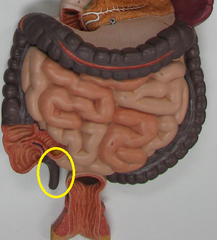
large intestine (colon) structure
cecum, ascending, transverse, descending, sigmoid

Flexures of the large intestine
hepatic flexure (between ascending and transverse colon)
splenic flexure (between transverse and descending colon)
sigmoidal flexure (between descending and sigmoid colon)
rectum
internal and external anal sphincter
greater omentum
attaches to greater curve of the stomach and contaisn the transverse colon

lesser omentum
occupies the space between the lesser curve and the liver and consists of 2 ligaments
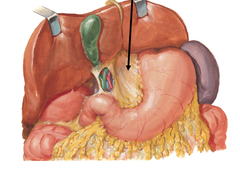
mesentery
smooth fat attached to large and small intestine

Kidneys

adrenal (suprarenal) glands
paired, pyramid-shaped organs atop the kidneys

ureter
The tubes that carry urine from the kidneys to the bladder.

bladder

uterus and related structures

prostate gland
