Chapter 5: Accounting for Merchandising Business
 Call Kai
 Learn
 Practice Test
 Spaced Repetition
 Match
 Flashcards
 Knowt Play
1/37

There's no tags or description
Looks like no tags are added yet.
38 Terms
Merchandising Business
Sells merchandise that is produced by other companies such as:
Whole-seller
Retailer
Wholeseller
Sells merchandise to other companies rather than to final consumer
Business-2-Business
Retailer
Purchase Merchandise from Companies and sells directly to consumers
Business-2-Consumer
Operating Cycle of Merchandising Business
process of companies spending cash, generating revenue, and receiving cash
operating between merchandise is different than service due to merchandise business having to purchase merchandise for sale to customers
Financial Statements are also different due to merchandise having Sales, COGS, Gross Profit, Operating Expense, that equal operating income; while sales only have fees and operating expense
Subsidiary Ledger
Large # of individual account with common characteristics that be grouped together in a separate ledger
Accounts Receivable (customer ledger) — lists individual customers account in alphabetical order
Accounts Payable (creditors ledger) — lists individual creditors account in alphabetical order
Individual sub ledger (Inventory Ledger) — lists individual inventory by item (bar code) number
General Ledger and Special Ledger
Prime ledger that contains all balance sheet and income statement accounts
used to record special type transactions
Controling Ledger
each subsidiary ledger is represented in general by summarizing account
Controlling Ledger = Subsidiary Ledger
What are the two systems for accounting merchandising transactions?
Perpetual — each purchase & sale is recorded in inventory account and related to subsidiary ledger
DEBIT: Inventory (purchased)
Periodic — Inventory does not show amount of merchandise available for sale or amount sale
instead of listed inventory on hand its called physical inventory
DEBIT: Purchases (purchased)
FOB Shipping Point and FOB destination (Free on Board)
FOB Shipping → buyer pays freight costs from shipping point to final destination
FOB Destination → Seller pays freight costs from shipping point to final buyer destination
What are the two types of adjusting process that are different from service?
Inventory Shrinkage — the loss of products between when a business buy and when it sells them different
Customer Returns & Allowance — Sellers are required to estimate customer returns, refunds, and allowances at the end of the accounting period.
What is the adjusting entry for inventory shrinkage?
Cost of Goods Sold xxx
Inventory xxx
Customer Returns & Allowance
Based upon these estimates, two adjusting journal entries are recorded.
The first adjusting entry debits Sales and credits Customer Refunds Payable for estimated customer refunds and allowances.
The second adjusting entry debits Estimated Returns Inventory and credits Cost of Goods Sold for merchandise that is expected to be returned.
What is the entry for estimated refunds and allowances?
Sales xxxx
Customer Refunds Payable xxxxx
What is the entry for items actually being returned?
Estimated Returns Inventory xxx
Cost of Goods Sold xxx
What is the entry for Cash refund?
Customer Refunds Payable xxxx
Cash xxx
What is the entry for returned merchandise?
Inventory xxx
Estimated Returned Inventory xxx
Financial Statement & Closing entries for retail business
Primarily affects the income statement and is normally prepared in either a single-step or multiple-step income statement
The revenue activities of a service business involve providing services to customers.
For a merchandising business, the revenues from selling merchandise are reported as sales, and its cost is recognized as an expense.
This expense is called the cost of goods sold or cost of merchandise sold.
The cost of goods sold is subtracted from sales to arrive at gross profit.
Gross profit is the profit before deducting operating expenses.
Operating expenses are subtracted from gross profit to arrive at operating income.
Merchandise on hand (not sold) at the end of an accounting period is called inventory or merchandise inventory.
Inventory is reported as a current asset on the balance sheet.
Single-Step Income
Steps is only deducting Revenues — Expenses

Multiple-Step Income
Contains several sections, subsections, and subtotal

Asset Turnover
Measures how a business uses its sales to general sales
Sales / Average total Assets
Sales Discount
a discount seller offers buyer for early payment
Gross Method
Sales invoice with credit terms that include a discount for early payment is recorded at invoice amount
Record the full invoice amount.
Net Method
Sales invoice with credit term that include discount for early payment recorded as Net Amount
Record the invoice amount minus the potential discount.
What is the periodic inventory system?
Purchases
Purchase Discount (-)
Purchase Return & Allowance (-)
Freight-In (+)
Credit Terms and Credit Period
When payments are to be made
When the buyer is allowed an amount of time
Debit Memorandum (Debit Memo)
informs the seller of the amount the buyer proposes to debit to the account payable
Coupon? Rebate? Point of Sale Coupons?
provides the customer a discount when purchasing a products)
provides the customer a refund after the product is purchased.
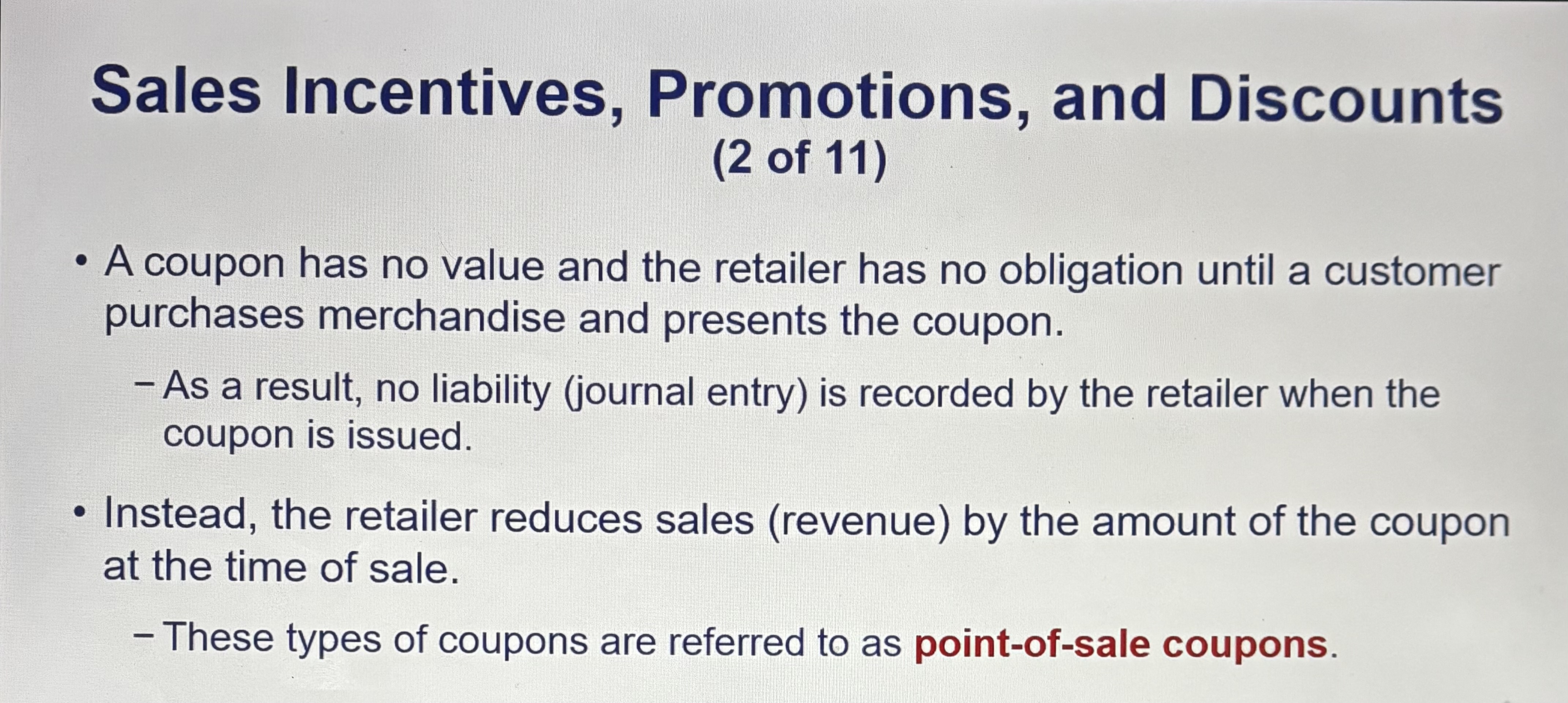
A coupon has no value and the retailer has no obligation until a customer purchases merchandise and presents the coupon. As a result, no liability (journal entry) is recorded by the retailer when the coupon is issued.
Coupon Payable?
we must multiple times the extimated percentage then multiplied by its price liability

Purchase
Are recorded in the purchase account rather than the inventory account
Purchase Discount
Is recorded as a deduction from purchases from period (subtract)
B2B (business-to-business) purchases may include a discount by the supplier (vendor) to encourage the buyer to pay before the end of the credit period.
For example, a supplier may offer 2/10, n/30, which means a 2% discount if the buyer pays within 10 days of the invoice date. If the buyer does not take the discount, the total invoice amount is due within 30 days.
Taken by a buyer that reduce the costs of the merchandise purchased
DEBIT: Accounts Payable
CREDIT: Purchase Discount
Purchases Returns and Allowances
Deducted from purchases
Closing differs because of inventory; there is no COGS to close. Instead, those are closed
DEBIT → ACCOUNTS PAYABLE
CREDIT → INVENTORY

Cash Sales
Are made by using debit cards (bank cards)
debit card sales are recorded as cash sales
sales may also be made using credit cards like Visa & Mastercard
Credit card sales are normally processed by a clearinghouse that contacts the bank that issued the card.
The issuing bank then electronically transfers cash directly to the retailer's bank account.
Sales Incentives, Promotions, and discounts
Retailers frequently offer sales incentives, promotions, and discounts.
Discounts may also be offered to encourage customers to pay early.
Such incentives and promotions often take the form of coupons and rebates.
A coupon provides the customer a discount when purchasing a products).
A rebate provides the customer a refund after the product is purchased.
The accounting for a coupon or rebate depends upon its terms and how it can be redeemed by the customer.
In contrast, assume that a coupon is issued when customers purchase merchandise.
In this case, when the retailer sold the merchandise, it incurred a future obligation (liability) to the customer.
As a result, the retailer must estimate the dollar value of coupons that will be redeemed, reduce sales, and record a related liability.
Trade Discounts
Wholesalers may offer special discounts off list prices to government agencies or businesses that order large quantities.
Sellers and buyers do not normally record the list prices of merchandise and trade discounts in their accounts.
Credit Memo
Indicating the intent to credit the customer's accounts receivable
Customer Refunds Payable xxx
Accounts Receivable xxx
What is the entry for recording the receipt amount due?
Cash xxx
Accounts receivable xxx
What is the entry for refunds made within the account?
Accounts Payable xxx
Inventory xxx
Freight-in Journal entry?
Debit: Freight-in
Credit: Cash