Chemistry Matter and Change-Chapter 6
 Call Kai
 Learn
 Practice Test
 Spaced Repetition
 Match
 Flashcards
 Knowt Play
1/34

There's no tags or description
Looks like no tags are added yet.
35 Terms
groups
vertical columns of the periodic table.
periods
horizontal rows in the periodic table; elements with similar properties are in the same row.
representative elements
Group A elements on the periodic table that include metals, metalloids, and nonmetals.
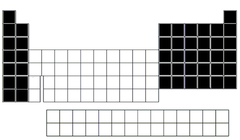
transition elements
Group B elements on the periodic table that include transition metals and inner transition metals.

metals
Elements that are shiny and are good conductors of heat and electricity; have low number of valence electrons; all elements on left side of table (except for hydrogen/ ex. tin, lead)

alkali metals
group 1 elements; usually exist as compounds with other elements; very reactive -more chemically very reactive than alkaline earth metals (ex. Sodium)

alkaline earth metals
group 2; highly reactive; harder and less reactive than alkali metals. (Ex. Magnisium)

transition metals
elements that form a bridge between the elements on the left and right sides of the periodic table. They have electrons in the d orbital (ex nickle, copper)

inner transition metals
the lanthanide series and actinide series; elements at the bottom of the periodic table.

nonmetals
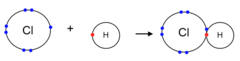
these elements are present in every living thing on earth and can form bonds with multiple atoms at once; nonmetals have high number of valence electrons so they gain or share

halogens
group 17; these nonmetals are highly unstable and are extremely reactive group of

noble gases
group 18; extremely unreactive group of nonmetals

metalloids
share the same physical and chemical properties of both metals and nonmetals. (ex. silicon, germanium are the most important, + antimony)

valence electrons
electrons on the outermost principal energy level of an atom (metals have low number, so they lose them/ nonmetals have high number so they gain or share).

Relationship between valence electrons and period
the energy level of the valence electrons of an element indicates the period on the periodic table in which it is found.
Relationship between valence electrons and group number
the group number of a representative element is the same as its number of valence electrons. there are many exceptions.
atomic radius for metals
half the distance between adjacent nuclei in a crystal of the element.
atomic radius for nonmetals
half the distance between nuclei of identical atoms that are chemically bonded together.
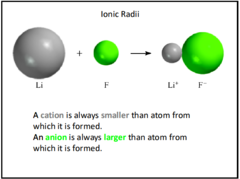
ion
an atom, radical, or molecule that has gained or lost one or more electrons and has a negative or positive charge.

ionic radius
the size of ions; the distance from the nucleus to the outer energy level of the ion.
ionization energy
the minimum amount of energy required to remove an electron from the ground state of an atom (higher ionization means harder to remove electron). Every time you remove an electron ionization energy increases. Metals=lowest ionization energies, want to be oxidized; Non-metals=highest ionization energy.

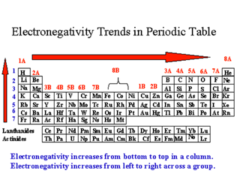
electronegativity
how strongly an atom pulls or attracts electrons to itself in a chemical bond; in the formation of an ionic bond.
atomic radius trends
increases as you move down a group because they gain energy level for each period, decreases as you move right across periods because they have the same number of energy level but a greater number of valence electron charge so a stronger pull.

electronegativity trends
decreases as you move down groups because size gets bigger and valence shell is further from the nucleus/weaker pull; increases as you move right across periods as the atom size gets smaller, and the pull for additional electrons is stronger (because the electrons are closer to the nucleus of those smaller atoms) and the atom is closer to reaching perfect octet. (F has the highest)

ionization energy trends
decreases as you move down groups because valence electrons reside in energy levels further away from the nucleus so they are more easily removed; increases as you move right across periods because they have more valence electrons and they are closer to achieving perfect octet, therefore required more energy to remove electron. (He has the largest energy, smallest atoms)

octet rule
atoms will gain, share, or give up electrons to achieve the electron configuration of a noble gas. meaning 8 valence electrons.
periodic law
there is periodic repetition of chemical and physical properties of the elements when they are arranged by increasing atomic number
Moseley
rearranged Mendeleev's periodic table order; arranged by increasing number of proton/atomic number for periodic table organization

Mendeleev
demonstrated a connection between atomic mass and elements properties; created periodic table ; arranged the elements in an order of increasing atomic mass; predicted the existence and properties of undiscovered elements.

Lothar Meyer
before Mendeleev; demonstrated a connection between atomic mass and elements properties; arranged the elements in an order of increasing atomic mass;
Newlands
arranged the elements in an order of increasing atomic mass; noticed the repetition of properties every eighth element; created the law of octaves

atomic radius
the size of atoms, measured from nucleus to outside edge

anion
ion with negative charge

cation
ion with positive charge

electron affinity
F has the highest
