Energy Metabolism (=Stoffwechsel)
 Call Kai
 Learn
 Practice Test
 Spaced Repetition
 Match
 Flashcards
 Knowt Play
1/35

There's no tags or description
Looks like no tags are added yet.
36 Terms
What is Energy Metabolism?
The study of how the body uses, stores and burns energy
How does the energy metabolism work? (Explain briefly)
Food nutrients(Nährstoffe) (carbohydrates, fats, proteins) and oxygen (O2) are converted through cellular respiration (Atmung) into ATP and heat. Cells use ATP directly to perform cellular work, releasing heat as a byproduct

What are the 4 steps of external respiration?
ventilation/gas exchange between atmosphere and air sacs (alveoli) in lungs
Exchange O2 and CO2 between air in the alveoli and blood
Transport of O2 and CO2 between lungs and tissues
Exchange of O2 and CO2 between blood and tissues (bridge to internal respiration)

What is internal respiration and how does it connect to external respiration?
Definition:
Cellular respiration inside the tissue cells (uses O2 and food to create ATP/energy).
Chemical Formula: Food + O2 → CO2 + HO2+ATP
The Connection: It cannot function without external respiration, because Step 4 is what delivers the required O2 directly to the cells.
What is the ultimate goal of both external ans internal respiration?
Energy Transformation:
Deliver O2 to the cells so they can transform food into ATP (cellular energy), this energy is required to fuel body functions, such as muscle contraction and movement
What is the energy Balance Equation?
Energy Input ( Calories from food intake) = Energy output (digestion, metabolism, transport of nutrients, physical activity)
Why is maintenance energy balance important?
Contributes to health and well being
Prevents the risk of developing many common health problems
Describe the 3 energy balance states And when a positive balance is required
Equilibrium: input = output, no weight change
Positive energy balance: input > output, increase in weight (necessary during pregnancy, for infants and children)
Negative energy balance: input < output, decrease in weight
How is Calorimetry divided to measure metabolic heat and gas exchange?
Direct Calorimetry: Measures actual bodily heat production
Indirect Calorimetry: Measures O2 consumption and CO2 production
What are the three essential facts/units about kilocalorie?
official def.: 1kcal = amount of heat required to raise the temperature of 1kg of water through 1°c (15° to 16°c)
1kcal = 1 calorie in nutrition
1kcal = 4,184 kJ (Kilojoules)
How can the energy in foods be measured?
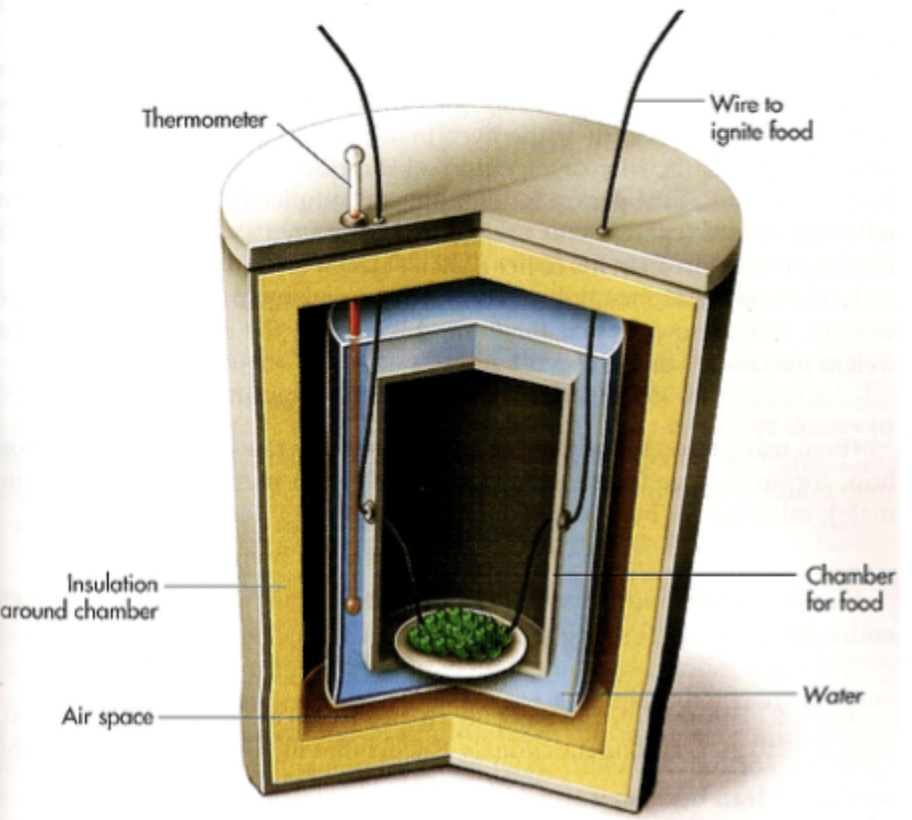
With the Bomb calorimetry
What are the 4 main structural components and function of a Bomb Calorimeter?
Chamber for food: Sealed inner vessel where the food sample is placed in pure oxygen.
Wire to ignite food: Electrical wire that ignites and completely combusts the food sample.
Water Jacket & Thermometer: Surrounding water bath where the thermometer measures the exact temperature rise from the released heat.
Air Space & Outer Insulation: Double-walled outer layer preventing heat loss to the room so 100% of heat warms the water.
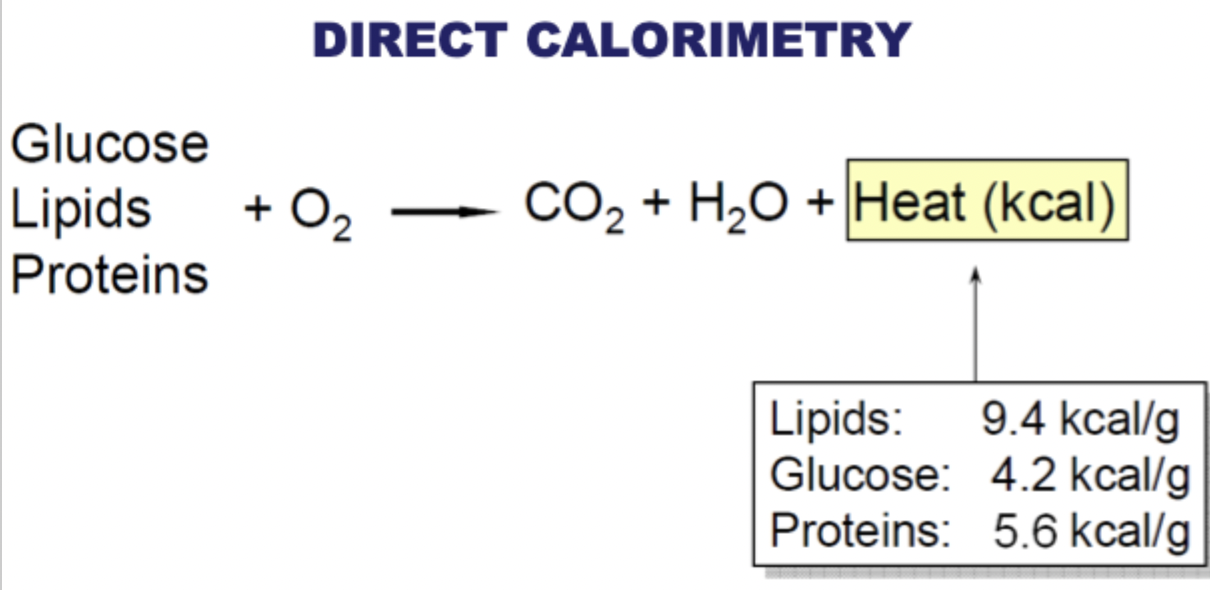
What do the caloric values from direct bomb calorimetry represent, and how do equal masses of nutrients compare?
They represent the gross combustive energy (brutto physical energy) obtained by 100% complete combustion with fire in an oxygen chamber. Equal amounts (1 gram) of different nutrients yield different caloric values:
Lipids/Fats: 9.4 kcal/g
Proteins: 5.6 kcal/g
Carbohydrates (Glucose): 4.2 kcal/g
Is it true that the same amount of food contains a different amount of calories?
Yes
1 g of each Fats, Protein, Carbs contains a different amount of calories (9,4; 5,6; 4,2 kcal/g)
What are the Atwater Factors for metabolizable energy in the human body?
Metabolizable energy is the net energy available to the human body after digestion, absorption, and metabolic excretion:
Fats: 9.0 kcal/g
Carbohydrates: 4.0 kcal/g
Proteins: 4.0 kcal/g
Alcohol: 7.0 kcal/g
Fiber: 0 kcal/g
Why does the metabolizable energy of protein in the human body (4.0 kcal/g) drop compared to a bomb calorimeter (5.6 kcal/g)?
The human body cannot metabolize or burn the nitrogen component of amino acids. The liver converts this nitrogen into urea, which the kidneys excrete in urine, removing unburned chemical energy (~1.3 kcal/g) from the body
How do you calculate total daily energy intake from macronutrient grams?
Multiply nutrient grams by their Atwater factors:
Carbs x 4 + Protein x 4 + Fat x 9
(E.g.: 585g carbs x 4 + 150g protein x4 + 110g fat x 9 = 3930kcal/day)
How can total energy expenditure of an individual be measured using a human calorimeter chamber?
The individual exercises inside a sealed, insulated room with water pipes running through it. Thermometers measure the temperature increase of the water as it absorbs released body heat. Simultaneously, air flow systems measure oxygen consumption (O2) and carbon dioxide output (CO2) from exhaled air

What is the difference between Direct Calorimetry and Indirect Calorimetry in humans?
Direct Calorimetry: Measures actual heat loss/production from the human body in a sealed, insulated chamber with water cooling pipes.
Indirect Calorimetry: Measures volume of oxygen consumed (O2) and carbon dioxide produced (CO2) via a gas mask/spirometer.
What is the Respiratory Quotient (RQ) formula, and what are the specific RQ values for glucose versus fat?
Formula: RQ = volume of CO2 produced */*Volume of O2 consumed
Therefore RQ for glucose oxidation: 6CO2/6O2 = 1
Therefore RQ for palmitic acid oxidation = 16CO2/23O2 = 0,7
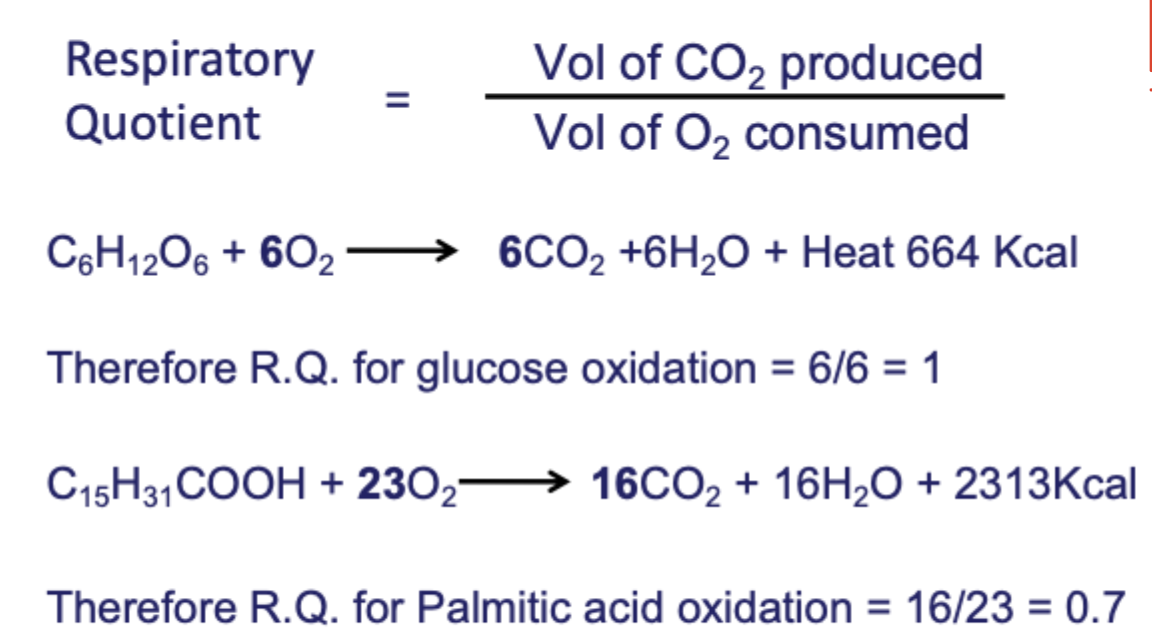
How do Respiratory Quotient (RQ) values in indirect calorimetry indicate which fuel substrate is being oxidized by the body?
The RQ is calculated as the ratio of carbon dioxide produced to oxygen consumed (RQ = Vco2/Vo2). The measured value directly indicates the primary fuel being burned:
RQ = 0.7: Pure fat oxidation (e.g., palmitic acid)
RQ = 0.8: Protein oxidation
RQ = 0.85: Mixed diet (average everyday metabolism)
RQ = 1.0: Pure carbohydrate oxidation (e.g., glucose)
RQ > 1.0: Lipogenesis (excess carbohydrates are converted and stored as fat)
oxidation means in this context burning

What is the complete equation for Daily Energy Expenditure (DEE)?
DEE = BMR + Physical activity + thermische effect of food (TEF) + Thermogenesis
Which huge function has basal metabolic rate (BMR)?
She is the energy which is keeping our body alive
How is Basal Metabolic Rate (BMR) precisely defined, and what percentage of DEE does it account for in sedentary individuals?
BMR is the energy expenditure of an individual at complete mental and physical rest in a thermoneutral environment, 12–18 hours post-meal. In sedentary individuals, it accounts for 60–70% of total daily energy expenditure (maintaining essential functions like brain, heart, kidney, lung activity, maintenance of ionic gradients; reactions of metabolic reactions)
What distinguishes (unterscheiden) Resting Metabolic Rate (RMR) from Basal Metabolic Rate (BMR)?
RMR is measured under less strict laboratory conditions (when the individual is not fully fasting or completely rested). RMR is typically 6% higher than BMR
How is BMR calculated using oxygen consumption, and what is the rule of thumb per kg of body weight?
BMR is calculated by measuring O2 consumption for 6 min and using following factor:
1 L of O2 consumed = 4.825kcal
Rule of thumb ca. 25kcal/kg/day (zur Schätzung des Grundumsatzes (BMR) pro kg body weight)
What are the average daily baseline BMR values for adult males and females?
Males: 1600–1800 kcal/day
Females: 1200–1450 kcal/day
Which factors affecting the increase of BMR?
lean body mass (muscle) and larger body surface area
Sex: M>F
Body temperature: in fever 30-35% up at 40°c
Nervous system activity (release of norepinephrine)
Hormones, esp. thyroid hormone (Schilddrüse)
Pregnancy and lactation
What are the two primary factors that affecting the BMR in a decreasing way?
low calories intake
Aging
What is the Thermic Effect of Food (TEF / Specific Dynamic Action), and how do specific nutrients compare?
energy required to digest, process and absorb food
High O2 consumption associated with digestion and absorption of foods
Protein 12% of total energy expenditure
Fats 2% of total energy expenditure
Mixed diets 5-10% of total energy expenditure
3000 kcal diet, TEF 150-300kcal
What role does Thermogenesis play in daily energy expenditure?
Thermogenesis is the energy expenditure used specifically for thermoregulation (maintaining constant body temperature in changing external environments)
Most important part for regulation of the temperature
What are the physical activity multipliers used to calculate DEE above BMR?
Physical activity is the most variable component of DEE of an individual:
Modest Activity: 0.3 x BMR
Moderate Activity: 0.4 x BMR
Heavy Activity: 0.5 BMR
How do you calculate the total daily energy expenditure of a person?
BMR: body weight (kg) x 25 kcal/kg = kcal/day
Activity: physical activity(modest,…) X BMR = kcal/day
Total expenditure: BMR + Activity = total e. kcal/day
How do daily energy requirements change across age groups?
22–50 years: 100% (baseline, e.g., 2000 kcal/day).
51–75 years: 90% of baseline (e.g., ~1800 kcal/day).
>75 years: 75–80% of baseline (e.g., ~1500–1600 kcal/day).
What additional calories must be added for heavy physical labor, pregnancy, and lactation?
Very Heavy Physical activity: Add +600 to +900 kcal/day. (Most important factor)
Pregnancy (2nd & 3rd trimester): Add +300 kcal/day.
Lactation: Add +500 kcal/day.
Just tell the header of which factors affecting energy requirements
body size: high with an high in muscle mass
Age
Physical activity
Pregnancy and lactation