Midterm Main Concepts Review
 Call Kai
 Learn
Learn Practice Test
 Spaced Repetition
 Match
Match Flashcards
 Knowt Play
1/51

There's no tags or description
Looks like no tags are added yet.
Name | Mastery | Learn | Test | Matching | Spaced | Call with Kai | Chat |
|---|
No analytics yet
Send a link to your students to track their progress
52 Terms
Dorsal Scapular muscle innervations
levator scapulae, rhomboids
suprascapular nerve muscle innervation
suprascapularis, infrascapularis
long thoracic nerve muscle innervation
serratus anterior
lateral pectoral nerve muscle innervation
pec major (both heads), pec minor
communicating branch muscle innervation
pec minor
medial pectoral nerve muscle innervation
pec major sternal head, pec minor
upper subscapular nerve muscle innervation
subscapularis
thoracodorsal nerve muscle innervation
latissimus dorsi
lower subscapular nerve muscle innervations
subscapularis, teres major
Spinal accessory nerve (CN XI) muscle innervations
traps (upper, middle, lower), sternocleidomastoid
musculocutaneous nerve muscle innervations
biceps brachii, brachialis, corocobrachialis
Axillary nerve muscle innervations
deltoids, teres minor
Radial nerve muscle innervations
triceps (long, lateral, medial), extensor carpi radialis (longus and brevis), brachioradialis

blue muscle
sternocleidomastoid

name the muscles
upper, middle, lower trapezius

name the muscles
rhomboids minor (superior), rhomboids major (inferior)

name the red muscle
levator scapulae
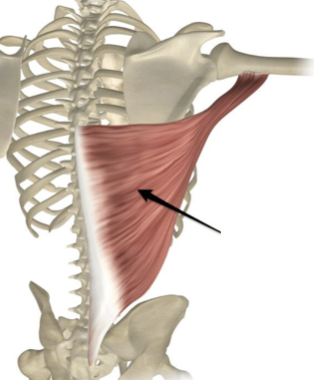
name the muscle
latissimus dorsi
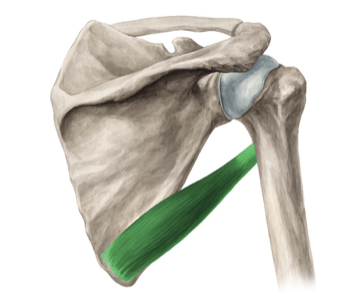
name the muscle
teres major

name the muscle
serratus anterior
ADHD
altered dopamine and norepinephrine signaling in the prefrontal cortex
premotor cortex vs prefrontal cortex
premotor plans movement (“gas”), prefrontal manages emotional regulation and executive decisions (“breaks”)
broca’s aphasia/ expressive aphasia
frontal lobe impairment; trouble speaking due to motor impairment
hemispacial neglect
parietal lobe impairment; dysfunctional visuospacial processing
test for hemispacial neglect
line bisection test
wernicke’s aphasia
temporal lobe impairment; inability to comprehend language causing nonsensical, but fluent speech
hemianopia
occipital lobe impairment; loss of half of visual field
quadrantanopia
occipital lobe impairment; loss of ¼ of visual field
visual agnosia
occipital lobe impairment; difficulty recognizing objects despite intact vision
cortical blindness
occipital lobe impairment; complete or partial loss of vision due to bilateral damage in primary visual cortex
prosopagnosia
occipital lobe impairment; difficulty recognizing faces

name the muscles
posterior, middle, anterior deltoid

name the muscle
supraspinatus

name the muscle
infraspinatus
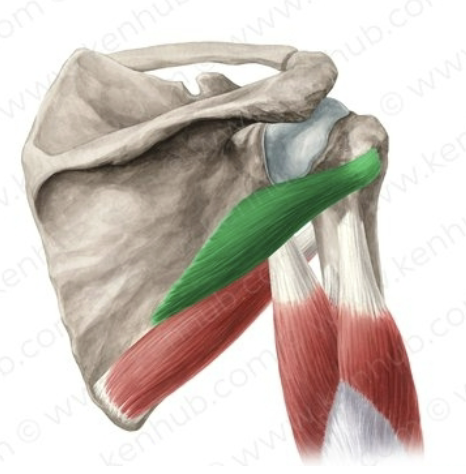
name the muscle
teres minor

name the muscle
subscapularis

rotator cuff
SITS: supraspinatus, infraspinatus, teres minor, subscapularis
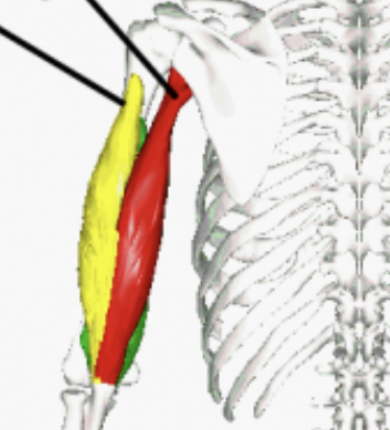
name the muscles
lateral, long, and medial head triceps
quadrangular space
teres minor, teres major, triceps brachii long head, and axillary nerve
Quadrangular space syndrome
compression on axillary nerve and posterior circumflex humeral artery as they pass through the QS causing posterior and lateral shoulder pain or numbness
Thalamic Stroke
sensory disturbances like chronic burning or aching pain, numbness, tingling, sensitivity to touch
amygdala impairment
anxiety, depression, PTSD, autism
cingulate gyrus dysfunction
chronic pain conditions like fibromyalgia, chronic back pain, neuropathic pain
limbic system
amygdala, hippocampus, cingulate gyrus
hippocampus impairment
alzheimer’s disease, impaired memory and spacial navigation, impaired emotional regulation
Parkinson’s Disease
degeneration of dopamine production in basal ganglia causing bradykinesia, resting tremors, rigidity, hypophonia, micrographia, and difficulty learning procedural tasks

name the muscle
corocobrachialis

name the muscle
brachialis

name the muscle
biceps brachii

name the muscles
pec minor (superior), pec major (inferior)
distal biceps tendon rupture
difficulty with supination and elbow flexion
proximal biceps tendon rupture
visible deformity and pain with shoulder flexion