pfr2
 Call Kai
 Learn
Learn Practice Test
 Spaced Repetition
 Match
Match Flashcards
 Knowt Play
1/56

There's no tags or description
Looks like no tags are added yet.
Name | Mastery | Learn | Test | Matching | Spaced | Call with Kai | Chat |
|---|
No analytics yet
Send a link to your students to track their progress
57 Terms
What is marriage? Art, 1 FC.
Marriage is a special contract of permanent union between a man and a woman entered into in accordance with law for the establishment of a conjugal and family life.
It is the foundation of the family and an inviolable social institution whose nature, consequences, and incidents are governed by law and not subject to stipulation, except that marriage settlements may fix the property relations during the marriage within the limits provided by this Code.
The State shall defend (Sec 3. Art XV, 1987)
The right of the spouses to found a family
The right of children to assistance
The right of the family to a family living wage and income
The right of families or family associations to participate in planning/implementing policies and program
Characteristics of Marriagae
Civil in character: established by state independently of its religious character
Institution for public order or policy: governed by rules established by law
Institution of natural character: one of its objects is the satisfaction of the intimate sentiments and needs of human beings for the organic perpetuation of man
Principal effects of a VALID marraige
Personal and economic relations between spouses;
Legitimacy of the sexual union of the family;
Personal and economic relations between parents and children;
Family relationship;
Emancipation of spouses from parental authority
Incapacity of spouses to make donations to each other;
Modification of criminal liability
LOVING v VIRGINIA [1967] - interracial marriages
FACTS: A White man and a Black woman married outside the state of Virginia. They were found guilty for violating Virginia's ban on interracial marriages. They sued the state claiming the statute violates the due process and equal protection clauses.
DOCTRINE: Freedom to marry has long been recognized as one of the vital personal rights essential to the orderly pursuit of happiness by free men. (Due Process & Equal Protection Clauses)
RULING: Virginia's anti-miscegenation statutes violate both due process and equal protection clauses.
What are the essential requisites of marriage? - Art 2, FC.
Legal capacity of the contracting parties who must be male and fema;e
Consent freely given in the presence of a solemnizing officer
What are the formal requisites of marriage? - Art 3, FC.
Authority of the solemnizing officer;
A valid marriage license except in cases in Chapter 2
A marriage cermony which takes place with the appearance of the contracting parties before the solemnizing officer and their personal declaration that they take each other as husband and wife in the presence of not less than 2 witnesses of legal age
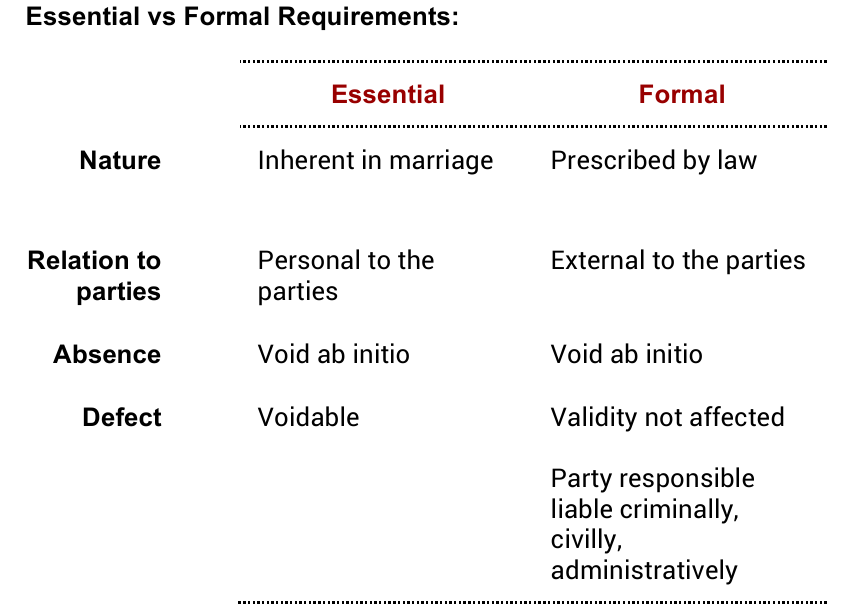
Essential vs Formal Requirements of Marriage
Who has the Legal Capacity for Marriage
Parties must be male and female
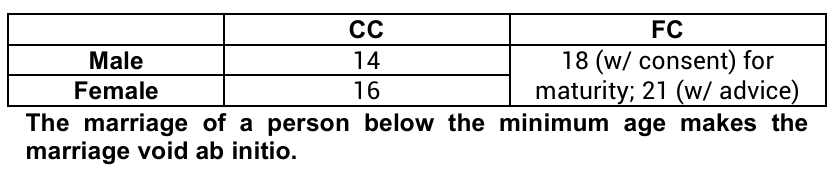
Minimum age of marriage
No subsisting marriagae
Minimum Age of Marriage in the CC and FC
EIGENMANN v GUERRA [1964] - previous law on minors
FACTS: Husband wanted to get out of marriage by saying that he was a minor when he entered the marriage, but at time of marriage he represented himself to be of age.
DOCTRINE: Husband has already been estopped by his misrepresentation, his claim of lack of written consent from his mother also not accepted because Parental Consent can be implied through presence at wedding. (Art. 4, FC)
RULING: Marriage upheld valid.
Today’s Law
“No marriage shall be valid, unless these essential requisites are present…” [Art 2, FC]
Thus, no exceptions provided:
Even with consent
Estoppel will not lie despite misrepresentation
What happens when consent is not freely given?
Marriage is a consent-based institution.
Absence or defect in the consent of either party may result to nullity or annulment of the marriage.
PEOPLE v SANTIAGO [1927] - LACK OF CONSENT; NIECE
FACTS: Uncle raped his niece-in-law and after raping her prepared a ceremony at his cousin's house where they went right after.
DOCTRINE: Consent if given with no intent to marry is tantamount to consent lacking, thus making the marriage null and void. It was Santiago's consent who was lacking and not the niece's.
RULING: Santiago charged for rape and marriage declared null and void.
Why Male or Female?
Imposed by tradition; purpose of marriage: to procreate
But FC expands the prupose of marriage beyond procreation, “for the establishment of conjugal and family life.”
Marriages solemnized outside of the PH - Art. 26
All marriages solemnized outside the Philippines, in accordance with the laws in force in the country where they were solemnized, and valid there as such, shall also be valid in this country, except those prohibited under Articles 35 (1), (4), (5) and (6), 3637 and 38. (17a)
Where a marriage between a Filipino citizen and a foreigner is validly celebrated and a divorce is thereafter validly obtained abroad by the alien spouse capacitating him or her to remarry, the Filipino spouse shall have capacity to remarry under Philippine law. (As amended by Executive Order 227)
Marriages validly solemnized outside the PH - Lex Loci Celebrationis
If complied with formalities required in the place where it was solemnized, then VALID in the PH.
Lex loci celebrationis
Consistent with Art. 17, CC. - The forms and solemnities of contracts, wills, and other public instruments shall be governed by the laws of the country in which they are executed. [lex loci celebrationis] When the acts referred to are executed before the diplomatic or consular officials of the Republic of the Philippines in a foreign country, the solemnities established by Philippine laws shall be observed in their execution.
Consular Offices are extensions of PH territory.
Who can the marriage be solemnized by? - Art 7, FC.
Any incumbent member of the judiciary within the court’s jurisdiction;
Any priest, rabbi, imam, or minister of any church or religious sect duly authorized by his church or religious sect and registered with the civil registrar general, acting within the limits of the written authority granted by his church or religious sect and provided that at least one of the contracting parties belongs to the solemnizing officer’s church or religious sect;
Any ship captain or airplane chief only in the case mentioned in Article 31; - articulo mortis
Any military commander of a unit to which a chaplain is assigned, in the absence of the latter, during a military operation, likewise only in the cases mentioned in Article 32; - articulo morti
Any consul-general, consul or vice-consul in the case provided in Article 10. - only within the embassy grounds
Where can the marriage by solemnized? - Art 8, FC.
The marriage shall be solemnized publicly in the chambers of the judge or in open court, in the church, chapel or temple, or in the office the consul-general, consul or vice-consul, as the case may be, and not elsewhere, except in cases of marriages contracted on the point of death or in remote places in accordance with Article 29 of this Code, or where both of the parties request the solemnizing officer in writing in which case the marriage may be solemnized at a house or place designated by them in a sworn statement to that effect. (57a)
Art 35, FC. - If the marriage is not solemnized by an authorized person?
The following marriages shall be void from the beginning:
(2) Those solemnized by any person not legally authorized to perform marriages unless such marriages were contracted with either or both parties believing in good faith that the solemnizing officer had the legal authority to do so;
GENERAL RULE: No solemnizing authority: VOID.
EXCEPTION: Both of the parties are deceived into the marriage, believing in good fatih that the solemnizing officer has the authority.
Marriages Exempted from License Requirement
Either or both of the contracting parties are at the point of death
There is no means of transportation
Muslim marriages under Muslim laws
A marriage in articulo mortis between passengers or crew members
Marriages in articulo mortis between persons within the zone of military operation
A man and a woman who have lived together as husband and wife for at least five years and without any legal impediment
A marriage license is issued by? - Art 9 and Art 10
Art. 9.
A marriage license is issued by the local civil registrar of the city or municipality where either party habitually resides, except for marriages exempt from a license under Chapter 2 (exceptional cases).
Art. 10.
Marriages between Filipino citizens abroad may be solemnized by a Philippine consul-general, consul, or vice-consul, who also performs the duties of a local civil registrar.
What does a sworn application for a marriage license contain? (Art 11)
Art. 11.
Each contracting party must file a sworn application for a marriage license containing:
Full name, birthplace, age, date of birth
Civil status and prior marriages (if any)
Residence and citizenship
Degree of relationship between parties
Names, residences, and citizenship of parents or guardian
Residence certificates are not required.
What happens when a birth/baptismal certificate is lost? - Art 12
Art. 12.
Applicants must present original or certified copies of birth or baptismal certificates.
If unavailable (lost, destroyed, or pending), they may submit:
A sworn instrument with two witnesses of lawful age attesting to their identity, parentage, and age; or
Parental appearance to swear to the applicant’s lawful age; or
The registrar may judge apparent age personally.
If previously married, what was the applicant submit to obtain a marriage license? - Art 13
Art. 13.
If previously married, the applicant must submit the death certificate of the deceased spouse or judicial decree of annulment, nullity, or divorce.
If unavailable, an affidavit stating the circumstances and civil status suffices
If either or both parties are 18-21 years old, what is required? - Art 14
Art. 14.
If either or both parties are 18–21 years old, written parental consent is required (from father, mother, surviving parent, or guardian).
Consent must be personally given before the registrar or in an affidavit with two witnesses.
If either or both are 21-24, what is needed? - Art 15
Art. 15.
If either or both are 21–25 years old, they must seek parental advice.
If no advice or it is unfavorable, the license is withheld for three months after publication.
A sworn statement proving advice was sought (or refused) must be attached.
When parental consent or advice is required, what is needed? - Art 16
Art. 16.
When parental consent or advice is required, the couple must attend marriage counseling by an authorized priest, imam, minister, or accredited counselor.
Failure to attach a counseling certificate suspends license issuance for three months.
If only one party needs consent/advice, both must attend counseling.
Issuance within the prohibited period results in administrative sanction but does not affect validity of marriage.
How many days does the local civil registrar post a public notice? - Art 17
Art. 17.
The local civil registrar posts a public notice of the application for 10 consecutive days in a conspicuous place, inviting any person with knowledge of an impediment to report it.
What happens when an applicant’s impediment is reported? - Art 18
Art. 18.
If any impediment is known or reported, the registrar records it but still issues the license after publication unless stopped by a court orde
How many days is a marriage license valid? What if it remains unused? - Art 20
Art. 20.
A marriage license is valid anywhere in the Philippines for 120 days from issuance and automatically canceled after expiration if unused.
The expiry date must be stamped in bold on the license.
What if both applicants are foreigners? - Art 21
Art. 21.
If either or both parties are foreigners, they must submit a certificate of legal capacity to marry from their consular or diplomatic officials.
Stateless persons or refugees submit an affidavit showing such capacity instead.
What does a marriage certificate state? - Art 21
The marriage certificate shall state:
Full names, sex, age, citizenship, religion, and residence of parties
Date and time of marriage
Reference to marriage license (if applicable)
Compliance with parental consent/advice and marriage settlement, if any
How many copies of the marriage certificate are there, and to whom does it go to? - Art 23?
Art. 23.
The solemnizing officer must:
Give the original certificate to one contracting party
Send duplicate and triplicate copies to the local civil registrar within 15 days
Keep the quadruplicate copy and other required documents (license, affidavits, etc.)
IMBONG v OCHOA (2014) - family planning
FACTS: Petitioners claim that requiring couples to attend family planning and responsible parenthood seminars and obtain certificates of compliance violates their religious beliefs.
DOCTRINE: The goal of RH Law is to help couples make informed choices on parenthood and decide intelligently. It does not compel them to accept the instructions therein. (Sec. 15, RA 10354 (RH Law))
RULING: Sec. 15 of the RH Law is constitutional. The law merely requires attendance and does not compel the couples to accept the instructions given, hence it does not violate religious beliefs.
Code of Muslim Personal Laws
Both parties Muslim
If the male party is Muslim, and the marriage was performed in accordance with Muslim law
If not solemnized by Muslim Law, FC applies
Difference between Marriage Certificate and Marriage License
License: issued PRIOR marriage; formal requisite
Contract/certificate: issued AFTER the ceremony; not a requisite. It is the Best proof of marriage.
Grounds for Void Marriages under the FC? Art 4 and 35
Art 4, FC. The absence of any of the essential or formal requisites shall render the marriage void ab initio, except as stated in Article 35 (2).
Art 35, FC.
Below 18 even with parental consent
Solemnized by any person not legally authorized to perform marriages UNLESS in good faith
Solemnized without license
Bigamous or polygamous
Mistake of identity
Void under Art 53.
ANTONE v BERONILLA - bigamy, declaration of nullity AFTER
FACTS: Defendant, charged with bigamy, claimed that there was a declaration of nullity of the first marriage. But declaration was made after contracting 2nd marriage.
DOCTRINE: Declaration of nullity must be secured BEFORE contracting subsequent marriage. (Art. 40, FC)
RULING: Defendant guilty of bigamy
Elements of bigamy
Accused must have been legally married
Marriage hasn’t been dissolved yet
Accused must have contracted a secondmarriage;
All requisites were complied with in the second marriage
Marriages between the following are incestuous and void ab initio — Art 37, FC`
Ascendants and descendants
Brothers and sisters
The following marriages shall be void ab initio for reasons of public policy — Art 38, FC.
Collateral blood relatives until the 4th civil degree
Step-parents and step-children
Parents-in-law and children-in-law
Adopting parent and adopted child
Surviving spouse of adopting parent and adopted child
Surviving spouse of adopted child and adopter
Adopted child and legitimate child
Killed other person’s spouse/his or her own spouse
In Re BAUTISTA [1978] - relatives, visa
FACTS: Immigration visa petition for wife was denied because wife is the daughter of first cousin of husband.
DOCTRINE: Marriage between collateral blood relatives up to 4th civil degree shall be void due to public policy. (Art. 38, FC)
RULING: Marraige was valid. Immigration visa should be approved. They were in the 5th degree.
What is the provision on psychological incapacitation - Art 36, FC.
Art 36, FC. A marriage contracted by any party who, at the time of the celebration, was psychologically incapacitated to comply with the essential marital obligations of marriage, shall likewise be void even if such incapacity becomes manifest only after its solemnization. (As amended by E.O. 227)
General Characteristics of Psychological Incapacity
Gravity
Antecedence
Incurability
Period for Filing Action - Art 39, FC.
Art 39, FC. The action or defense for the declaration of absolute nullity of a marriage shall not prescribe. [As amended by EO 227 and RA 8533; The phrase “However, in case of marriage celebrated before the effectivity of this Code and falling under Art 36, such action or defense shall prescribe in ten years after this Code shall have taken effect” has been deleted by RA 8533]
For the purpose of contracting the subsequent marriage under the preceding paragraph, the spouse present must institute a summary proceeding as provided in this Code for the declaration of presumptive death of the absentee, without prejudice to the effect of reappearance of the absent spouse.
What is the provision on final judgment declaring the marriage void - Art 40, FC.
Art 40, FC. The absolute nullity of a previous marriage may be invoked for purposes of remarriage on the basis solely of a final judgment declaring such previous marriage void.
Article 40 of the Family Code states that a person can remarry only after obtaining a final court judgment declaring their previous marriage void. This ensures legal certainty and prevents individuals from claiming their prior marriage was void without proper judicial authority. Without such a judgment, any subsequent marriage is also void.
What are the Grounds for Voidable Marriages - Art 45
18-21, solemnized without the consent of parents, guardian or person with parental authority unless after attaining the age of 21 freely cohabited
unsound mind
fraud
force, intimidation, undue influence
impotence/physically incapable of consummating the marriage
STD incurable
Lack of Parental Consent for Voidable Marriage
If the mother consents, even if the father does not, marriage is voidable.
Bias given by law.
violates Constitutional mandate of equality before the law of women and men. ○ Violates Magna Carta for Women: equal rights for men and women in matters involving marriage and family life.
NO BASIS for hierarchy.
Required to avoid hasty and ill-advised marriages
How to ratify the lack of parental consent?
Voluntary cohabitation after 21 years of age by party who did not get consent
MOE v DINKINS [1981]
FACTS: Petitioners wanted to declare the parental consent requirement for the marriage of minors as unconstitutional.
DOCTRINE: Valid state interest in needing parental consent: (1) To prevent immature persons from entering marriage; (2) Vulnerability of Children; and (3) To protect the privacy of parents in their child rearing. Parental consent ensures that at least one mature person will participate in the decision. (Art. 45(1), FC)
RULING: Statute is not unconstitutional in the requirement of parental consent in the marriage of males between the age of 16-18, and females between the age of 14-18. The State interests in mature decision-making and in preventing unstable marriages are legitimate under its parens patriae power.
Insanity for Voidable Marraiges
Test: whether the party at the time of the marriage was capable of understanding the nature and consequences of marriage itself (Tolentino).
Even if the party is mentally weak, so long as he or she understands the consequences of the step he or she is taking, the marriage is still valid (Sempio-Diy).
Mental disorder that does NOT deprive the contracting party of understanding is NOT a ground for annulment.
Intoxication amounting to lack of mental capacity and somnambulism ARE considered unsoundness of mind.
Defect in reason: there was no knowledge of what he or she was giving consent to.
Capacity to Act: supposed to attach to a person who has NOT been previously declared incapable.
Presumed to continue UNLESS the contrary is proved.
Burden of proof: on person alleging insanity.
Consent obtained by fraud for Voidable Marriages - Art 46, FC.
Art 46, FC. Any of the following circumstances shall constitute fraud referred to in Number 3 of the preceding Article:
Non-disclosure of a previous conviction by final judgment of the other party of a crime involving moral turpitude;
Concealment by the wife of the fact that at the time of the marriage, she was pregnant by a man other than his husband
Concealment of sexually transmissible disease, regardless of its nature, existing at the time of the marriage;
Concealment of drug addiction, habitual alcoholism or homosexuality or lesbianism existing at the time of the marriage.
What are the Molina Guidelines
Burden of proof to show nullity of marriage belongs to plaintiff
Root cause must be medically or clinially identified; alleged in the complaintl sufficiently proven by experts; clearly explained in the decision — must be psychological
Proven to exist at the time of celebration of the marriage
Medically and clinically permanent or incurable
Grave enough to bring about the disability of the party to assume the essential obligations of marriage
Essential marital obligations not complied with must be stated in the petition
Interpretations given by the National Appellate Matrimonial Tribunal of the Catholic Church in the PH must be considered
Prosecuting attorney or fiscal and the Sol Gen must appear as counsel for the state
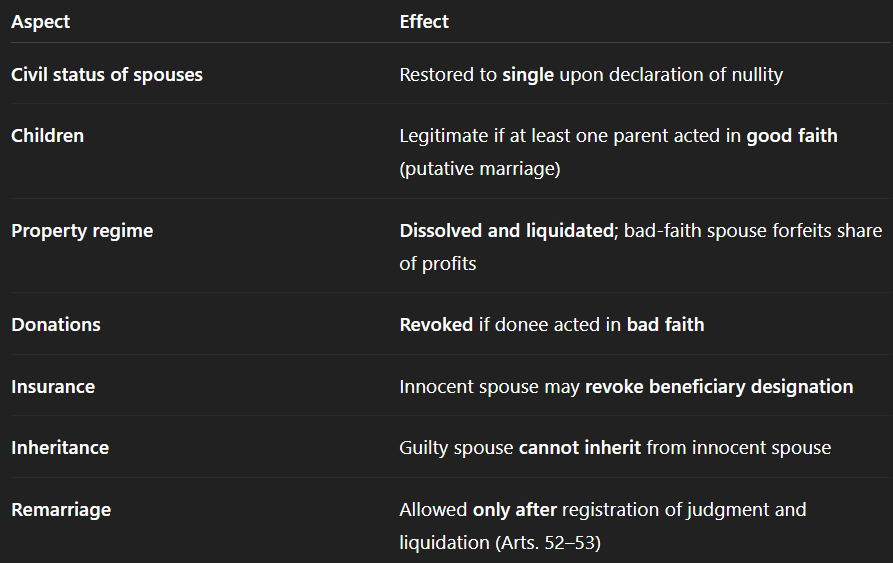
Effects of Nullity on Void Marriages
BUCCAT v BUCCAT - pregnant wife, is it fraud?
FACTS: Husband and wife got married, 3 months later, wife gave birth after a full-term pregnancy. Husband filed for annulment on the ground of vitiated consent.
DOCTRINE: There should be a clear proof of fraud for a marriage to be annulled. 6 months is already too evident not to be noticed. (Art. 45(3) & 46(2) FC)
RULING: No fraud since the husband should have already observed the wife's physical condition at the time of the marriage. Petition for annulment dismissed.
AQUINO v DELIZO - pregnant wife, is it fraud?
FACTS: 4 months after the spouses got married, the wife gave birth to a child. Husband filed for annulment on the ground of fraud, with wife concealing prenancy by another man.
DOCTRINE: At 4 months, Conchita's pregnancy was not readily apparent. It's only on the 6th month that the physical signs of pregnancy becomes more apparent. (Art. 45(3) & 46(2) FC)
RULING: Fraud by concealment was present, especially since the wife was “naturally plump”. Petition was remanded for consideration.
Impotence
Non-consummation of marriage owing to the physical incapacity of one of the spouses. Physical incapacity: impotence or total inability to have sexual intercourse with one’s spouse; NOT sterility.
Requisites for impotence:
Must be present at the time of the marriage;
Incurable;
Continuous.