Field Bio II Need To Know!!

0.0(0)
Studied by 0 people
call kaiCall Kai
learnLearn
examPractice Test
spaced repetitionSpaced Repetition
heart puzzleMatch
flashcardsFlashcards
GameKnowt Play
Card Sorting

1/16

encourage image

There's no tags or description

Looks like no tags are added yet.

Last updated 1:27 PM on 10/1/26
Name
Mastery
Learn
Test
Matching
Spaced
Call with Kai
Chat

No analytics yet

Send a link to your students to track their progress

17 Terms

1
New cards
<p>Red, large and bunched - Spotted Salamander, Ambystoma maculatum</p><p>Yellow, smaller, bunched - Jefferson Salamander, Ambystoma jeffersonianum</p><p>Green, singular, round - Wood Frog, Lithobates sylvaticus</p>

Red, large and bunched - Spotted Salamander, Ambystoma maculatum

Yellow, smaller, bunched - Jefferson Salamander, Ambystoma jeffersonianum

Green, singular, round - Wood Frog, Lithobates sylvaticus

What are they?

2
New cards
<p>Planorbidae</p>

Planorbidae

Rams Horn Snail

3
New cards
<p>Lymnaeidae</p>

Lymnaeidae

Pond Snail/Pointed Winkle

4
New cards

Eastern Newt

Notophthalmus viridescens.

A small, 2.5–5 inch salamander with a unique three-stage life cycle: aquatic larva, terrestrial juvenile ("red eft"), and aquatic adult.

Females have narrower tails, with no spots on feet. Males have large tails, spots on feet and thighs, large rear hands.

<p><span>Notophthalmus viridescens. </span></p><p><span>A small, 2.5–5 inch salamander with a unique three-stage life cycle: aquatic larva, terrestrial juvenile ("red eft"), and aquatic adult.</span></p><p><span>Females have narrower tails, with no spots on feet. Males have large tails, spots on feet and thighs, large rear hands.</span></p>
5
New cards

American Bullfrog Tadpoles

Rana catesbeiana.

White belly, vermiculated and spotted tail, 3-5 years to mature.

<p><span>Rana catesbeiana.</span></p><p><span>White belly, vermiculated and spotted tail, 3-5 years to mature. </span></p>
6
New cards

Midland Painted Turtle

Chrysemys picta.

  • Shell (Carapace): Smooth, oval, and relatively flat. Its most unique feature is that the large segments (scutes) align in relatively straight rows across the back, unlike other subspecies where they alternate. Coloration is olive to black with pale leading edges on the scutes.

  • Plastron (Bottom Shell): Plain yellow or lightly spotted, though it may be stained reddish-brown by minerals or algae. Female have a FLAT plastron, males have an indent.

  • Skin Markings: The head, neck, and limbs are black or olive with distinctive yellow and red stripes. Two bright yellow spots are usually visible behind each eye.

  • Size: Adults typically range from 4.5 to 7 inches (11–18 cm) in length. Females are generally larger and more domed than males, while males have notably longer front claws and thicker tails.


<p><span>Chrysemys picta.</span></p><ul><li><p><strong><span>Shell (Carapace):</span></strong><span> Smooth, oval, and relatively flat. Its most unique feature is that the large segments (</span><strong><span>scutes</span></strong><span>) align in relatively straight rows across the back, unlike other subspecies where they alternate. Coloration is olive to black with pale leading edges on the scutes.</span></p></li><li><p><strong><span>Plastron (Bottom Shell):</span></strong><span> Plain yellow or lightly spotted, though it may be stained reddish-brown by minerals or algae. </span>Female have a FLAT plastron, males have an indent.</p></li><li><p><strong><span>Skin Markings:</span></strong><span> The head, neck, and limbs are black or olive with distinctive yellow and red stripes. Two bright yellow spots are usually visible behind each eye.</span></p></li><li><p><strong><span>Size:</span></strong><span> Adults typically range from </span><strong><span>4.5 to 7 inches</span></strong><span> (11–18 cm) in length. Females are generally larger and more domed than males, while males have notably longer front claws and thicker tails.</span></p></li></ul><p></p>
7
New cards

Common Musk Turtle

Sternotherus odoratus.

  • Size: They are exceptionally small, typically reaching only 3 to 5 inches in shell length.

  • Appearance: They have a highly domed, oval carapace (top shell) that is usually dark brown, gray, or black and often covered in algae.

  • Identifying Features: Most species, like the S. odoratus, have two distinct yellow stripes on each side of the head and small, fleshy chin projections called barbels.


<p><span>Sternotherus odoratus.</span></p><ul><li><p><span><strong>Size:</strong> They are exceptionally small, typically reaching only <strong>3 to 5 inches</strong> in shell length.</span></p></li><li><p><span><strong>Appearance:</strong> They have a highly domed, oval carapace (top shell) that is usually dark brown, gray, or black and often covered in algae.</span></p></li><li><p><span><strong>Identifying Features:</strong> Most species, like the <em>S. odoratus</em>, have two distinct yellow stripes on each side of the head and small, fleshy chin projections called <strong>barbels</strong>.</span></p></li></ul><p></p>
8
New cards

Wood Frog

Lithobates sylvaticus
They are small to medium-sized (approx. 1.5–3.25 inches) with a distinctive dark "robber's mask" across their eyes. Their skin color ranges from tan and pinkish-brown to dark brown.

<p><span>Lithobates sylvaticus</span><br>They are small to medium-sized (approx. 1.5–3.25 inches) with a distinctive dark <strong>"robber's mask"</strong> across their eyes. Their skin color ranges from tan and pinkish-brown to dark brown.</p>
9
New cards

Spring Peeper

Pseudacris crucifer
These tiny frogs typically grow to only 0.75–1.25 inches (1.9–3.2 cm) long. Their color varies from tan and brown to olive or gray, which helps them camouflage against tree bark and leaf litter.
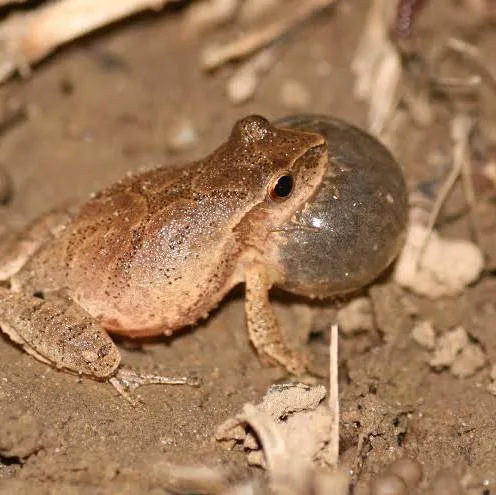
<p><span>Pseudacris crucifer</span><br>These tiny frogs typically grow to only 0.75–1.25 inches (1.9–3.2 cm) long. Their color varies from tan and brown to olive or gray, which helps them camouflage against tree bark and leaf litter.</p>
10
New cards

Leopard Frog

Lithobates pipiens
Typically 2–4.5 inches (5–11.5 cm) long. They are green or brown with large, dark, circular spots that have a light-colored "halo" around them.

<p><span>Lithobates pipiens</span><br>Typically 2–4.5 inches (5–11.5 cm) long. They are green or brown with large, dark, circular spots that have a light-colored "halo" around them.</p>
11
New cards

Pickerel Frog

Lithobates palustris
Its most defining feature is the two parallel rows of dark, squarish or rectangular spots running down its back.
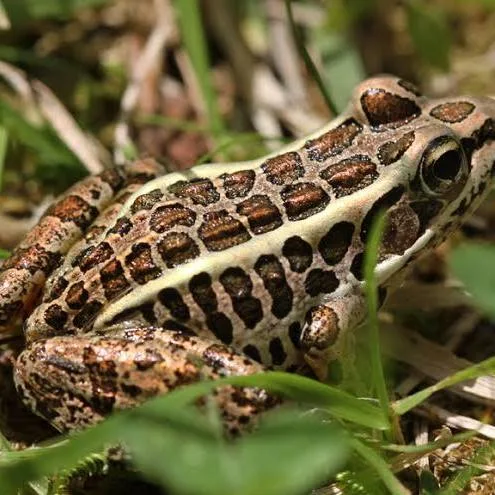
<p>Lithobates palustris<br>Its most defining feature is the two parallel rows of dark, <strong>squarish or rectangular spots</strong> running down its back.</p>
12
New cards

Green Frog

Lithobates clamitans melanota
Typically 2.25–4 inches (5.5–10 cm) long. They have green heads with bodies that can range from bright green to bronze, olive, or brown. Has dorsolateral fold.

<p>Lithobates clamitans melanota<br><span>Typically 2.25–4 inches (5.5–10 cm) long. They have green heads with bodies that can range from bright green to bronze, olive, or brown. Has dorsolateral fold.</span></p>
13
New cards

American Bullfrog

Lithobates catesbeianus
Adults can reach 3.5–8 inches (9–20 cm) in length and weigh up to 1.1 lbs (0.5 kg). No dorsolateral fold.

<p><span>Lithobates catesbeianus</span><br><span>Adults can reach 3.5–8 inches (9–20 cm) in length and weigh up to 1.1 lbs (0.5 kg). No dorsolateral fold.</span></p>
14
New cards

Blue Cohosh

(Caulophyllum thalictroides) – Woodland perennial with bluish-green compound leaves, small yellow-green flowers, and distinctive bright blue berries. Found in rich deciduous forests. Autotroph; rhizomatous; often mycorrhizal.
Uses: Traditionally used medicinally (especially in women’s health), but toxic if misused and not considered edible.

<p><strong>(<em>Caulophyllum thalictroides</em>)</strong> – Woodland perennial with bluish-green compound leaves, small yellow-green flowers, and distinctive bright blue berries. Found in rich deciduous forests. <strong>Autotroph; rhizomatous; often mycorrhizal.</strong><br><strong>Uses:</strong> Traditionally used medicinally (especially in women’s health), but <strong>toxic if misused and not considered edible</strong>.</p>
15
New cards

Musk Turtle

Sternotherus odoratus

  • Small, smooth domed shell

  • Two yellow stripes on head


<p>Sternotherus odoratus</p><ul><li><p>Small, smooth domed shell</p></li><li><p>Two yellow stripes on head</p></li></ul><p></p>
16
New cards

Eastern Ratsnake

Pantherophis alleghaniensis

  • Black/gray body

  • White chin

  • Faint pattern (fades with age)


<p>Pantherophis alleghaniensis</p><ul><li><p>Black/gray body</p></li><li><p>White chin</p></li><li><p>Faint pattern (fades with age)</p></li></ul><p></p>
17
New cards

Common Watersnake

Nerodia sipedon

  • Dark crossbands (widest on back)

  • Thick-bodied

  • Often near water


<p>Nerodia sipedon</p><ul><li><p>Dark crossbands (widest on back)</p></li><li><p>Thick-bodied</p></li><li><p>Often near water</p></li></ul><p></p>



