Chapter 4: Imperfections in Solids
 Call Kai
 Learn
 Practice Test
 Spaced Repetition
 Match
 Flashcards
 Knowt Play
1/138

Earn XP
Description and Tags
139 Terms
False
All solids contain large numbers of various defects or imperfections.
True or False.
Perfect order exists throughout crystalline materials on an atomic scale.
Crystalline defect
This refers to a lattice irregularity having one or more of its dimensions on the order of an atomic diameter
geometry, dimensionality of the defect
Classification of crystalline imperfections is frequently made according to _________ or ______________.
point defects
linear (or one-dimensional) defects
Interfacial defects
Enumerate the types of imperfections in crystalline solids.
Point defects
TYPES OF IMPERFECTIONS
those associated with one or two atomic positions
Interfacial defects
TYPES OF IMPERFECTIONS
are two-dimensional
boundaries
Interfacial defects are also called?
vacancy or vacant lattice site
The simplest of the point defects.
vacancy or vacant lattice site
one normally occupied from which an atom is missing
False
It is not possible to create a material that is free of vacancies.
True or False
Not all crystalline solids contain vacancies.
The presence of vacancies increases the entropy of the crystal.
Why is the existence of vacancies necessary?
equilibrium number of vacancies Nv
The ________________ for a given quantity of material (usually per meter cubed) depends on and increases with temperature.
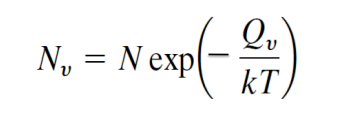
What is the formula for the equilibrium number of vacancies Nv
total number of atomic sites (most commonly per cubic meter)
From the formula of the equilibrium number of vacancies Nv, what does N represent?
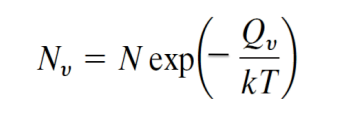
the energy required for the formation of a vacancy (J/mol or eV/atom)
From the formula of the equilibrium number of vacancies Nv, what does Qv represent?
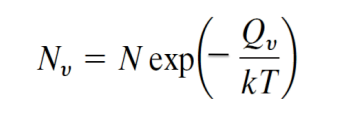
1.38 x10⁻²³ J/atom-K, or 8.62 x10⁻⁵ eV/atom-K
k is the Boltzmann’s constant, what does this value equal to?
self-interstitial
A _____________ is an atom from the crystal that is crowded into a small void space that under ordinary circumstances is not occupied.
self-interstitial
It is a small void space that under ordinary circumstances is not occupied.
It is because the atom introduced is substantially larger than the interstitial position in which it is situated.
Why does self-interstitial introduce relatively large distortions in the surrounding lattice of metals?
False
The formation of self-interstitial is not highly probable, and it exists in very small concentrations, which are significantly lower than for vacancies.
True or False.
The probability of the formation of self-interstitial is significantly higher than vacancies.
True
True or False
A pure metal consisting of only one type of atom is not possible; impurity or foreign atoms will always be present, and some will exist as crystalline point defects.
99.9999%
10^22 to 10^23
It is difficult to refine metals to a purity in excess of ________. At this level, on the order of __________ impurity atoms are present in 1 m3 of material.
alloys
Most familiar metals are not highly pure; rather, they are ________, in which impurity atoms have been added intentionally to impart specific characteristics to the material.
mechanical strength
corrosion resistance
Ordinarily, alloying is used in metals to improve ___________ and ____________.
92.5% silver, 7.5% copper
Sterling silver is an alloy of?
True
True or False
In normal ambient environments, pure silver is highly corrosion resistant, but also very soft.
copper
Alloying with _________ significantly enhances the mechanical strength of silver without depreciating the corrosion resistance appreciably.
Solid Solution (Second Phase)
It is formed when an impurity is added to a metal.
Solvent (host atoms)
It represents the element/compound that is present in the greatest amount.
Solute
It is used to denote an element or compound present in a minor concentration.
solid solution
A ___________ forms when, as the solute atoms are added to the host material, the crystal structure is maintained and no new structures are formed.
liquid solution
If two liquids that are soluble in each other (such as water and alcohol) are combined, a __________ is produced as the molecules intermix, and its composition is homogeneous throughout.
False
A solid solution is also compositionally homogeneous; the impurity atoms are randomly and uniformly dispersed within the solid.
True or False
A solid solution is also compositionally heterogeneous.
Substitutional
Interstitial
Types of Impurity point defects found in solid solutions.
Substitutional
Solute or impurity atoms replace or substitute for the host atoms.
Hume–Rothery rules
Several features of the solute and solvent atoms determine the degree to which the solute dissolves in the solid. These are expressed as four ____________.
1. Atomic size factor
2. Crystal structure
3. Electronegativity
4. Valences
What are the four Hume–Rothery rules?
interstitial solid solutions
For ____________, impurity atoms fill the voids or interstices among the host atoms.
tetrahedral and octahedral
For both FCC and BCC crystal structures, there are two types of interstitial sites. What are they?
coordination number
Interstitial sites are distinguished by the number of nearest neighbor host atoms, also known as?
Tetrahedral sites
These sites have a coordination number of 4.
Octahedral sites
These sites have a coordination number of 6.
4-sided tetrahedron
A ___________ is formed by drawing straight lines from the centers of the surrounding host atoms
octahedron
An ___________ is produced by joining six sphere centers.
True
True or False
For metallic materials that have relatively high atomic packing factors, these interstitial positions are relatively small.
False
The atomic diameter of an interstitial impurity must be substantially smaller than that of the host atoms.
True or False
The atomic diameter of an interstitial impurity must be substantially larger than that of the host atoms.
Composition/ Concentration
the relative content of a specific element or constituent in an alloy
Weight/mass percent (wt%)
Atom percent (at%)
Two common ways to specify composition:
Weight/mass percent (wt%)
the basis is the weight of particular element relative to the total weight
Atom percent (at%)
it is the number of moles of an element in relation to the total moles of the elements in the alloy
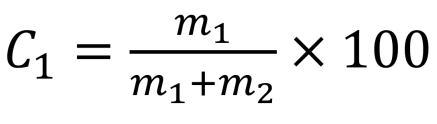
where
C1 – Concentration of an atom 1 (wt%)
m1 or m2 -represents the weight (or mass) of element 1 or 2
What is the formula for the computation of weight/mass percent (for a two-element alloy)?
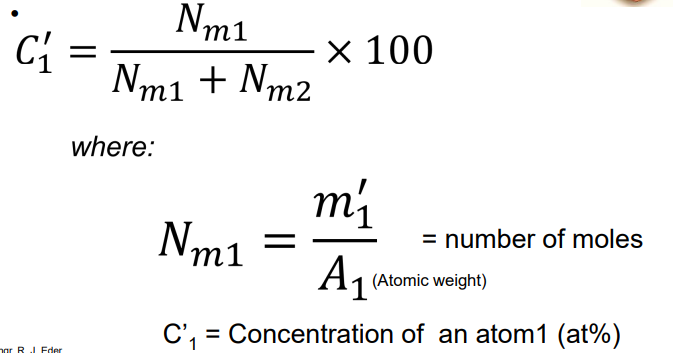
What is the formula for the computation of atom percent (for a two-element alloy)?
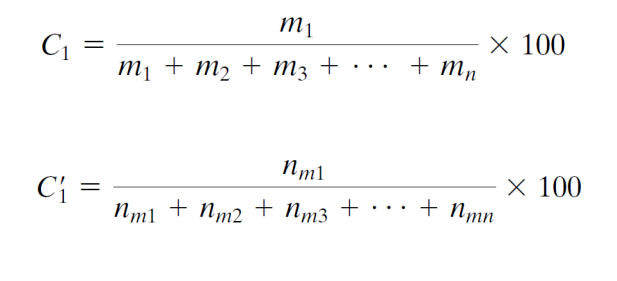
What is the formula for the computation of atom percent and the weight/mass percent when an alloy contains more than two (say n) elements?
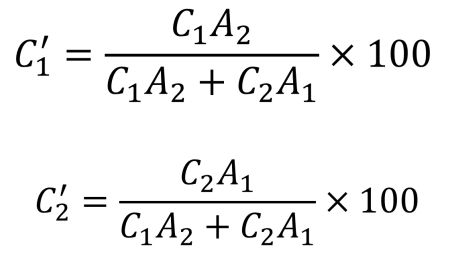
you can use C1 and C2 = 100 to simplify calculation
What is the formula used for the conversion of weight/ mass percent to atom percent?
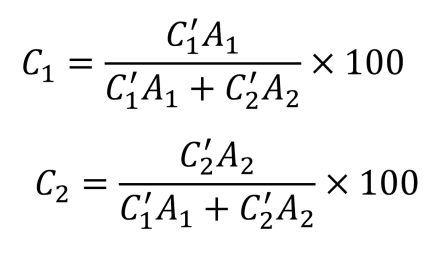
What is the formula used for the conversion of atom percent to weight/ mass percent?
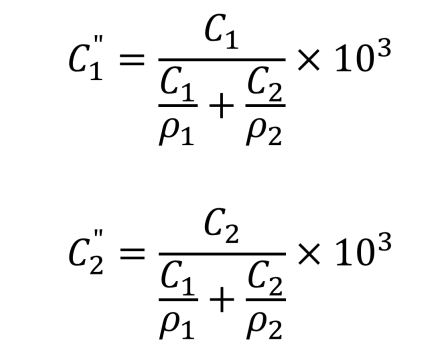
What is the formula used for the conversion of weight/ mass percent to mass per unit volume (for a two-element alloy)?
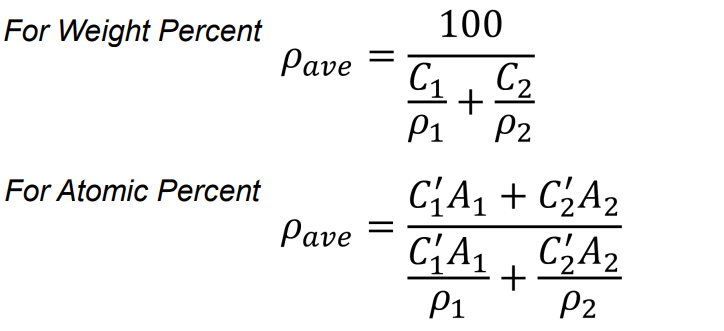
conversion of density formula (for a two-element metal alloy)
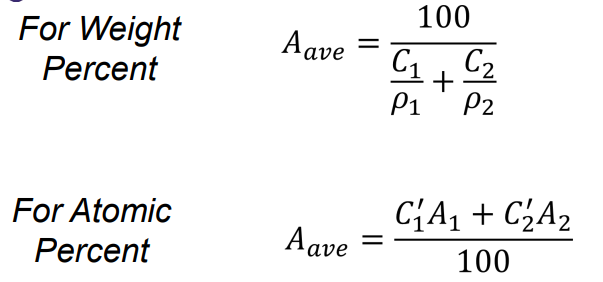
conversion of atomic weight formula (for a two-element metal alloy)
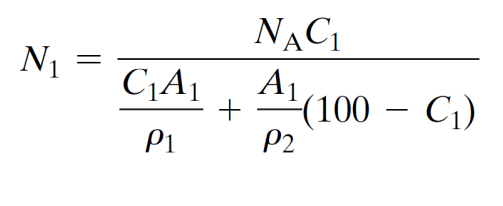
Number of atoms /cm3 (N1 ) of one element in a solid solution
Dislocation
It is another type of defect in crystals; they are areas where atoms are out of position in crystal structure
Dislocation
It is a linear or one-dimensional defect around which some of the atoms are misaligned.
Taylor, Orowan, Polyani, 1934
Before the discovery of the dislocation by ________, __________ and _________ in _________, no one could figure out how the plastic deformation properties of a metal could be greatly changed solely by forming (without changing the chemical composition).
edge dislocation
screw dislocation
There are two basic types of dislocations:
True
True or False
Edge and screw dislocations are just extreme forms of the possible dislocation structures that can occur.
Vito Volterra
The theory describing the elastic fields of the defects was originally developed by _______ in 1907.
defect on the atomic scale
G. I. Taylor
The theory describing the elastic fields of the defects was originally developed by Vito Volterra in 1907, but the term 'dislocation' to refer to a ___________ was coined by _______ in 1934.
Edge dislocation
It is an extra portion of a plane of atoms, or half-plane, the edge of which terminates within the crystal
Edge dislocation
It is a linear defect that centers on the line that is defined along the end of the extra half-plane of atoms.
Dislocation Line
A line that is defined along the end of the extra half- plane of atoms.
Dislocation motion is analogous to movement of a caterpillar. The caterpillar would have to exert a large force to move its entire body at once. Instead it moves the rear portion of its body forward a small amount and creates a hump. The hump then moves forward and eventual moves all of the body forward by a small amount.
Dislocations allow deformation to occur at much lower stress than in a perfect crystal. Why?
screw dislocation
Another type of dislocation, called a __________, may be thought of as being formed by a shear stress that is applied to produce the distortion.
Screw Dislocations
The upper front region of the crystal is shifted one atomic distance to the right relative to the bottom portion.
True
True or False
The atomic distortion associated with a screw dislocation is also linear and along a dislocation line.
screw dislocation
The ___________ derives its name from the spiral or helical path or ramp that is traced around the dislocation line by the atomic planes of atoms.

What symbol is used to designate a screw dislocation?
True
True or False
The stresses caused by a screw dislocation are less complex than those of an edge dislocation.
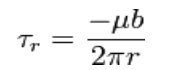
where μ is the shear modulus of the material,
b is the Burgers vector, and
r is a radial coordinate
Equation for screw dislocations.
micropipe
If the Burgers vector is very large, the core may actually be empty resulting in a ________, as commonly observed in silicon carbide.
Burgers vector
The magnitude and direction of the lattice distortion associated with a dislocation are expressed in terms of a _______.
relative orientations of dislocation line and Burgers vector
The nature of a dislocation (i.e., edge, screw, or mixed) is defined by the ________________,.
True
True or False.
For an edge, the burgers vectors are perpendicular, whereas for a screw, they are parallel. Burgers vectors are neither perpendicular nor parallel for a mixed dislocation.
True
True or False
Even though a dislocation changes direction and nature within a crystal, the Burgers vector is the same at all points along its line.
plane of dislocation
The direction of the Burgers vector depends on the?
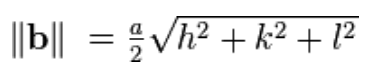
where:
a is the unit cell length of the crystal
||b|| is the magnitude of Burgers vector and
h, k, and l are the components of the Burgers vector, b = <h k l>
The magnitude of a burgers vector is usually represented by the equation:
interatomic spacing
In most metallic materials, the magnitude of the Burgers vector for a dislocation is of a magnitude equal to the ___________ of the material.
mixed dislocations
In many materials, dislocations are found where the line direction and Burgers vector are neither perpendicular or parallel and these dislocations are called __________, consisting of both screw and edge character
Interfacial Defects
_________ are boundaries that have two dimensions and normally separate regions of the materials that have different crystal structures and/or crystallographic orientations.
external surfaces,
grain boundaries,
phase boundaries,
twin boundaries,
stacking faults.
Interfacial Defects include:
External Surface
Along which the crystal structure terminates.
External Surface
Surface atoms are not bonded to the maximum number of nearest neighbors, and are therefore in a higher energy state than the atoms at interior positions.
Grain Boundaries
It is a boundary separating two small grains or crystals having different crystallographic orientations in polycrystalline materials. It is represented schematically from an atomic perspective.
Small (or low) angle grain boundary
when this orientation mismatch is slight; on the order of a few degrees.
these boundaries can be described in terms of dislocation arrays.
Tilt boundary
one simple small-angle grain boundary is formed when edge dislocations are aligned; the angle of misorientation, θ
Twist boundary
takes place when the angle of misorientation is parallel to the boundary, which can be described by an array of screw dislocations
Phase Boundaries
exist in multiphase materials wherein a different phase exists on each side of the boundary
Twin Boundaries
It is a special type of grain boundary across which there are specific mirror lattice summary; that is atoms on one side of the boundary are located in mirror image positions of the atoms on the other side.
Twins
_______ result from atomic displacements that are produced from applied mechanical shear forces and also, during annealing heat treatments following deformation.
Twinning
__________ occurs on a definite crystallographic plane and in a specific direction, both of which depend on the crystal structure.
Mechanical twins
Result from atomic displacements that are produced from applied mechanical shear forces