Bio 251 Lab Practical #1 Review
 Call Kai
 Learn
Learn Practice Test
 Spaced Repetition
 Match
Match Flashcards
 Knowt Play
1/112

There's no tags or description
Looks like no tags are added yet.
Name | Mastery | Learn | Test | Matching | Spaced | Call with Kai | Chat |
|---|
No analytics yet
Send a link to your students to track their progress
113 Terms
Dorsal/Posterior
Toward or at the back of the body; behind

Ventral/Anterior
Toward or at the front of the body; in front of

Lateral
Away from the midline of the body, on the outer side of

Medial
Toward or at the midline of the body; on the inner side of

Distal
Farther from the origin of a body part or the point of attachment of a limb to the body trumk

Proximal
Closer to the origin of the body part or the point of attachment of a limb to the body trunk

Superficial
Toward or at the body surface

Deep
Away from the body surface; more internal

Superior
Toward the head end or upper part of a structure or the body; above

Inferior
Away from the head end or toward the lower part of a structure or the body; below
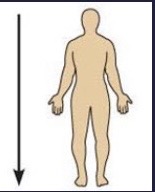
Articulating Surface
Joints; surface of a bone that contacts another bone
Non-Articulating Surface
Part of the bone that doesn't connect to another bone/non-moveable
Depression
A dent or superficial hole in a bone
Opening
Full holes in bones, allows blood vessels and nerves to enter the bone
Condyle
A large, rounded, articulating knob
Facet
A flattened or shallow articulating surface
Head
A prominent, rounded, articulating end of a bone
Crest
A narrow, ridgelike projection
Epicondyle
A projection above a condyle
Process
Any marked, bony prominence
Spine
A sharp, slender process
Trochanter
A massive process found only on the femur
Tubercle
A small, rounded process
Tuberosity
A large, roughened process
Alveolus
A deep pit or socket
Fissure
A narrow, slit-like opening
Foramen (pl: foramina)
A rounded opening through a bone
Fossa
A flattened or shallow surface
Fovea
A small pit or depression
Meatus or canal
A tube-like passageway through a bone
Sinus
A cavity or hollow space in a bone
Sulcus
A groove that accommodates a vessel, nerve, or tendon
Periosteum
A glistening white, double-layered membrane which covers the external surface of the entire bone except the joint surfaces
Diaphysis
Tubular shaft which forms the long axis of the bone
Epiphysis
Bone ends
Epiphyseal Plate
Commonly called the growth plate; a disc of hyaline cartilage that grows during childhood to lengthen the bone
Articular Cartilage
Glassy-smooth hyaline cartilage that covers the opposing bone surfaces; absorb compression placed on the joint & keep the bone ends from being crushed
Meniscus
Articular discs that extend inward from the articular capsule & partially or completely divide the synovial cavity in 2
Joint Cavity
Unique to synovial joints; contains a small amout of synovial fluid; a potential space because it's normally almost nonexistent, but can expand if fluid accumulates (happens during inflammation)
Synovial Fluid
Slippery substance that occupies all free spaces within the joint capsule; derived largely by filtration from blood flowing through the capillaries in the synovial membrane; viscous, egg-white consistency to prevent friction
Fibrous Joints
Bones joined by collagen fibers of connective tissue; immovable
Cartilaginous Joints
Bones joined by cartilage; have both rigid & slightly moveable examples
Synovial Joints
Articulating bones are separated by a fluid-filled cavity; most joints are classified this way; freely moveable
Plane, Condylar, Ball-&-Socket, Hinge, Saddle, & Pivot
The 6 shape names of synovial joints
Sutures, Syndesmoses, & Gomphoses
3 types of fibrous joints
Sutures
Found only between bones of skull
Syndesmoses
Junction of bones held together by ligaments
Gomphoses
Tooth attached to socket with periodontal ligament
Synchondroses & Symphyses
2 types of cartilaginous joints
Synchondroses
Joints of hyaline cartilage between the shaft & the epiphyseal plates of growing long bones
Symphyses
Bones are joined by fibrocartilage
Synarthroses, Amphiarthroses, & Diarthroses
3 types of functional joints
Synarthroses
Immovable joints
Amphiarthroses
Slightly movable joints
Diarthroses
Freely movable joints (synovial joints)
7
How many tarsals are there?
5
How many metatarsals are there?
14
How many phalanges are there?
8
How many carpals are there?
5
How many metacarpals are there?
Fibrous, Cartilaginous, & Synovial
3 structural classifications
Temporal bone of skull & mandible
Temporomandibular Joint

Sternum & clavicle
Sternoclavicular Joint

Scapula & humerus
Humeroscapular or Glenohumeral Joint

Metacarpal & proximal phalanx
Metacarpophalangeal Joint

Adjacent phalanges
Interphalangeal Joints

Os Coxa & Femur
Coxal Joint

Femur and tibia
Tibiofemoral Joint

Between frontal & parietal bones
Example of sutures
Ligament between fibula & tibia
Example of syndesmoses
Tooth held in socket of alveolar process
Example of gomphoses
% Solution = (mass or volume of solute)/(volume of solution) x 100
Percent Solution Equation
M = (moles of solute)/(L of solution)
Molarity Equation
Moles = (mass of solute)/(molecular weight of solute)
Moles of Solute Equation
Mucous Membranes
Line all body cavities that open to the outside of the body, such as hollow organs of digestive, respiratory, & urogenital tracts
Serous Membranes
Have visceral layer & pareital layer separated by serous fluid
Pleura
Line thoracic wall & cover lungs
Pericardium
Encloses heart
Peritoneum
Encloses abdominopelvic viscera
Digestive, Respiratory Tract, Reproductive Tract, & Urinary Tract
Open body cavities
Ilium, ischium, & pubis
3 bones that make up os coxa
Temporomandibular Joint
Joint between temporal bone & mandible
Sternoclavicular Joint
Joint between sternum & clavicle
Humeroscapular Joint
Joint between humerus & scapula
Elbow Joint
Joint between humerus & radius/ulna
Metacarpophalangeal Joint
Joint between metacarpals & proximal phalanx
Interphalangeal Joints
Joints in between adjacent phalanges
Coxal Joint
Joint between os coxa & femur
Tibiofemoral Joint
Joint between tibia & femur
Talocrural Joint
Joint between talus & tibia-fibula
Simple Squamous Epithelia
Single layer of flattened cells; substances that need to quickly/easily cross layer

Stratified Squamous Epithelia
Multiple layers of flat cells; protective w/o being excessively thick; where body experiences friction

Simple Cuboidal Epithelia
Single layer of cells with equal proportions; absorption or secretion

Simple Columnar Epithelia
Single layer of tall cells; absorption or secretion; frequently has cilia

Pseudostratified Columnar Epithelia
Appears to be multiple layers but is really only single layer bc all cells are attached to basement membrane; cells diff sizes; has cilia

Transitional Epithelia
Stratified, but cell shape is diff depending on layer; found in organs that change shape
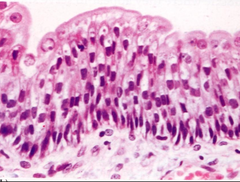
Skin
Stratified squamous, but with keratin; provides tough & dry quality

Connective Tissue
Most widespread & abundant body tissue; support, protection, insulation, storage, & transport
Loose Areolar Connective Tissue
Cells & fibers are loosely aggregated
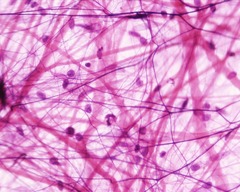
Adipose Tissue
"Fat" ; fibers not readily evident, but has honeycomb appearance
