chapter 2 bio: The Chemical Foundation of Life
 Call Kai
 Learn
Learn Practice Test
 Spaced Repetition
 Match
Match Flashcards
 Knowt Play
1/81

Earn XP
Description and Tags
Comprehensive vocabulary flashcards covering fundamental chemistry, atomic structures, chemical bonds, properties of water, and organic functional groups.
Name | Mastery | Learn | Test | Matching | Spaced | Call with Kai | Chat |
|---|
No analytics yet
Send a link to your students to track their progress
82 Terms
Acid
A molecule that donates hydrogen ions and increases the concentration of hydrogen ions in a solution.
Adhesion
The attraction between water molecules and other molecules.
Aliphatic Hydrocarbon
A hydrocarbon consisting of a linear chain of carbon atoms.
Anion
A negative ion that is formed by an atom gaining one or more electrons.
Aromatic Hydrocarbon
A hydrocarbon consisting of closed rings of carbon atoms.
Atom
The smallest unit of matter that retains all of the chemical properties of an element; composed of two regions: the nucleus and the outer region containing electrons.
Atomic Number
The total number of protons in an atom, which appears above the chemical symbol on the periodic table.
Atomic Weight
The calculated mean of the atomic weights of an element's isotopes; appears as the approximate atomic mass below the element's symbol on the periodic table.
Balanced Chemical Equation
A statement of a chemical reaction with the number of each type of atom equalized for both the products and reactants.
Base
A molecule that donates hydroxide ions or otherwise binds excess hydrogen ions and decreases the hydrogen ions' concentration in a solution.
Buffer
A substance that resists a change in pH by absorbing or releasing hydrogen or hydroxide ions.
Calorie
The amount of heat required to change the temperature of one gram of water by one degree Celsius.
Capillary Action
The movement of water within narrow tubular structures occurring because adhesive forces between water molecules and inner surfaces exceed the cohesive forces between water molecules.

Cation
A positive ion that is formed by an atom losing one or more electrons.
Chemical Bond
An interaction between two or more of the same or different atoms that results in forming molecules.
Chemical Reaction
A process leading to rearranging atoms in molecules.
Chemical Reactivity
The ability to combine and to chemically bond with each other.
Cohesion
Intermolecular forces between water molecules caused by the polar nature of water; responsible for surface tension.
Compound
A substance composed of molecules consisting of atoms of at least two different elements.
Covalent Bond
A type of strong bond formed between two atoms of the same or different elements; forms when electrons are shared between atoms.
Dissociation
The release of an ion from a molecule such that the original molecule now consists of an ion and the charged remains of the original, such as when water dissociates into H+ and OH−.
Electrolyte
An ion necessary for nerve impulse conduction, muscle contractions, and water balance.
Electron
A negatively charged subatomic particle that resides outside of the nucleus in the electron orbital; lacks functional mass and has a negative charge of −1 unit.
Electron Configuration
The arrangement of electrons in an atom's electron shell (for example, 1s22s22p6).
Electron Orbital
How electrons are spatially distributed surrounding the nucleus; the area where we are most likely to find an electron.

Electron Transfer
The movement of electrons from one element to another; important in creating ionic bonds.
Electronegativity
The ability of some elements to attract electrons (often of hydrogen atoms), acquiring partial negative charges in molecules and creating partial positive charges on the hydrogen atoms.
Element
One of 118 unique substances (98 of which occur naturally) that cannot break down into smaller substances; each element has unique properties and a specified number of protons.
Enantiomers
Molecules that share overall structure and bonding patterns, but differ in how the atoms are three dimensionally placed such that they are non-superimposable mirror images of each other.

Equilibrium
The steady state of relative reactant and product concentration in reversible chemical reactions in a closed system.
Evaporation
A change from liquid to gaseous state at a body of water's surface, plant leaves, or an organism's skin.
Functional Group
A group of atoms that occur within molecules and confer specific chemical properties to those molecules. found along the carbon backbone of macromolecules.

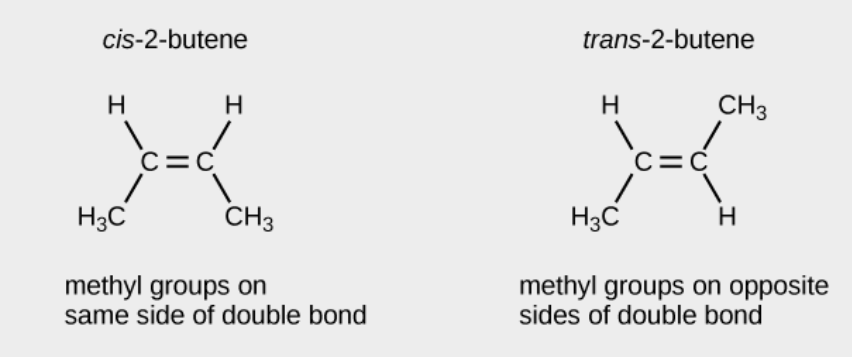
Geometric Isomer
An isomer with similar bonding patterns differing in the placement of atoms alongside a double covalent bond. ex. fatty acids, oleic and eliadic: oleic acid is the cis configuration (hydrogens are on the same side at the double bond causing a bend or v shape in the molcule) of eliadic acid which is the trans configuration of oleic acid.

Heat of Vaporization of Water
The high amount of energy required for liquid water to turn into water vapor.
Hydrocarbon
A molecule that consists only of carbon and hydrogen.
Hydrogen Bond
A weak bond between slightly positively charged hydrogen atoms and slightly negatively charged atoms in other molecules.
Hydrophilic
Describes ions or polar molecules that interact well with other polar molecules such as water.
Hydrophobic
Describes uncharged nonpolar molecules that do not interact well with polar molecules such as water.
Inert Gas
Also called noble gas; an element with a filled outer electron shell that is unreactive with other atoms.
Ion
An atom or chemical group that does not contain equal numbers of protons and electrons.
Ionic Bond
A chemical bond that forms between ions with opposite charges (cations and anions) via the unequal sharing or transfer of electrons.
Irreversible Chemical Reaction
A chemical reaction where reactants proceed unidirectionally to form products.
Isomers
Molecules that differ from one another even though they share the same chemical formula.
Isotope
One or more forms of an element that have different numbers of neutrons.
Law of Mass Action
A chemical law stating that the rate of a reaction is proportional to the concentration of the reacting substances.
Litmus Paper
Also called pH paper; filter paper treated with a natural water-soluble dye that changes its color as the pH of the environment changes in order to use it as a pH indicator.
Mass Number
The total number of protons and neutrons in an atom.
Matter
Anything that has mass and occupies space.
Molecule
Two or more atoms chemically bonded together.
Neutron
An uncharged particle that resides in an atom's nucleus; has a mass of one amu.
Nonpolar Covalent Bond
A type of covalent bond that forms between atoms when electrons are shared equally between them.
Nucleus
The core of an atom; contains protons and neutrons.
Octet Rule
The rule that atoms are most stable when they hold eight electrons in their outermost shells.
Orbital
A region surrounding the nucleus that contains electron(s).
Organic Molecule
Any molecule containing carbon, with the exception of carbon dioxide.
Periodic Table
An organizational chart of elements indicating each element's atomic number and atomic mass, providing key information about the elements' properties.

pH Scale
A scale ranging from zero to 14 (representing 'puissance d’hydrogène' or potential of hydrogen) that is inversely proportional to the hydrogen ions' concentration in a solution.

Polar Covalent Bond
A type of covalent bond that forms as a result of unequal electron sharing, resulting in creating slightly positive and negative charged molecule regions.
Product
A molecule that is the result of a chemical reaction.
Proton
A positively charged particle that resides in the atom's nucleus; has a mass of one amu and a charge of +1.
Radioisotope
An isotope that emits radiation comprised of subatomic particles to form more stable elements.
Reactant
A molecule that takes part in a chemical reaction.
Reversible Chemical Reaction
A chemical reaction that functions bidirectionally, where products may turn into reactants if their concentration is great enough.
Solvent
A substance capable of dissolving another substance.
Specific Heat Capacity
The amount of heat one gram of a substance must absorb or lose to change its temperature by one degree Celsius.
Sphere of Hydration
A structure formed when a polar water molecule surrounds charged or polar molecules, thus keeping them dissolved and in solution.

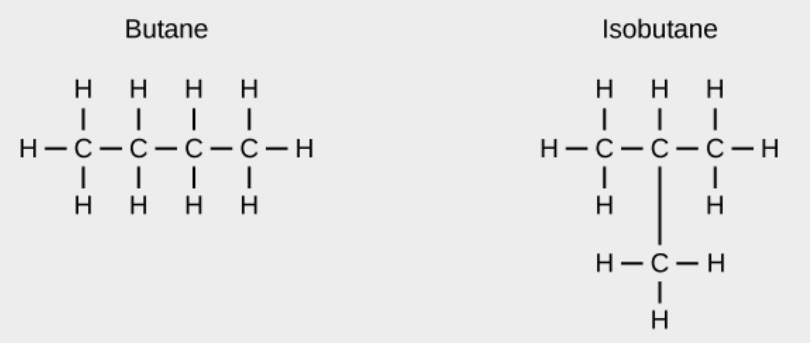
Structural Isomers
Molecules that share a chemical formula but differ in the placement of their chemical bonds.
Substituted Hydrocarbon
A hydrocarbon chain or ring containing an atom of another element in place of one of the backbone carbons.
Surface Tension
Tension at the surface of a body of liquid that prevents the molecules from separating; created by the attractive cohesive forces between the liquid's molecules.
Valence Shell
The outermost shell of an atom.
Van der Waals Interaction
A very weak interaction between molecules due to temporary charges attracting atoms that are very close together.
Bohr Model
A model developed in 1913 by Niels Bohr in which electrons exist within principal shells, occupying the lowest energy shell available closest to the nucleus.

Oxidation
The loss of an electron during a chemical reaction.
Reduction
The gain of an electron during a chemical reaction.
Carbon Dating
A technique using carbon isotopes to determine the age of carbon-containing biological remains that are less than about 50,000 years old.

Hydroxyl Group
A polar functional group with the chemical structure −OH.
Methyl Group
A nonpolar functional group with the chemical structure −CH3.
Carbonyl Group
A polar functional group characterized by a carbon atom double-bonded to an oxygen atom (C=O).
Carboxyl Group
A charged, acidic functional group (−COOH) that ionizes to release H+ ions into solution.
Amino Group
A charged, basic functional group (−NH2) that accepts H+ from solution to form −NH3+.
Phosphate Group
A charged, acidic functional group that ionizes to release H+ ions into solution.
Sulfhydryl Group
A polar functional group with the chemical structure −SH.