Cell-cell communication: General Principles

0.0(0)
Studied by 0 people
call kaiCall Kai
learnLearn
examPractice Test
spaced repetitionSpaced Repetition
heart puzzleMatch
flashcardsFlashcards
GameKnowt Play
Card Sorting

1/11

encourage image

There's no tags or description

Looks like no tags are added yet.

Last updated 3:46 AM on 10/10/26
Name
Mastery
Learn
Test
Matching
Spaced
Call with Kai
Chat

No analytics yet

Send a link to your students to track their progress

12 Terms

1
New cards

How can cell signaling be classified based on the distance a signal travels from the signaling cell to the responding cell?

Endocrine

  • Secreted by distant cells (signal travels long distance)

Paracrine

  • Secreted by neighboring cells (signal travels short distance, local)

Autocrine

  • Signaling cell = responding cell (self-regulation)

Contact-dependent

  • Physical contact between membrane proteins on signaling cell and responding cell

Synaptic

  • Both close and far travel distance for signal

  • Electrical signal from distance

  • Very local chemical signal at synapse (example of paracrine)


<p><span style="line-height: 107%;"><strong>Endocrine</strong></span></p><ul><li><p class="MsoListParagraph"><span style="line-height: 107%;">Secreted by <u>distant</u> cells (signal travels long distance)</span></p></li></ul><p class="MsoNormal"><span style="line-height: 107%;"><strong>Paracrine</strong></span></p><ul><li><p class="MsoListParagraph"><span style="line-height: 107%;">Secreted by <u>neighboring</u> cells (signal travels short distance, <u>local</u>)</span></p></li></ul><p class="MsoNormal"><span style="line-height: 107%;"><strong>Autocrine</strong></span></p><ul><li><p class="MsoListParagraph"><span style="line-height: 107%;">Signaling cell = responding cell (self-regulation)</span></p></li></ul><p class="MsoNormal"><span style="line-height: 107%;"><strong>Contact-dependent</strong></span></p><ul><li><p class="MsoListParagraph"><span style="line-height: 107%;"><u>Physical contact</u> between membrane proteins on signaling cell and responding cell</span></p></li></ul><p class="MsoNormal"><span style="line-height: 107%;"><strong>Synaptic</strong></span></p><ul><li><p class="MsoListParagraphCxSpFirst"><span style="line-height: 107%;">Both close and far travel distance for signal</span></p></li><li><p class="MsoListParagraphCxSpMiddle"><span style="line-height: 107%;">Electrical signal from <u>distance</u></span></p></li><li><p class="MsoListParagraphCxSpLast"><span style="line-height: 107%;">Very <u>local</u> chemical signal at synapse (example of <em>paracrine</em>)</span></p></li></ul><p></p>
2
New cards

How does the chemical nature of a signaling molecule (hydrophilic vs. hydrophobic) determine where its receptor must be located?

Thinking question: What differences in signal sequences and protein sorting pathways would you predict for each of their receptor proteins?

Hydrophilic signaling molecules are not permeable to membranes so rely on cell-surface receptors

  • Cell-surface receptors would contain an ER import signal and enter the endomembrane system involving entry into the ER, golgi and finally the plasma membrane via exocytosis

Hydrophobic signaling molecules are permeable to membranes so use intracellular receptors

  • Intracellular receptors located in cytosol would not contain a signal sequence. Intracellular receptors located in nucleus would contain a nuclear localization signal (NLS)


<p><span style="line-height: 107%;"><strong>Hydrophilic</strong> signaling molecules are <strong>not permeable</strong> to membranes so rely on <strong>cell-surface receptors</strong></span></p><ul><li><p class="MsoListParagraphCxSpMiddle"><span style="line-height: 107%;">Cell-surface receptors would contain an <strong>ER import signal</strong> and enter the endomembrane system involving entry into the <strong>ER</strong>, <strong>golgi</strong> and finally the <strong>plasma membrane</strong> via exocytosis</span></p></li></ul><p class="MsoListParagraphCxSpMiddle"><span style="line-height: 107%;"><strong>Hydrophobic</strong> signaling molecules are <strong>permeable</strong> to membranes so use <strong>intracellular receptors</strong></span></p><ul><li><p class="MsoListParagraphCxSpLast"><span style="line-height: 107%;">Intracellular receptors located in cytosol would <strong>not contain a signal sequence</strong>. Intracellular receptors located in nucleus would contain <strong>a nuclear localization signal </strong>(<strong>NLS</strong>)</span></p></li></ul><p></p>
3
New cards

How is a receptor recognizing its signaling molecule similar to an enzyme recognizing its substrate?

Interactions between receptor and signaling molecule (ligand) are specific

Similar to enzyme binding substrate:

  • Same types of non-covalent interactions

  • Shape and chemical complementarity of receptor binding site to signaling molecule


4
New cards

How does the distance a signal travels impact the required binding affinity of its receptor?

For example, which of these should have a higher (“tighter”) binding affinity – chemical synaptic (paracrine/local signaling) or endocrine signaling (distant signaling)?

The further the distance a signal travels the higher the binding affinity of its receptor.

  • Endocrine signaling needs a higher binding affinity than chemical synaptic (paracrine) signaling.

  • In endocrine signaling, the signal is distributed throughout the body so there is a lower signal concentration at the receptor so there needs to be tight binding. In contrast, there is a high signal concentration at the receptor in the synapse, so binding doesn’t need to be as tight.


<p><span style="line-height: 107%;">The <strong><u>further</u></strong> the <strong>distance </strong>a <strong>signal travels</strong> the <strong><u>higher</u></strong> the <strong>binding affinity</strong> of its <strong>receptor</strong>.</span></p><ul><li><p class="MsoListParagraphCxSpMiddle"><span style="line-height: 107%;"><strong>Endocrine signaling</strong> needs a <strong>higher binding affinity</strong> than chemical synaptic (paracrine) signaling.</span></p></li><li><p class="MsoListParagraphCxSpLast"><span style="line-height: 107%;">In endocrine signaling, the signal is distributed throughout the body so there is a lower signal concentration at the receptor so there needs to be tight binding. In contrast, there is a high signal concentration at the receptor in the synapse, so binding doesn’t need to be as tight.</span></p></li></ul><p></p>
5
New cards

What are the main types of "molecular switches" used in cell signaling, and why are reversible "switches" essential for relaying signals inside the cell?

  • Molecular switches only have two conformations – ON or OFF. Only the ON conformation can interact with other proteins to relay signals.

  • Examples: protein phosphorylation, G-proteins (explained next flashcard)

  • Reversible molecular switches are essential because signaling pathways need to be turned on and turned off – activate pathway when signal arrives or inactivate pathway when signal disappears (respond to changes in environment)


<ul><li><p><span style="line-height: 107%;">Molecular switches only have <strong><u>two conformations</u></strong> – <strong>ON</strong> or <strong>OFF</strong>. Only the <strong>ON conformation</strong> can interact with other proteins to relay signals.</span></p></li><li><p class="MsoListParagraphCxSpMiddle"><span style="line-height: 107%;">Examples: protein phosphorylation, G-proteins (explained next flashcard)</span></p></li><li><p class="MsoListParagraphCxSpLast"><span style="line-height: 107%;"><strong>Reversible </strong>molecular switches are essential because signaling pathways need to be <strong>turned on</strong> and <strong>turned off </strong>– activate pathway when signal arrives or inactivate pathway when signal disappears (<strong>respond </strong>to <strong>changes</strong> in environment)</span></p></li></ul><p></p>
6
New cards

What two things do all G-proteins do?? How do those two things make it a perfect molecular switch? What can't G-proteins do??

G-proteins do two things:

  • Bind GTP

  • Hydrolyze GTP to GDP (GTPase activity, it is an enzyme)

Perfect molecular switch:

  • 2 conformations – GTP bound (ON) or GDP bound (OFF)

  • Reversible switch – can change between two conformations to be ON or OFF

G-proteins do not:

  • Phosphorylate GDP to GTP!


<p><span style="line-height: 107%;"><strong>G-proteins do two things:</strong></span></p><ul><li><p class="MsoListParagraphCxSpFirst"><span style="line-height: 107%;">Bind GTP</span></p></li><li><p class="MsoListParagraphCxSpLast"><span style="line-height: 107%;">Hydrolyze GTP to GDP (GTPase activity, it is an enzyme)</span></p></li></ul><p class="MsoNormal"><span style="line-height: 107%;"><strong>Perfect molecular switch:</strong></span></p><ul><li><p class="MsoListParagraphCxSpFirst"><span style="line-height: 107%;">2 conformations – GTP bound (ON) or GDP bound (OFF)</span></p></li><li><p class="MsoListParagraphCxSpLast"><span style="line-height: 107%;">Reversible switch – can change between two conformations to be ON or OFF</span></p></li></ul><p class="MsoNormal"><span style="line-height: 107%;"><strong>G-proteins do not:</strong></span></p><ul><li><p class="MsoListParagraph"><span style="line-height: 107%;">Phosphorylate GDP to GTP!</span></p></li></ul><p></p>
7
New cards

Why are amplification steps required for a strong cellular response? How would you identify if a step in a cascade is an amplification step?

  • When a signal binds to its receptor it is a 1:1 relationship. But amplification steps allow one protein/molecule to be activated and then many copies of the next molecule/protein to be produced in the cascade to create a strong response.

  • Amplification step can be identified if one step leads to the next step producing a lot of molecules/proteins thereby amplifying the signal (not a 1:1 relationship)


<ul><li><p><span style="line-height: 107%;">When a signal binds to its receptor it is a 1:1 relationship. But amplification steps allow one protein/molecule to be activated and then <strong>many copies</strong> of the next molecule/protein to be produced in the cascade to create a strong response.</span></p></li><li><p class="MsoListParagraphCxSpLast"><span style="line-height: 107%;">Amplification step can be identified if one step leads to the next step producing a lot of molecules/proteins thereby amplifying the signal (not a 1:1 relationship)</span></p></li></ul><p></p>
8
New cards

What are the key second messengers, and what allows them to be used to rapidly amplify and also end a cellular response?

  • Key second messengers: cAMP, Ca2+

  • Lots of starting material present to generate these second messengers = rapidly amplify signal. E.g. lots of ATP in cells to generate cAMP or lots of Ca2+ stored in smooth ER in muscles

  • Second messengers can be rapidly broken down/removed = end cellular response


<ul><li><p><span style="line-height: 107%;">Key second messengers: <strong>cAMP</strong>, <strong>Ca<sup>2+</sup></strong></span></p></li><li><p class="MsoListParagraphCxSpMiddle"><span style="line-height: 107%;"><strong>Lots of starting material</strong> present to generate these second messengers <strong>= rapidly amplify signal</strong>. E.g. lots of ATP in cells to generate cAMP or lots of Ca<sup>2+</sup> stored in smooth ER in muscles</span></p></li><li><p class="MsoListParagraphCxSpLast"><span style="line-height: 107%;">Second messengers can be <strong>rapidly broken down/removed</strong> <strong>= end cellular response</strong></span></p></li></ul><p></p>
9
New cards

What determines how rapidly a cell responds to a signal? 

Speed of response = delivery of signal to receptor + reaction in cell

Reaction is main factor:

  • Change proteins already present in cell = fast response to signal

  • Change gene expression which produces new proteins = slow response to signal (but often longer-lasting)


<p><span style="line-height: 107%;">Speed of response = <strong>delivery</strong> of signal to receptor + <strong>reaction</strong> in cell</span></p><p class="MsoListParagraphCxSpMiddle"><span style="line-height: 107%;"><strong>Reaction</strong> is main factor:</span></p><ul><li><p class="MsoListParagraphCxSpMiddle"><span style="line-height: 107%;"><strong>Change proteins already present</strong> in cell = <strong>fast response</strong> to signal</span></p></li><li><p class="MsoListParagraphCxSpLast"><span style="line-height: 107%;"><strong>Change gene expression which produces <u>new</u> proteins = slow response </strong>to signal (but often longer-lasting)</span></p></li></ul><p></p>
10
New cards

Would you expect a faster or slower response from a hydrophobic signaling molecule? Why?

Hydrophobic signaling molecules cross plasma membrane and activate intracellular receptors. This usually results in changes in gene expression leading to a slower response.

Example: cortisol.
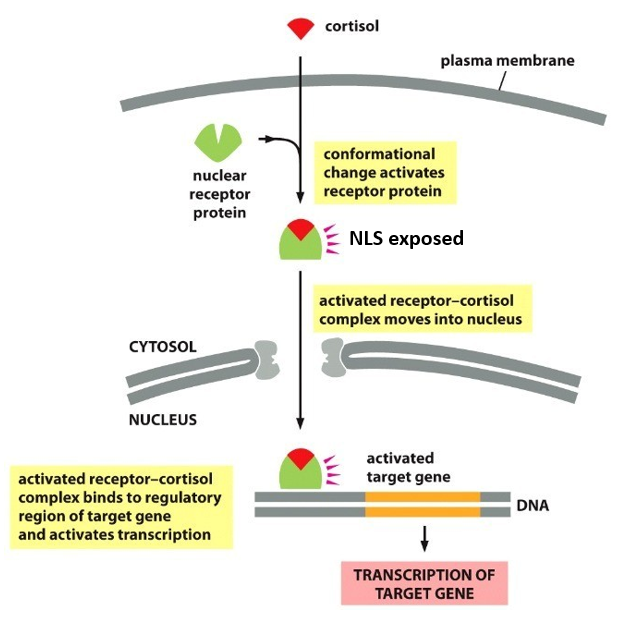
<p><span style="line-height: 107%;"><strong>Hydrophobic </strong>signaling molecules cross plasma membrane and activate intracellular receptors. This usually results in <strong>changes in gene expression</strong> leading to a slower response.</span></p><p><span style="line-height: 107%;">Example: cortisol.</span></p>
11
New cards

What three factors determine what response a cell has to a signal, and how can different cell types have different responses to the same signaling molecule?

  • Receptor for signal (no receptor, no response)

  • Type of receptor (determines which kinase is activated)

  • Targets present in that cell type

  • Different cell types will express different proteins. A kinase is often at end of signaling pathway so kinase will phosphorylate different target proteins specific to cell type = different response


<ul><li><p><span style="line-height: 107%;"><strong>Receptor </strong>for signal (no receptor, no response)</span></p></li><li><p class="MsoListParagraphCxSpMiddle"><span style="line-height: 107%;"><strong>Type </strong>of receptor (determines which kinase is activated)</span></p></li><li><p class="MsoListParagraphCxSpMiddle"><span style="line-height: 107%;"><strong>Targets </strong>present in that cell type</span></p></li><li><p class="MsoListParagraphCxSpLast"><span style="line-height: 107%;"><strong>Different cell types</strong> will <strong>express different proteins</strong>. A kinase is often at end of signaling pathway so kinase will phosphorylate <u>different target proteins</u> specific to cell type = <strong>different response</strong></span></p></li></ul><p></p>
12
New cards

Summary of basic steps in cell signaling :)

knowt flashcard image



