PSY304 Week 1 - On Canvas: Dixon et al, Chapter 1: • The Process of Social Research (pp 5-7) • Four Facebook Studies (pp 7-12) Tracy, Chapters 1-2
 Call Kai
 Learn
Learn Practice Test
 Spaced Repetition
 Match
Match Flashcards
 Knowt Play
1/53

Earn XP
Description and Tags
On Canvas: Dixon et al, Chapter 1: • The Process of Social Research (pp 5-7) • Four Facebook Studies (pp 7-12) Tracy, Chapters 1-2
Name | Mastery | Learn | Test | Matching | Spaced | Call with Kai | Chat |
|---|
No analytics yet
Send a link to your students to track their progress
54 Terms
Benefits of Learning to Conduct Research
It may be an essential skill for a course you are taking now or later, capstone projects, or a thesis, exp for further/higher education
Can be helpful in the workplace
Students / others may ask for advice on research projects
Ex. class surveys, effectiveness of programs, etc
Social Science Research
the topic must have some social aspect such as studying people, interactions, groups of people, social networks or whole nations.
The research is also scientific, or based on systematic and verifiable observations
Aims to explain the natural world through systematic observations and logical reasoning
Occurs in sociology, anthropology, psychology, and political science, among others
The Process of Social Research - major steps

Research design means to devise a plan
3 is to carry out your research design by gathering data to answer your research question
Step four is to analyze and interpret your data
The Process of Social Research - IN DEPTH

Every major step often has a series of substeps
Ex. choosing a research topic often involves choosing a major general topic first via some research and narrowing down in order to formulate a research question
Not one size fits all, and diff research may require different steps
major research method approach types
Experiments
Surveys
Field research
In depth interviews
Existing data analysis
experiment
is a distinctive methodological approach with two key features: manipulation and control
Researchers introduce changes to the environment (manipulation) so that behaviour can be observed under diff conditions, and the conditions are the same except for the manipulation (control)
Survey
involves asking questions, usually of a randomly selected group of people
An example survey of FB user interactions with content used surveys to study if men or women were more inclined to engage with relationship maintenance activities
Led to affect on perception of social capital / social resources (???)
how do surveys help?
help researchers understand patterns and relationships that may be generalizable to a larger group of people
Survey data is, like experimental data is typically numerical and thus amendable to qualitative analysis
Cons are that it is just a snapshot, and may not be truthful or predictive of what they do
Field research
involves observing people in their natural settings and often interviewing them - can be stand alone, and produces qualitative data
Systematic, requires careful observation, listening and analytics skills
They try to observe the broader social context of people’s behaviours
Unique bc does not attempt to intentionally change people’s behaviours
Con: conclusions sometimes may not apply beyond the sometimes narrow group being studied + they capture what people say, but are not necessarily reflective of what people do
Existing Data Analysis & Content Analysis
Existing Data Analysis - is the analysis of data from sources of info that were not directly produced by the researcher who uses them
Can include ads, books, historical documents, and official stats
Content analysis - is a type of using a specific type of existing data analysis (???)
Self-reflextivity
refers to peoples careful consideration of the ways in which theist past experiences, POVs, and roles impact their interactions with, and interpretations of any particular interaction or context
context
it is important to immerse yourself in and make sense of the context of the research- to find cues, notes, and build larger knowledge about the bigger picture
Thick description
refers to the way researchers immersive themselves in a culture, investigate the particular circumstances present in that scene, and only then move towards grander statements and theories
Qualitative methods
an umbrella concept that covers interviews (group or 1-1), participant observation (online or irl), textual analysis (paper or electronic)
→ Do not need to include long term immersion in a culture or require a holistic examination of all social practices
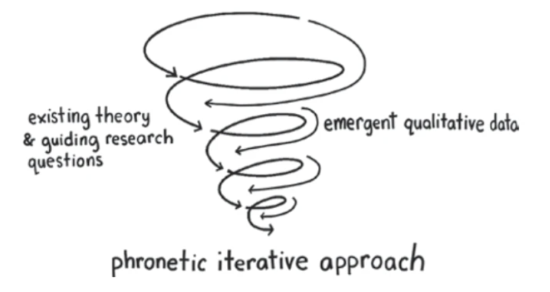
Phronetic research
concerned with contextual knowledge that is iteratively constructed, action oriented, and imbued with certain values
Prioritizes practice in context
Second order interpretations
researchers construct explanations for the participant’s explanations
Iterative approach
researcher alternates between considering existing theories, research interests, or predefined questions/goals on one hand, with emergent qualitative data on the other
Phenomenon & Field
the locus of study, is the issue or theme brought ot bear by research questions (ex. Burnout, code switching behaviour, socialization, terrorist activity, greeting behaviours)
→ Field of study - the collection of spaces, people, texts and places in which the phenomenon may be found and explored
→ Ex. a person interested in te phenomenon of “hazing” may be particularly attracted to studying groups that put new members through intense rites of passage- potential fields of study could then include military boot camps, frats/sororities, or the training of investment bankers
site
the specific geographical or architectural area (ex. A frat house)
settings
the specific parameters of the space (ex. The basement)
Participants
the focal people of the exercise
Scene
generally refer to the field, sites, settings, and groups of participants
Satisfice
it is common to come up with a single decision that is merely adequate rather than optimal
Deductive reasoning
researchers begin with broad or general theory, make an educated hypothesis about the social world based on this theory, conduct research to test the hypothesis, and use the evidence gathered from that research to confirm or disconfirm the theory
abduction
the back and forth process of constructing a hypothesis, carrying that hypothesis into field of investigation, and revising it when or if the hypothesis is negated by new discoveries
Sensitizing concepts
theories or interpretive deices that service as jumping off points of lenses for qualitative study. Serve as the background ideas that offer frameworks through which researchers see, organize, and experience the emerging data.
Gestalt
captures peoples tendency to piece together various parts into an integrated system or culture
Aspects of culture are best understood in relation to others!
Naturalistic inquiry
the process of analyzing social action in uncontrived field settings in which the inquirer does not impose predetermined theories or manipulate the setting
Thick description
practice of going beyond surface understandings to explore the contextual meanings of behaviours
Bricolage
using a variety of data (partial and mismatched) to construct meaningful, aesthetically pleasing, and useful research synthesis
Symbolic interactionism (SI)
peoples actions result from their interpretations of the situations that confront them in their everyday lives
People act and make meaning in the world based on how they define and interpret the situation and people around them
Symbols
words numbers or gestures that “stand for” smtg else
Signs
natural symptoms or indicators of immediate stimulus in the environment
Sapir-Whorf Hypothesis
we do not perceive or understand issues or concepts for which we do not have words
Ex. we did not have the word “texting” before 2000s
Looking-glass self
self that is created by others’ reactions to us and imaging how we look to others
Self-fulfilling prophecy
people tend to shape themselves after others’ expectations
Ex. confident people who expect to be treated with respect are often treated as such by others
Structure
to refer to the big D discourses of enduring schools of knowledge, societal norms, and myths
Structuration theory
directs he researcher’s attention to the relationship between individual action and institutional structure. Esp. the way cultures organizations and social systems are constituted or created through the micro practices of people
Duality of structure
the idea thet rules policies and structures are only valid when people follow them and make decisions based on them
Grand narratives
systems of stories driven by our formal expectations for things to unfold in a particular manner
Sensemaking
emphasizes meaning making, ambiguity, and identity. Well suited for qualitative and interpretive data analysis. People make sense of their environments retrospectively!
Ethnocentrism
the belief that one’s own racial and ethical values and ways of being are superior to those of others
Nuremberg code & human subject protections
Nuremberg code - uncovered and judged the atrocious and inhumane experimentation conducted by Nazi physicians on prisoners of war
Led to creation of human subject protections - measures required by the institutional review board (IRB) in many countries, includes principles such as voluntary and informed consent, freedom from coercion, comprehension of risks and benefits, and a scientifically valid research design
Etic
a perspective in which behaviour is described according to externally services, non culture specific criteria
Naturalistic inquiry
the analysis of social action in uncontrived field settings
Post qualitative methodologies
methodologies that are always becoming and do not have a fixed nature with strict boundaries
Quantified self
the practice of people wearing self monitoring sensors that measure, track and log aspects of their daily life
Theory
a bundled system of principles that service to explain certain phenomena
def of Research
is the systematic application of a family of methods that are employed to provide trustworthy information about problems
Methodology
a conceptual framework, philosophical approach, and driving purpose for research being conducted
What do we need to know? Who is involved? How will we get up the study in the context?
Method
tools used to systematically collect data and then analyze data according to the research design
Paradigm
why are you doing the study? What are the guiding influences that shape your inquiry?
Ethnography
studies cultures and cultural practices systemically
Describes a group or culture
Examines behaviour in response to particular social situations
Can examine a group’s beliefs or interpretations
Phenomenological thinker
“a qualitative investigator who studies people's lived experiences and how they make sense of them“
“They prioritize individual perceptions and conscious awareness over external, objective facts.”