Def & Fracture | Exam 2 Memory
 Call Kai
 Learn
Learn Practice Test
 Spaced Repetition
 Match
Match Flashcards
 Knowt Play
1/8

There's no tags or description
Looks like no tags are added yet.
Name | Mastery | Learn | Test | Matching | Spaced | Call with Kai | Chat |
|---|
No analytics yet
Send a link to your students to track their progress
9 Terms
Volume Defects
Precipitate: A precipitate is a small region of a different phase that forms within the main material when atoms SEPARATE out of a solid solution. Example: Small particles forming inside an aluminum alloy AFTER heat treatment. Why it is a volume defect: It occupies a three-dimensional region within the material. Key idea: A different phase forms inside the original material.

Void: An empty space or CAVITY (makes sense that it is a volume defect) inside a material where there is little or no solid material. Example: A cavity that develops inside a metal during MANUFACTURING OR DEFORMATION. Why it is a volume defect: It is an empty three-dimensional region. Key idea: A void is an internal empty space.

Pore: A pore is a small opening or cavity within a material. Example: Tiny holes remaining in a CERAMIC [oh think ceramic module!] after sintering. Why it is a volume defect: It occupies a three-dimensional region in the material.
Void vs. pore: The terms OVERLAP. In many materials-science contexts, a pore is a type of void; the distinction often depends on the material and context. Key idea: Pores are common in ceramics and powder-processed materials.
A coarse grained material shows better strength at room temperature compared to an equivalent smaller grained material.
COARSE grained. Think larger grain. Larger grain = lower yield strength by Hall-Petch.
Thus, statement is false. A finer grain or smaller grain will have a higher yield strength by Hall-Petch.
Energy of a Grain Boundary (High Angle)
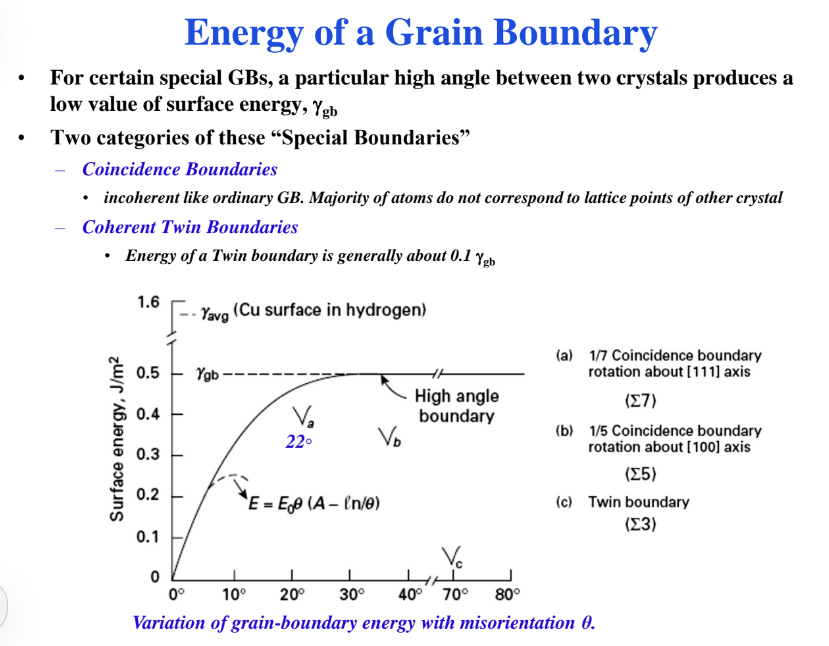
As the angle of mis-orientation (theta) increases for the high angle grain boundaries, at certain angles the lattice shows coincidence (some matching). Grain boundary energy for such special boundaries is lower than the general trend.
Yes! True. See previous slide.
Hall-Petch equation gives the relation between grain size and _________________
yield strength.
See left.

What is associated with a cry (crackling sound produced upon deformation) of tin?
twinning!!!
Memory: Tin Cries. Tin Twinning.
Cry = crackling sound produced upon deformation!!
Serrated Stress-Strain Curve Due to Twinning (HCP)

Serrated Stress-Strain Curve Due to Twinning (HCP) Cont.

The stress-strain curve of single crystal undergoing twinning shows ___________
sudden peaks
sudden drop in the stress
No irregularity
Jagged irregularities in elastic region
sudden drop in the stress
(HCP?) BECAUSE twinning occurs suddenly when the applied stress become sufficiently high; a twin can RAPIDLY form within the crystal. Twinning orients part of the crystal lattice into a NEW crystallographic orientation! THEN stress DROPS. THE RAPID propagation of a twin can accommodate STRAIN suddenly. This can cause a temporary reduction in the measured stress, producing a sharp drop in the curve. Then, stress builds up again. Deformation continues, and stress RISES (okayyyy) until ANOTHER TWIN forms or another deformation event occurs. Repetition produces the characteristic SERRATED pattern.
Chat: Why does twinning cause a sudden drop in stress? When a single crystal undergoes twinning, PART of its crystal lattice SUDDENLY rearranges into a mirror-image orientation of the original lattice!! 1.) Stress increases: You apply FORCE to the crystal, increasing the stress needed to deform it. [Just regular stuff I believe]. 2.) Twinning begins: Once the stress reaches a CRITICAL value, atoms RAPIDLY rearrange into a twin orientation. 3.) Sudden (?) deformation occurs: The crystal changes shape quickly, so the strain increases suddenly?? 4.)Stress drops: The rapid rearrangement can temporarily relieve the applied stress, producing a sudden drop on the stress–strain curve!!!! Why are the other answers incorrect? Sudden peaks: Peaks may occur in some curves, but they are not the characteristic answer expected here. No irregularity: Twinning can produce abrupt changes in deformation rather than a completely smooth curve. Jagged irregularities in elastic region: The elastic region is where deformation is primarily REVERSIBLE. Twinning is a PLASTIC deformation mechanism, so this is incorrect. Memory trick: Twinning = atoms suddenly rearrange → sudden strain BURST→ stress drop. LEFT FOR MORE ON STRAIN BURST. Quick recall: A strain burst is a rapid increase in DEFORMATION, NOT A sudden increase in stress. 3.) Sudden strain burst: The strain increases abruptly over a short time, and the stress may drop as the crystal rapidly deforms!!!
Text: BURSTING of TWINS (means a twin region forms and grows rapidly inside a crystal when the applied stress reaches a critical level!!) during STRAINING may lead to a SUDDEN DROP in stress in the S-S curve.
![<p> </p><p>sudden drop in the stress</p><p><br>(HCP?) BECAUSE twinning occurs suddenly when the applied stress become sufficiently high; a twin can RAPIDLY form within the crystal. Twinning orients part of the crystal lattice into a NEW crystallographic orientation! THEN stress DROPS. <strong>THE RAPID propagation of a twin can accommodate STRAIN suddenly. This can cause a temporary reduction in the measured stress, producing a sharp drop in the curve.</strong> Then, stress builds up again. Deformation continues, and stress RISES (okayyyy) until ANOTHER TWIN forms or another deformation event occurs. Repetition produces the characteristic SERRATED pattern. </p><p>Chat: Why does twinning cause a sudden drop in stress? When a single crystal undergoes twinning, PART of its crystal lattice SUDDENLY rearranges into a mirror-image orientation of the original lattice!! 1.) Stress increases: You apply FORCE to the crystal, increasing the stress needed to deform it. [Just regular stuff I believe]. 2.) Twinning begins: Once the stress reaches a CRITICAL value, atoms RAPIDLY rearrange into a twin orientation. 3.) Sudden (?) deformation occurs: <strong>The crystal changes shape quickly, so the strain increases suddenly</strong>?? 4.)Stress drops: The rapid rearrangement can<strong> temporarily relieve the applied stress, producing a sudden drop on the stress–strain curve!!!! </strong>Why are the other answers incorrect? Sudden peaks: Peaks may occur in some curves, but they are not the characteristic answer expected here. No irregularity: Twinning can produce abrupt changes in deformation rather than a completely smooth curve. Jagged irregularities in elastic region: The elastic region is where deformation is primarily REVERSIBLE.<strong> Twinning is a PLASTIC deformation mechanism</strong>, so this is incorrect. <strong>Memory trick: Twinning = atoms suddenly rearrange → sudden strain BURST→ stress drop. LEFT FOR MORE ON STRAIN BURST. </strong>Quick recall: A strain burst is a rapid increase in DEFORMATION, NOT A sudden increase in stress. <strong>3.) Sudden strain burst: The strain increases abruptly over a short time, and the stress may drop as the crystal rapidly deforms!!!</strong></p><p>Text: BURSTING of TWINS (means a twin region forms and grows rapidly inside a crystal when the applied stress reaches a critical level!!) during STRAINING may lead to a SUDDEN DROP in stress in the S-S curve. </p>](https://assets.knowt.com/user-attachments/cfaa8045-323b-4730-b164-687d2e275330.png)