3.1.3 lipids
 Call Kai
 Learn
 Practice Test
 Spaced Repetition
 Match
 Flashcards
 Knowt Play
1/19

There's no tags or description
Looks like no tags are added yet.
20 Terms
What are lipids vital for? (3)
Provide buoyancy
long term store of energy protect vital organs
hydrophobic so it can act as a waterproof layer for organisms
Two types of lipids
triglycerides and phospholipids
3 triglycerides properties
High bond energy due to high proportion of C - H bonds so lipids can store lots of energy
non-polar molecule does not attract hydrogen ions so insoluble so doesn't affect water potential during osmosis
high ratio of hydrogen: oxygen atoms so lipids can release water when oxidised so good for desert animals
Describe triglyceride structure
Formed by condensation reaction between 1 glycerol molecule and three fatty acid molecules

Formation of triglycerides
A condensation reaction between glycerol and 3 fatty acids (RCOOH), with the elimination of 3 molecules of water and the formation of 3 ester bonds.
Fatty acid structure
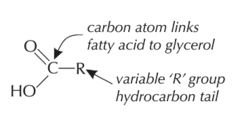
Definitions of saturated and unsaturated fatty acids. How do we know if a fatty acid is saturated or unsaturated?
Saturated fatty acids: fatty acids which only contain single bonds between carbon atoms
Unsaturated fatty acids: fatty acids which contain at least one double bond between carbon atoms
This depends on its hydrocarbon 'R' group
Which one is saturated with hydrogen atoms:
Unsaturated fatty acids
Saturated fatty acids
Saturated fatty acids Not unsaturated fatty acids
Structure of unsaturated fatty acid chain
The fatty acid chains are rigid. The chains have bends (kinks) in them (where the double bonds occur). This means that they can’t line up closely next to each other
Structure of saturated fatty acid chains
The fatty acid chains are flexible. The chains are straight, so they
can line up closely next to each other
Which is viscous & more dense-
Unsaturated fatty acids
Saturated fatty acids
Saturated fatty acids
Which has a higher m/boiling point (therefore more intermolecular forces)?
Unsaturated fatty acids
Saturated fatty acids
Saturated fatty acids
State of matter at room temp for:
Unsaturated fatty acids
Saturated fatty acids
Unsaturated fatty acids: liquid usually
Saturated fatty acids: solid usually

Phospholipid structure
A condensation reaction between glycerol and a fatty acid forms an ESTER BOND
SO 1 glycerol is attached to...
• 2 fatty acids
• 1 phosphate group

T OR F: triglycerides and phospholipids are both fully hydrophobic
False because phospholipids have hydrophilic head and hydrophobic tail
T or f: hydrophobic tail repels water and mixes with fats
T
What holds together the hydrophobic tails?
Van der Waals forces and hydrophobic interactions hold the phospholipid tails together
What do phospholipids form in water? (3)
bilayer in water
micelles in water
monolayer on surface

Describe how phospholipids can arrange themselves to form a cell membrane
The plasma membrane is a phospholipid bilayer, with hydrophilic phosphate
heads on the outside of the bilayer and hydrophobic fatty acid tails on the inside
of the bilayer.
• The hydrophilic phosphate heads attract water to either side of the bilayer /
point towards water.
• The hydrophobic fatty acid tails repel water / point away from water.
T OR F: lipid isn't a polymer
True because it does not consist of repeating units