Exam 3 Assemblages
 Call Kai
 Learn
 Practice Test
 Spaced Repetition
 Match
 Flashcards
 Knowt Play
1/88

There's no tags or description
Looks like no tags are added yet.
89 Terms
Too much carbon makes steel ____ ___ ____.
hard but brittle
Too little carbon makes steel ___ __ ____.
soft and weak
The optimal carbon content for steel is <___%
0.03
Steel structural shapes are formed at a ____ __ ____ ____ where they are ___ ____ by passing through a series of rollers to get to the correct shape.
structural or steel mill, hot rolled
What are the 6 common steel shapes?
1) ________ ________
2) ____ ____
3) ______
4) ________ ___
5) _____
6) ______
american standard, wide flange, channel, structural tee, angle, bars
(How to read a designation) What is the depth of a W12×26?
12
(How to read a designation) What is the designation of a W12×26?
wide flange
(How to read a designation) What is the weight per foot of a W12×26?
26lbs
Open-web steel joists are ____ _____ _____ _____ formed through a combination of ___ ____ and ____ _____ welded together.
mass produced steel trusses, steel angles, steel bars
What are the three main ways of joining steel members?
rivets, bolts, welding
How do you know high strength bolts are tightened correctly?
1) ____ ___ ___ ____ method
2) ____ _____ bolts
3) ___ ______ _____ or ___ ____ indicators
turn of the nut, tension control, load indicator washers, direct tension
The edges of steel members are _____ so the welding electrode has full access so the joint can be welded proprerly.
beveled
A _____ connection bolts only the web, transmits only shear forces, and cannot transmit bending moment.
framed
A _____ connection welds the flanges across the joint with a full penetration groove.
moment
You can stabilize a steel frame against lateral loads by:
1) _____ bracing
2) _____ bracing
3) ____ _____
4) ______ connections
diagonal, eccentric, shear panels, moment
A ____ ____ is used to attach a steel column to a foundation using ___ ____ cast into the foundation.
base plate, anchor bolts
You plumb-up a steel frame building via ____ ______ and ______ ______.
temporary cables, connection tightening
Column splicing is made at ___ ___ above the floor for convenience and to _____ ___ _____ ____ _____
waist level, avoid beam-column connection conflicts
What materials can be used to fireproof steel members?
1) _______ and ______
2) ______
3) ______
4) _____--___ ______
5) ______ _____ _____
6) ______ ______ & _____
concrete and masonry, plaster, drywall, spray-on fireproofing, mineral fiber slabs, intumescent mastics & paints
What are the three main types of improved beams?
1) ______ beam
2) ____ _____ ____
3) _____ ______
castellated, rigid steel frame, plate girders
A ___ _____ is a membrane that is supported by masts or other rigid structural elements such as frames or arches. The fabric and cables transmit external loads to the rigid supports and ground anchors by means of (blank) forces.
tensile structure
The three main types of tensile structures are: _____, ______, and ___-_____.
tensile, pneumatic, air-supported
Light gauge steel framing members are produced through ___-____ which is _____ thin sheets of steel.
cold-forming, bending
The two basic shapes for light-gauge steel framing are ____-_____ _____ and _____ ______ ____ for the top and bottom track of the wall.
c-shaped studs, runner channel sections
Light gauge steel shapes are specified by:
1) ____
2) ____
3) _____
4) _____
shape, size, gauge, length
Why is the gauge of steel so important?
1) _____ gauges are ______
2) _______ & ______ depend on configuration, depth and gauge
thicker, structural, strength stiffness
Lightly loaded welded wire fabric is used in _____, _____ ____, and ______ applications.
residential, light commercial, sidewalk
Heavily loaded welded wire fabric is used for ______ in _____ and _____ settings.
reinforcement, warehouse, factory
Welded wire fabric is used to prevent cracking from ______, _______ stress, ______ _____, ______ _____, and ____ ______.
shrinkage, temperature, concentrated loads, frost heaving, ground settlement
Control joints are _____ for slabs on grade. They must be…
1) provided at ____ ____
2) ______ and _____
3) reinforcing mesh must be ______ around each joint
important, various intervals, straight, intentional, discontinued
____ ____ are small diameter metal rods that hold formwork together.
form ties
The four main components of formwork are: ______ ____, a ___ ____, ___ ____, and _____.
form material, support system, form ties, bracing
What are the materials that can be used for formwork?
1) ____
2) _____ & _______
3) _____ ______
4) ______ _____ _____
wood, metal, fiberglass, panelized systems, insulated concrete forms
Do you understand how sitecast concrete columns are formed?
yes
Reinforcing bars are offset at the top of columns to _____ ___ _______ for the column in the next story.
overlap the reinforcing
What are the three types of elevated one-way floor and roof framing systems?
1) one-way ____ ___
2) one-way _____ ____ ____
3) ____-_____ ____ ____ _____
solid slab, concrete joist system, wide-module concrete joist system
What is special about elevated two-way floor and roof framing systems?
1) more __________
2) can be accomplished with a ____ ____, _____, _____, etc.
3) can hold ____ _____
economical, flat slab, joist, beams, higher loads
What are the various types of elevated two-way floor and roof framing systems?
1) two-way ___ ____
2) two-way ___ ____
3) two-way ___ ____
4) two-way ____ ____
solid slab, flat slab, flat plate, waffle slab
What are the innovations in sitecast concrete?
1) lightwight ____ and ______
2) _____ ______
3) ___-___
4) _____ ______
5) ____ forms
6) ____ forms
7) ____-___
8) _______
concrete, admixures, formwork materials, lift-slab, flying formwork, gang, slip, tilt-up, shotcrete
(PRECAST) Solid flat slabs are typically associated with ___ spans and _____ slab depths. They have more ____ ____.
short, minimal, dead weight
(PRECAST) Hollow core slabs are typically associated with ___ spans and are ____ used.
intermediate, commonly
(PRECAST Double tee slabs are typically associated with ___ spans and are _____ used.
longer, commonly
(PRECAST) Single tee slabs are typically associated with ___ spans and have ____ ____ during construction.
longer, stability issues
Topping slabs become a working part of the precast slabs’ ____ _____ and are usually ____ thick.
structural action, 2"
What are the four main precast concrete beam and girder shapes?
1) _______
2) __-_____
3) ______ ___
4) _______
rectangular, l-shaped, inverted tee, aashto
Stirrups are typically left ______ from the top of precast concrete beams and are then cast into the concrete topping to create ____ ______ ____.
projecting, composite structural action
The ____ ______ on L-shaped beams and inverted tees provide ____ _____ for precast slab elements which ____ _____ in a building by supporting slabs near the bottom of the beams, as compared to rectangular beams without ledgers.
projecting ledgers, direct support, conserves headroom
What is used to connect precast elements? _____, _____, ______, ______, ____ ____.
bolting, welding, grouting, posttensioning, direct bearing

What are the dashed lines in this picture?
rebar cages
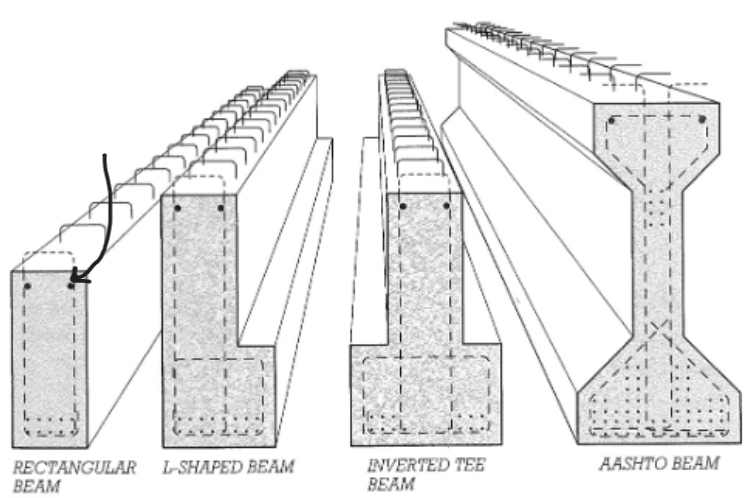
What are the thicker black dots in this picture?
rebar

What are the small black dots in this picture?
steel cables

What is the blue beam shape?
rectangular

What is the green beam shape?
L-shaped
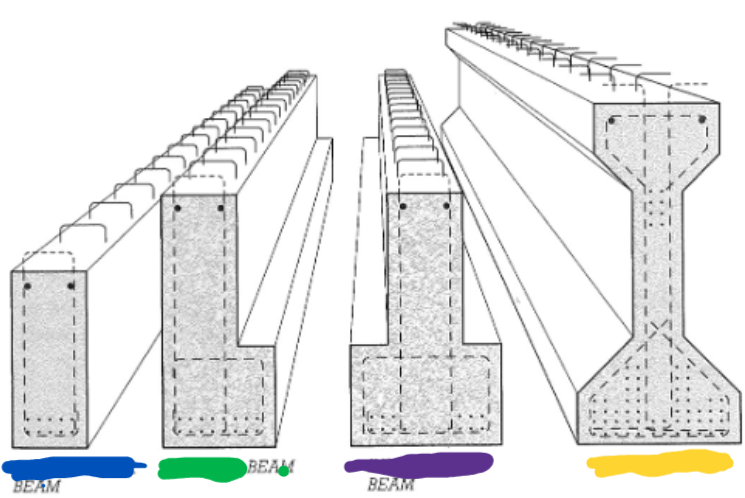
What is the purple beam shape?
inverted tee

What is the yellow beam shape?
aashto

What are the small black dots in this picture? (Could be either of two things)
rebar, welded wire fabric
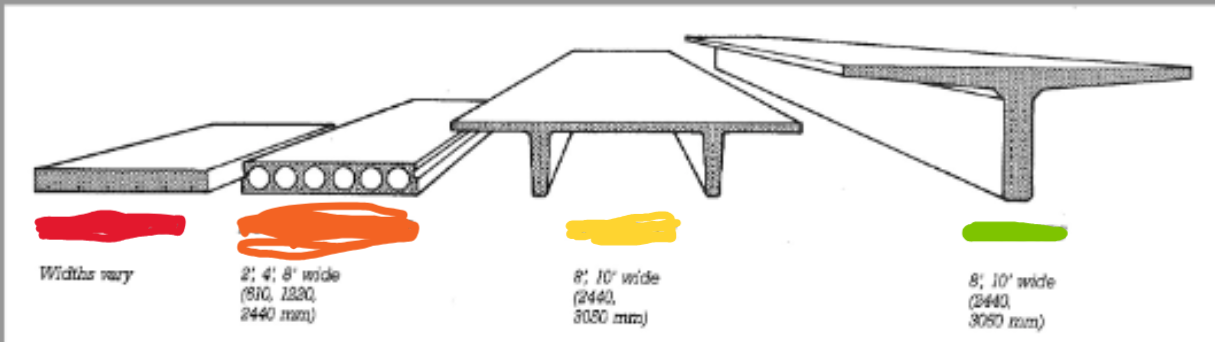
What is the red slab type?
solid slab

What is the orange slab type?
hollow core

What is the yellow slab type?
double tee

What is the green slab type?
single tee

What does the red tag indicate?
concrete

What does the orange tag indicate?
welded wire fabric

What does the yellow tag indicate?
vapor retarder

What does the green tag indicate?
crushed stone drainage layer

What does the blue tag indicate?
formwork

What does the purple tag indicate?
bracing

The orange tag shows that the welded wire fabric overlaps at the ends to improve ____ _______.
structural continuity
The benefits of masonry cavity walls are their ______ ______, _______ ______, and ______.
insulating value, reduced weight, drainage
Adjustable masonry ties are _____ for the masons because they allow for irregularities in course heights.
convenient
Adjustable masonry ties may be _____ _____ for some structural purposes.
insufficiently rigid
______ flashing is a continuous sheet of flashing material that is made up of copper, plastic, or rubber/bituminous. Its attached to the backup wall and run through the outside of the masonry.
concealed
Internal flashing ____ water, allows it to _____, and are accompanied by ______.
collects, drain, weeps
Internal flashing is placed at the _______ of the wall cavity and at _____ in said cavity. (like doors, windows, shelf angles, etc.)
bottom, interruptions
_______ flashing prevents moisture penetration and can be located on the tops of walls and roof edges.
exterior
When internal flashing meets the exterior surface of a masonry wall: the flashing should be carried at least _______ beyond the outside face of the wall.
3/4”
When internal flashing meets the exterior surface of a masonry wall: the flashing should be turned ______ at a _____ degree angle so that drainage water drips free of the wall.
downward, 45
When FLEXIBLE internal flashing meets the exterior surface of a masonry wall: it should be ______ to a sheet of ____ flashing just before it exits the wall.
cemented, metal
End dams keep ____ from running off the ends of the _____ and ______.
water, sills, lintel
High quality flashing materials are important on masonry walls because they":
1) are almost _______ __ _____
2) are quite ______ in comparison to the rest of the wall, so spending the money is worth it.
impossible to replace, cheap
High quality flashings are made out of:
1) _____
2) _____ _____
3) _______
4) _______
copper, stainless steel, plastics, composites
What spanning systems can be supported on masonry bearing walls?
1) ____ _____ framing
2) ____ _____ framing
3) ______ _____ framing
4) _____ ______ framing
5) _____ ______ framing
light wood, heavy timber, structural steel, sitecast concrete, precast concrete
__ ______ masonry units shrink after installation because they give off ____ ____.
new concrete, excess water
______ ____ masonry units expand because they tend to ______ ____.
new clay, absorb water
_______ masonry has ____ tensile strength.
brick, no
______ reinforcing needs to be ______ throughout _____ joints like an expansion joint/control joint so it does not _____ the movement of the joint.
joint, interrupted, movement, constrain
_______ indicates that water has begun to enter the masonry wall. It is best controlled by investigating and correcting the source of the leakage.
efflorescence
_____ can’t freeze until cured.
mortar
Mortar can be mixed with _______ to speed up curing time.
admixtures
Using ___ ____ ____ cement can also accelerate the curing time of mortar.
high early strength