205 final exam
 Call Kai
 Learn
 Practice Test
 Spaced Repetition
 Match
 Flashcards
 Knowt Play
1/85

There's no tags or description
Looks like no tags are added yet.
86 Terms
functions of blood
Transport:
nutrients from digestive tract
oxygen from lungs to body
carbon dioxide from body to lungs
waste products from body to kidneys
hormones
Assist:
in regulating body temp
in maintaining body pH
w/ preventing blood loss
w/ body’s defense mechanisms
amount of plasma in domestic animals
55% (70% for exotics)
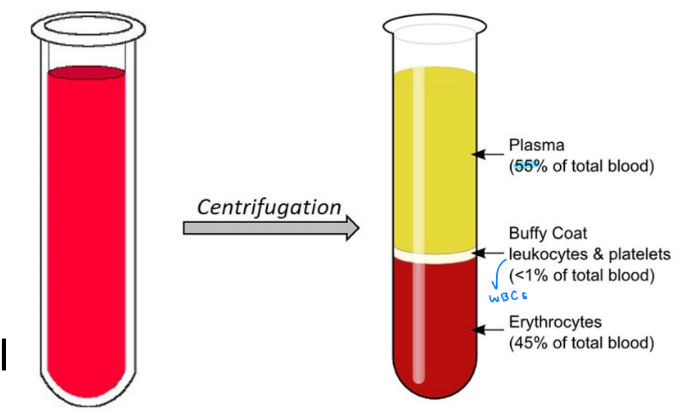
What is in blood (when it is no longer whole blood)?
~92% water
55% - Plasma
and
Formed elements:
1% - buffy coat (WBCs & platelets)
45% - RBCs
what is plasma made of?
92% water
ions (Na & Cl)
organic molecules (AA, proteins, glucose, lipids, nitrogenous waste)
trace elements & vitamins
gases (CO2 & O2) (bound to hemoglobin on RBCs)
It is the internal environment for all cells
Collected w/ anticoagulant

Proteins in plasma:
albumins
globulins
fibrinogens
transferrin
Proteins in plasma: albumins
Most abundant protein in blood, made by liver
contributors to plasma osmotic pressure
carrier for some substances
Proteins in plasma: globulins
clotting factors, enzymes, antibodies
carriers for some substances
Gamma globulins most important bc they are antibodies (not all globulins are antibodies, only gamma)
Proteins in plasma: Fibrinogen
most abundant & bulky clotting factor
forms fibrin threads (essential to blood clotting)
in plasma, not serum
Proteins in plasma: transferrin
iron transport
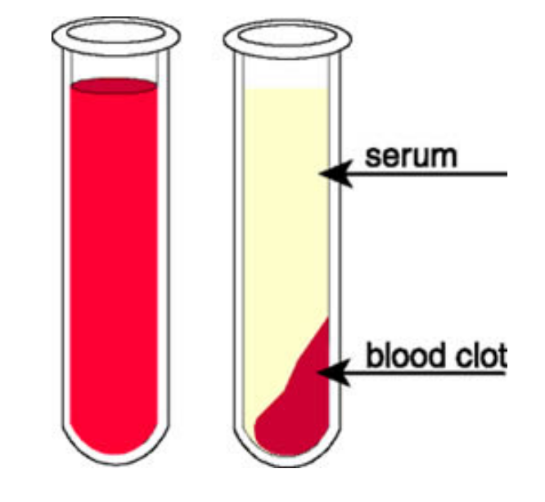
serum
plasma w/out clotting factors (ie. fibrinogen)
bulky proteins must be removed from sample, so blood is collected w/out anticoagulants (clotting factors will be used in clot formation, so only serum remains)
What must be in the tube to prevent collected blood from clotting?
anticoagulant
Needed to collect plasma
formed elements (cells) of blood
leukocytes
erythrocytes
platelets

Erythrocytes (RBCs) anatomy & role
biconcave discs; mature RBCs (those in circulation) hv no nucleus
structure allows for more surface area for gas exchange
120-140 day lifespan
Full of protein called hemoglobin (globin is protein)
gas carrying protein
Leukocytes: granulocytes (what they do & wright’s stain)
eosinophils: makes toxic compounds against pathogens (& worm parasites)
stains red/pink w/ eosin
Basophils: release histamine (inflammation) & heparin (prevents clots)
stains blue w/ methylene blue
AKA mast cells
Neutrophils: phagocytes (ingests)
1st to arrive to bacterial infections
form pus (dead neutrophils & liquified tissue)
stains purple-ish (indifferent to either stain, takes on both)
structure of hemoglobin
α & β chains make up globin
CO2 attaches to globin
hemes lie on the globin
iron contatining molecule
oxygen attaches to heme (on the iron in the middle)
each hemoglobin molecule has 4 hemes & 2 strands of α & β

Leukocytes (WBCs)
Granulocytes (hv cytoplasmic granules, stain)
neutrophils
eosinophils
basophils
Agranulocytes (no cytoplasmic granules, no stain)
lymphocytes
monocytes
Leukocytes: agranulocytes (& what they do)
Lymphocytes (adaptive immunity)
T (thymus): cell has integral proteins called CD, helps us differentiate:
T-helper (“politely” shows a piece of pathogen to trigger a immune response) vs
T- cytotoxic uses of intergral proteins to release killer vesicles into invasive cell
B (bursa): receptor is Y shaped; future antibodies are clipped off Y-shaped molecules (memory cells) (as animal ages, there can be less, so some vaccines need boosters)
NK
Monocytes: phagocytic; leaves blood to become macrophage
Platelets
AKA thrombocytes
cell fragments essential to clotting
Normal physiological states of hemoglobin
Oxyhemoglobin: O2 is bound to heme
Carbaminohemoglobin: CO2 bound to globulin
Pathologic states of hemoglobin
Methemoglobin
Carboxyhemoglobin
Methemoglobin
ex: if ruminants graze a freshly fertilized pasture, nitrates/nitrites are consumed & absorbed into the blood; it acts on the “red dots” on heme (iron in ferris form) & nitrates/nitrites reduce & convert it into ferric form, losing their ability to carry O2 (animal basically suffocates)
In summary: methemoglobin is a hemoglobin that has a recued state of iron, which is ferric state, that is incapable of binding to oxygen
Carboxyhemoglobin
carbonmonoxide (CO) poisoning
CO irreversibly binds to globin chains bc it as 210X greater affinity to globin than CO2
Animal needs a transfusion to be saved
what happens to old RBCs?
they flag themselves to be broken down by flipping the inside of the lipid bilayer membrane to the outside
sphingolipids only on the inside are exposed outside
Spleen has splenic macrophages that will “eat” it
Lysosomes will chop up the cell membrane of the RBC (loaded with hemoglobin)
Enzymes start breaking down the hemoglobin protein
globin is broken into amino acids, which will be reutilized
As for heme, first the iron is taken out and transferred by a protein called transferrin to be stored in liver, spleen, and bones (primary location!)