Clinical Syndrome of Basal Ganglia and their Drug Treatment
 Call Kai
 Learn
Learn Practice Test
 Spaced Repetition
 Match
Match Flashcards
 Knowt Play
1/36

There's no tags or description
Looks like no tags are added yet.
Name | Mastery | Learn | Test | Matching | Spaced | Call with Kai | Chat |
|---|
No analytics yet
Send a link to your students to track their progress
37 Terms
How do we move?

Brain Movement Program - Recap
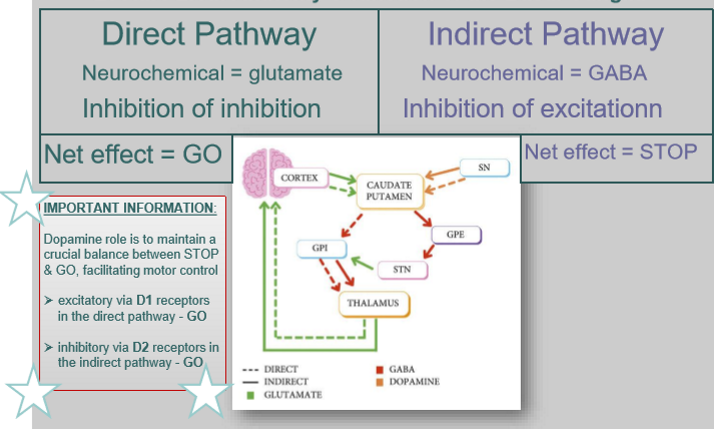
How do we describe MOVEMENT?

Language related to Pathophysiology in the Basal Ganglia - PHENOTYPICAL DESCRIPTION

Language related to Pathophysiology in the Basal Ganglia - AETIOLOGICAL DESCRIPTION

Hypokinetic Movement Disorders: PARKINSONISM

Hypokinetic Movement Disorders: Parkinsonian Symptoms

Hypokinetic Movement Disorders: Parkinsonian Signs

Hypokinetic Movement Disorders: Aetiology

How does DOPAMINE cause Parkinson’s Disease?

Hypokinetic Movement Disorders: Treatment

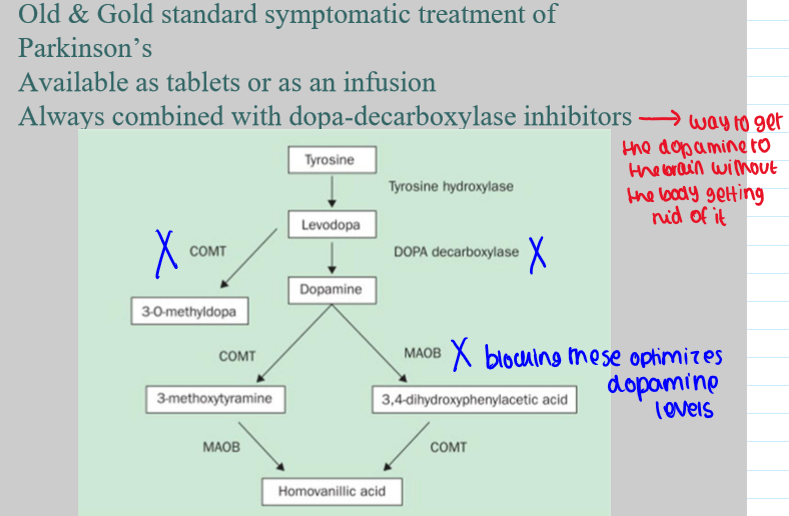
Hypokinetic Movement Disorders: Treatment - LEVODOPA and LEVODOPA ADJUNCTS

Hypokinetic Movement Disorders: Treatment - DOPAMINE AGONISTS
Different formulations: tablets, patches, infusions
Pros: long acting or quick acting, effective, also treat Restless Leg Syndrome
Cons: Risk of impulse control disorders / behaviors
Hypokinetic Movement Disorders: Treatment - MAOB INHIBITION

Hypokinetic Movement Disorders: Treatment - COMT INHIBITION

Hypokinetic Movement Disorders: Treatment - NON-TABLET INHIBITORS
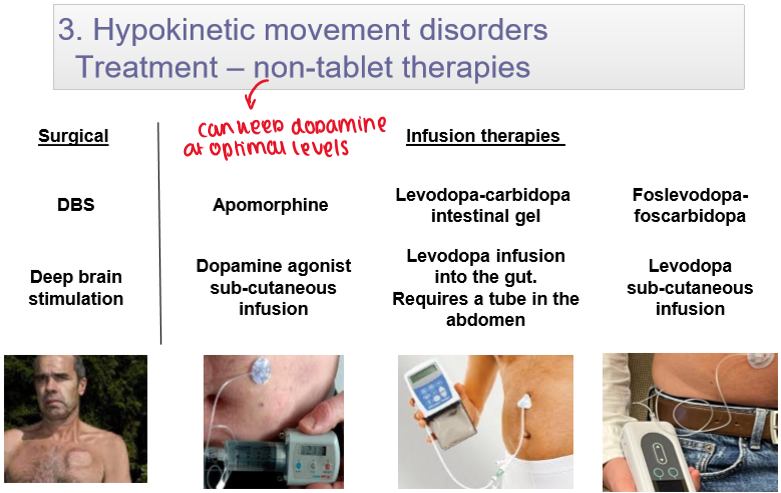
Hypokinetic Movement Disorders: Treatment - DEEP BRAIN STIMULATION

Hyperkinetic Movement Disorders - TREMOR

Hyperkinetic Movement Disorders - TREMOR PATHOPHYSIOLOGY

Hyperkinetic Movement Disorders - TREMOR TREATMENT

Hyperkinetic Movement Disorders - CHOREA
1) Involuntary, continuous flow of brief, non-rhythmical and unpredictable movements, which appear to move in a stream from one body part to another.
2) Can be described as “dance-like” due to the fluidity and variability in direction, amplitude and timing.
3) Patient appears fidgety, restless, when asked will struggle to suppress the movements.
Hyperkinetic Movement Disorders - CHOREA CAUSES

Hyperkinetic Movement Disorders - CHOREA - HUNTINGTON’S DISEASE

Hyperkinetic Movement Disorders - CHOREA - HUNTINGTON’S DISEASE PRESENTATION
1) Cognitive: impaired decision making, slowed thinking
2) Behavioral: Irritability, depression, apathy, anxiety, delusions
3) Physical: Chorea, motor persistence, eye movement abnormalities
Hyperkinetic Movement Disorders - TREATMENTS
Hyperkinetic Movement Disorders - DYSTONIA
1) Abnormal twisting posture:
axial/ facial/ truncal / global
may be associated with jerky tremor
Due to Overactivity of Muscles
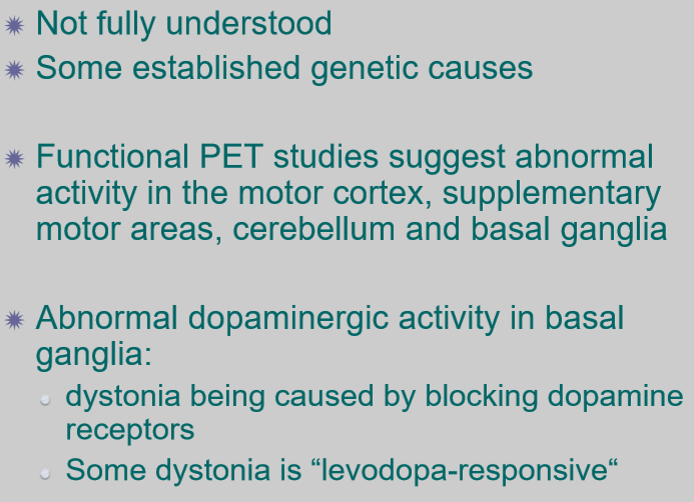
Hyperkinetic Movement Disorders - DYSTONIA PATHOPHYSIOLOGY
Hyperkinetic Movement Disorders - DYSTONIA CAUSES
✹Stroke
✹Brain injury
✹Parkinsons disease
✹Huntington’s disease
✹Wilson’s disease
✹Genetic
✹Iidiopathic
Hyperkinetic Movement Disorders - DYSTONIA TREATMENT

Hyperkinetic Movement Disorders - TICS

Hyperkinetic Movement Disorders - TICS AND CO-OCCURENCES

Hyperkinetic Movement Disorders - TICS TREATMENTS
1) Main stay of treatment in through neuro-behavioural approaches, such as CBT
2) Some people with Tics access pharmacological treatments through specialist clinics, such as clonidine
3) Deep brain stimulation is undertaken in some parts of the world, but is not licenced for tics in the UK
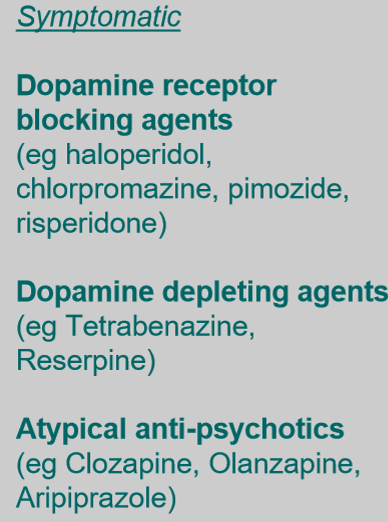
Hyperkinetic Movement Disorders - DRUGS CAUSING MOVEMENT DISORDERS

What is OCULOGYRIC CRISIS?
Characteristic acute response to certain drugs
1) Fixed stare, upward deviation of eyes
2) Neck extension
3) Trunk extension
4) Jaw spasms +/- tongue protrusion
5) ‘Acute dystonic’ reaction
What is NEUROLEPTIC MALIGNANT SYNDROME?

What is TARDIVE DYSKINESIA?
1) Chorea-like oral-facial movements
Dystonic trunk posturing
2) Exact mechanism unclear – likely dopamine sensitvity of basal ganglia –ie secondary receptor/ plastic changes
What are the TREATMENTS for Tardive Dyskinesia?
1) Gradual withdrawal of offending agent
2) Use of a dopamine depleting agent (tetrabenazine)
3) Use of a benzodiazepine (clonazepam) if distressing