2 Code of Ethics & Core Values
 Call Kai
 Learn
 Practice Test
 Spaced Repetition
 Match
 Flashcards
 Knowt Play
1/25

There's no tags or description
Looks like no tags are added yet.
26 Terms
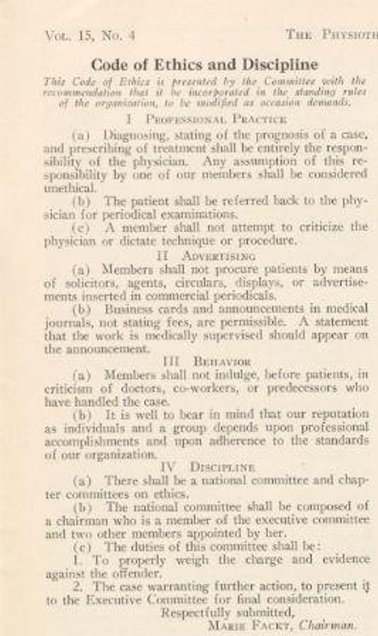
First Code of Ethics in 1935
Focused on the preeminence of the physician’s _______ and ________
Prohibited _______
The code has been amended 9 times
Guide for _______ conduct was added
Standards for Ethical Conducts of PTA’s
prescription and diagnosis
advertising
professional
The Code of Ethics
Revised to be in agreement with the relevant elements of Vision 2020.
Reflect the _______ of physical therapy as a doctoring profession.
Integrate the ______ ______of the profession
Address all the ______of the physical therapist
Reflect the consensus views of all stakeholders
practice
Core Values
roles
The Code of Ethics for the Physical Therapist (Code of Ethics) delineates the ______ _______ of all physical therapists as determined by the House of Delegates of the American Physical Therapy Association (APTA).
ethical obligations
What are the purposes of this Code of Ethics?
Define the ethical principles that form the foundation of physical therapist practice in patient/client management, consultation, education, research, and administration.
Provide standards of behavior and performance that form the basis of professional accountability to the public.
Provide guidance for physical therapists facing ethical challenges, regardless of their professional roles and responsibilities.
Educate physical therapists, students, other health care professionals, regulators, and the public regarding the core values, ethical principles, and standards that guide the professional conduct of the physical therapist.
Establish the standards by which the American Physical Therapy Association can determine if a physical therapist has engaged in unethical conduct
No code of ethics is _______ nor can it address every situation. Physical therapists are encouraged to seek _______ advice or consultation in instances where the guidance of the Code of Ethics may not be definitive
exhaustive; additional
This Code of Ethics is built upon the five roles of the physical therapist (management of patients/clients, consultation, education, research, and administration), the ______ values of the profession, and the multiple realms of ethical action (________, ________, ________)
core; individual, organizational, and societal
What are the realms of ethical action? *KNOW THIS
individual, organizational, and societal
What are the five roles of the physical therapist that the Code of Ethics is built upon?
management of patients/clients, consultation, education, research, and administration
Physical therapist practice is guided by what set of seven core values?
accountability, altruism, compassion/caring, excellence, integrity, professional duty, and social responsibility.
Throughout the document the primary core values that support specific principles are indicated in parentheses
Unless a specific role is indicated in the principle, the duties and obligations being delineated pertain to the _____ roles of the physical therapist. Fundamental to the Code of Ethics is the special obligation of physical therapists to _______, _______, and _______ those with impairments, activity limitations, participation restrictions, and disabilities to facilitate greater independence, health, wellness, and enhanced quality of life..
five; empower, educate, and enable
What is the Summary of Principle/ Standards? *KNOW THIS
Duty to all individuals
Duty to patients/ clients
Accountability for sound judgments.
Integrity in relationships
Fulfilling legal and professional obligations
Lifelong acquisition of knowledge, skills, and abilities
Organizational behaviors and business practices
Meeting health needs of people
What is this core value?
active acceptance of the responsibility for the diverse roles, obligations, and actions of the physical therapist including self regulation and other behaviors that positively influence patient/client outcomes, the profession and the health needs of society
Accountability
What is this core value?
primary regard for or devotion to the interest of patients/clients, thus assuming the fiduciary responsibility of placing the needs of the patient/client ahead of the physical therapist’s self interest
Altruism
What is this core value?
_______ is the desire to identify with or sense something of another’s experience; a precursor of caring
_______ is the concern, empathy, and consideration for the needs and values of others
Compassion
Caring
What is this core value?
physical therapy practice that consistently uses current knowledge and theory while understanding personal limits, integrates judgment and the patient/client perspective, embraces advancement, challenges mediocrity, and works toward development of new knowledge
Excellence
What is this core value?
steadfast adherence to high ethical principles or professional standards; truthfulness, fairness, doing what you say you will do, and “speaking forth” about why you do what you do.
Integrity
What is this core value?
the commitment to meeting one’s obligations to provide effective physical therapy services to patients/clients, to serve the profession, and to positively influence the health of society
Professional Duty
What is this core value?
promotion of a mutual trust between the profession and the larger public that necessitates responding to societal needs for health and wellness.
Social Responsibility
What is the Principle 1?
Physical therapists shall respect the inherent dignity and rights of all individuals.
A. Physical therapists shall act in a respectful manner toward each person regardless of age, gender, race, nationality, religion, ethnicity, social or economic status, sexual orientation, health condition, or disability.
B. Physical therapists shall recognize their personal biases and shall not discriminate against others in physical therapist practice, consultation, education, research, and administration
What is Principle 2?
Physical therapists shall be trustworthy and compassionate in addressing the rights and needs of patients/clients
A. Physical therapists shall adhere to the core values of the profession and shall act in the best interests of patients/clients over the interests of the physical therapist.
B. Physical therapists shall provide physical therapy services with compassionate and caring behaviors that incorporate the individual and cultural differences of patients/clients.
C. Physical therapists shall provide the information necessary to allow patients or their surrogates to make informed decisions about physical therapy care or participation in clinical research.
D. Physical therapists shall collaborate with patients/clients to empower them in decisions about their health care.
E. Physical therapists shall protect confidential patient/client information and may disclose confidential information to appropriate authorities only when allowed or as required by law.
What is Principle 3?
Physical therapists shall be accountable for making sound professional judgments.
A. Physical therapists shall demonstrate independent and objective professional judgment in the patient’s/client’s best interest in all practice settings
B. Physical therapists shall demonstrate professional judgment informed by professional standards, evidence (including current literature and established best practice), practitioner experience, and patient/client values.
C. Physical therapists shall make judgments within their scope of practice and level of expertise and shall communicate with, collaborate with, or refer to peers or other health care professionals when necessary.
D. Physical therapists shall not engage in conflicts of interest that interfere with professional judgment.
E. Physical therapists shall provide appropriate direction of and communication with physical therapist assistants and support personnel.
What is Principle 4?
Physical therapists shall demonstrate integrity in their relationships with patients/clients, families, colleagues, students, research participants, other health care providers, employers, payers, and the public.
A. Physical therapists shall provide truthful, accurate, and relevant information and shall not make misleading representations.
B. Physical therapists shall not exploit persons over whom they have supervisory, evaluative or other authority (eg, patients/clients, students, supervisees, research participants, or employees).
C. Physical therapists shall discourage misconduct by health care professionals and report illegal or unethical acts to the relevant authority, when appropriate.
D. Physical therapists shall report suspected cases of abuse involving children or vulnerable adults to the appropriate authority, subject to law.
E. Physical therapists shall not engage in any sexual relationship with any of their patients/clients, supervisees, or students.
F. Physical therapists shall not harass anyone verbally, physically, emotionally, or sexually.
What is Principle 5?
Physical therapists shall fulfill their legal and professional obligations.
A. Physical therapists shall comply with applicable local, state, and federal laws and regulations.
B. Physical therapists shall have primary responsibility for supervision of physical therapist assistants and support personnel.
C. Physical therapists involved in research shall abide by accepted standards governing protection of research participants.
D. Physical therapists shall encourage colleagues with physical, psychological, or substance related impairments that may adversely impact their professional responsibilities to seek assistance or counsel.
E. Physical therapists who have knowledge that a colleague is unable to perform their professional responsibilities with reasonable skill and safety shall report this information to the appropriate authority.
F. Physical therapists shall provide notice and information about alternatives for obtaining care in the event the physical therapist terminates the provider relationship while the patient/client continues to need physical therapy services.
What is Principle 6?
Physical therapists shall enhance their expertise through the lifelong acquisition and refinement of knowledge, skills, abilities, and professional behaviors.
A. Physical therapists shall achieve and maintain professional competence.
B. Physical therapists shall take responsibility for their professional development based on critical self assessment and reflection on changes in physical therapist practice, education, health care delivery, and technology.
C. Physical therapists shall evaluate the strength of evidence and applicability of content presented during professional development activities before integrating the content or techniques into practice.
D. Physical therapists shall cultivate practice environments that support professional development, lifelong learning, and excellence.
What is Principle 7?
Physical therapists shall promote organizational behaviors and business practices that benefit patients/clients and society.
A. Physical therapists shall promote practice environments that support autonomous and accountable professional judgments.
B. Physical therapists shall seek remuneration as is deserved and reasonable for physical therapist services.
C. Physical therapists shall not accept gifts or other considerations that influence or give an appearance of influencing their professional judgment.
D. Physical therapists shall fully disclose any financial interest they have in products or services that they recommend to patients/clients.
E. Physical therapists shall be aware of charges and shall ensure that documentation and coding for physical therapy services accurately reflect the nature and extent of the services provided.
F. Physical therapists shall refrain from employment arrangements, or other arrangements, that prevent physical therapists from fulfilling professional obligations to patients/ clients.
What is Principle 8?
Physical therapists shall participate in efforts to meet the health needs of people locally, nationally, or globally.
A. Physical therapists shall provide pro bono physical therapy services or support organizations that meet the health needs of people who are economically disadvantaged, uninsured, and underinsured.
B. Physical therapists shall advocate to reduce health disparities and health care inequities, improve access to health care services, and address the health, wellness, and preventive health care needs of people.
C. Physical therapists shall be responsible stewards of health care resources and shall avoid overutilization or underutilization of physical therapy services.
D. Physical therapists shall educate members of the public about the benefits of physical therapy and the unique role of the physical therapist.