Anatomy Ch 11
 Call Kai
 Learn
 Practice Test
 Spaced Repetition
 Match
 Flashcards
 Knowt Play
1/21

There's no tags or description
Looks like no tags are added yet.
22 Terms
Functions of the Nervous System
Maintaining homeostasis
Regulate and coordinate activities to maintain balance
Receiving sensory input →Monitor internal and external stimuli
Integrating information → Brain and spinal cord process sensory input and initiate responses
Controlling muscles and glands
Establishing and maintaining mental activity →Consciousness, thinking, memory, and emotion
Efferent
Motor
Transmits action potentials AWAY from CNS to muscles and glands
Afferent
Sensory
Transmits action potentials TOWARD CNS
Central Nervous System
Brain and spinal cord
Peripheral Nervous System
Nerves, ganglia, and receptors
Transmits information to and from central nervous system
Brain
Interprets and stores information and sends orders to muscles, glands, and organs
A part of CNS
Spinal Cord
Pathway connecting the brain and peripheral nervous system
A part of CNS
Autonomic Nervous System
Automatically regulates glands, internal organs, blood vessels, pupil dilation, digestion, and blood pressure
A part of PNS
Somatic Nervous System
Carries sensory information and controls movement of the skeletal muscles
A part of PNS
Parasympathetic Division
Maintains body functions under ordinary conditions; saves energy
Regulates
A part of autonomic nervous system
Sympathetic Division
Prepares the body to react and expend energy in times of stress
Readiness
A part of autonomic nervous system
Structural Classification of Neurons
Based on number of dendrites
Multipolar Neuron
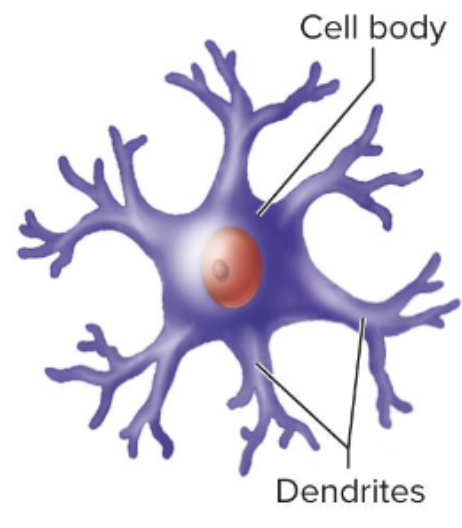
Has many dendrites and one axon
Most neurons in CNS; motor neurons

Bipolar Neuron
One dendrite and one axon
Sensory in retina of the eye and nasal cavity

Pseudo-unipolar Neuron
Appears to have one axon and no dendrites
Single process that divides into two branches
Part that extends to the periphery has dendrite-like sensory receptors

Anaxonic Neuron
Multiple dendrites and no axon
Found in brain and retina where they only communicate using graded
potentials
Myelinated Axons
Myelin protects and insulates axons from one another, speeds transmission, functions in repair of axons
Not continuous; gaps called nodes of Ranvier
White matter
Degeneration of myelin sheaths occurs in multiple sclerosis and some cases of diabetes mellitus
Unmyelinated Axons
Rest in invaginations of Schwann cells or oligodendrocytes
Not wrapped around the axon; gray matter
Interneurons
Within CNS from one neuron to another
Propagation of Action Potentials
Action potential starts at the trigger zone when threshold is reached
Continuous Conduction
Action potential moves one-way along unmyelinated axons
Saltatory Conduction
In myelinated axons, impulses jump between nodes for faster transmission