Sexual Reproduction Lecture 3
 Call Kai
 Learn
 Practice Test
 Spaced Repetition
 Match
 Flashcards
 Knowt Play
1/24

Earn XP
Description and Tags
Sexuality Research
25 Terms
Sexology
The Study of Sexuality (Understand and predict sexual behavior)
Sexologists
One who studies human sexuality
How do sexologists study human sexuality; what methods of research?
Study a sample of people in a population. Types of samples?
Random sample : randomly chosen subset of a population
Representative sample: limited sample that provides
an accurate representation of the larger target
population
• Has similar characteristics as population
• Various subgroups represented proportionately to
their incidents in target population
Convenience sample: selected based on convenience and accessibility i.e. students in a class
What sort of sample sizes are better
Larger
Types of samples in a population
Convenient
Random
Representative
Random sample : randomly chosen subset of a
population
• Representative sample: limited sample that provides
an accurate representation of the larger target
population
• Has similar characteristics as population
• Various subgroups represented proportionately to
their incidents in target population
• Convenience sample: selected based on convenience
and accessibility i.e. students in a class
Possible problems/biases; define
Volunteer bias —> tendency for representatives to be more experiences then other; Ex. More sexually active/positive about sex
Demographics —> Tendency for people in a population to be overrepresented or underrepresented; typival when convenience sampling
How do scientists conduct research on sexuality?
Non-experimental Research
Qualitative studies
Survey Studies
Direct observation studies
Experimental Research
Define all the research methods

Nonexperimental Research Methods: Qualitative Studies (Define)
typically involves small groups of people and asking open ended questions
participants share their knowledge and beliefs
Data gathering typically involves interviews/focus groups
Nothing is manipulated or controlled in a qualitative study
Qualitative Studies Advantages vs Disadvantages
Advantages: flexibility in data gathering procedures + in depth exploration
Disadvantages: Hard to generalize results; influenced by emotions, values and memories; typically only used for sexuality studies
A specialized type of qualitative study; define
Case Studies

Nonexperimental Research Methods: Surveys
Advantages:
Interviews —> provide richer data (flexibility, clarity, more understanding)
Questionnaires —> (Anonymous, may improve honesty, cheaper)
Disadvantages (both)
Non-response, Inaccurate information due to self-reporting, Demographic bias
Methods of surveys

Most Famous Survey Study?
Kinsey Reports

Major Findings of Kinsey Reports
American men and women masturbated, had premarital sex, same sex interactions, adultery, oral, anal and more
Sexual behavior is influenced by educational level
Heterosexuality and homosexuality are often not an all-or-none proposition and occurs a long a continuum.
Kinsey Report Sampling
A broad spectrum of Americans
a) rural + urban
b) various ages, occupations, reigions
BUT only white Americans were sampled
Other issues with the sample: composed of educated urban Protestants and volunteers
Newer Survey: (NHSLS)
Conclusion:
Americans not increasingly “sex crazy”, as feared
Most people content with their erotic lives, less sexually active and more sexually conservative than believed

Newer Survey: 2009 National Survey of Sexual Health and Behavior
Oral and anal sex more widely practiced\Internet has influenced knowledge, norms and behaviors
Attitudes about same-sex relationships have changed and same-sex marriages are legal in some states
Development of vaccine to prevent cancers associated with STI HPV
Marketing of Viagra and medications to treat ED
These and other developments have changed the outlook on sexuality

Non-experimental Research Methods: Direct Observation
observe and record the responses of the subjects (use small samples)
Advantages
No falsification
Records kept indefinitely
Disadvantages
Behavior is influenced by others
Common for psychology and sociology; harder for sexology (Master and Johnson example)
Direct Observation Study on Sexuality?
Masters and Johnson

What are the devices for measuring sexual arousal
Penile Plethysmograph
Vaginal Photoplethysmograph
Additional Technologies
Vaginal and Rectal Myographs
measure muscular activity in pelvic area
Functional MRI (fMRI):
Magnetic resonance imaging (MRI) is an imaging tool that creates detailed, cross-sectional pictures of the inside of the body using radio frequency waves, powerful magnets and a computer
View and map sexual processes in the brain and throughout the body

Experimental method
These experiments used to investigate cause and effect relationships

Experimental methods: Types of variables
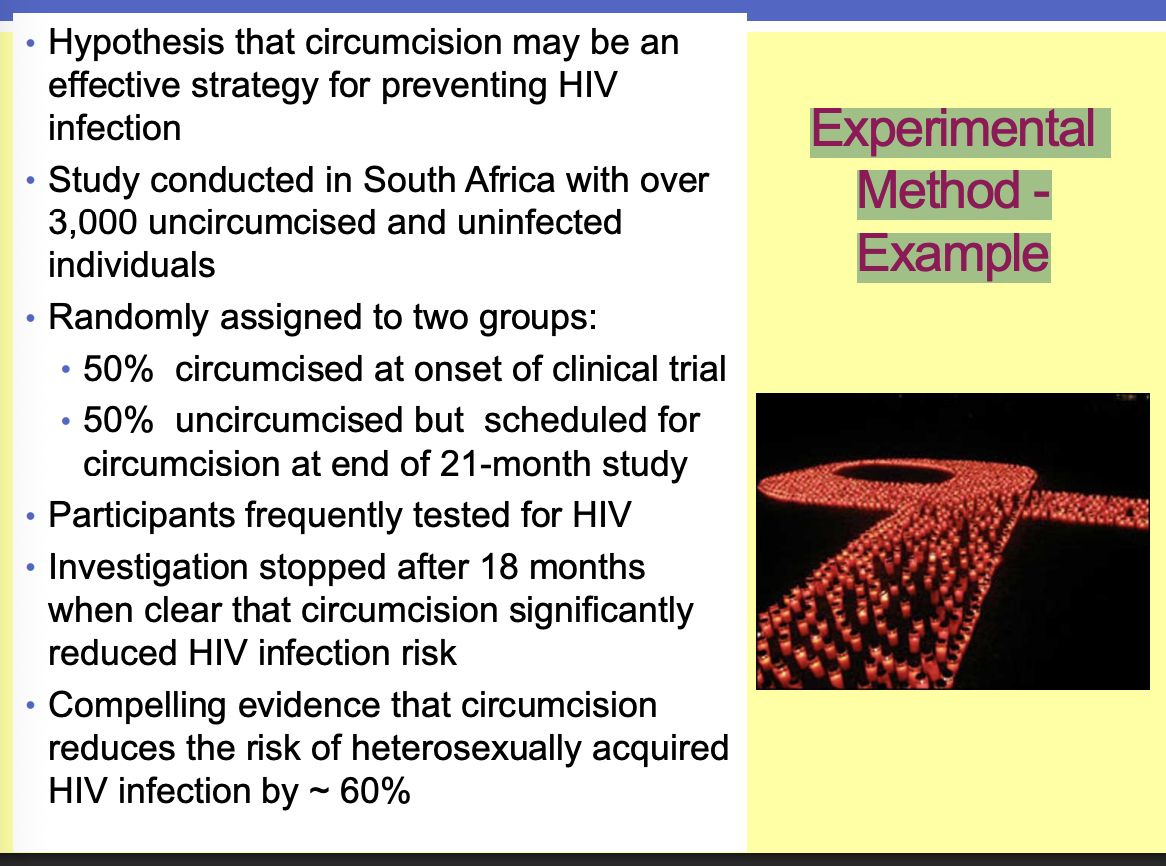
Hypothesis: Circumcision may be an effective strategy for preventing HIV infection.
Study Design: Over 3,000 uncircumcised and uninfected individuals were randomly assigned to two groups: 50% were circumcised at the onset of the trial, and 50% remained uncircumcised as a control group (scheduled for circumcision at the end of the study).
Independent Variable: Circumcision status (whether they received the circumcision treatment or not).
Dependent Variable: Whether or not participants contracted HIV (measured by frequent HIV testing).
Results: The study was stopped after 18 months because it became clear that circumcision significantly reduced the risk of heterosexually acquired HIV infection by about 60%.

Experimental Method - Example
Ethical Guidelines for Researchers
• Subjects must give their informed consent
