Glomerular Filteration
 Call Kai
 Learn
Learn Practice Test
 Spaced Repetition
 Match
Match Flashcards
 Knowt Play
1/20

There's no tags or description
Looks like no tags are added yet.
Name | Mastery | Learn | Test | Matching | Spaced | Call with Kai | Chat |
|---|
No analytics yet
Send a link to your students to track their progress
21 Terms
Basic kidney anatomy diagram

What are the nephrons?
Hollow tubes - closed at the proximal end, open at the distal end
Functional uni of the kidneys
~1.25 million nephrons per kidney and 3-4mm long

What are the segments of the nephron in order?
Renal corpuscle (glomerulus + Bowman's capsule) → proximal convoluted tubule (PCT) → loop of Henle (descending limb → thin ascending limb → thick ascending limb) → distal convoluted tubule (DCT) → collecting duct

What happens during glomerular filtration?
Blood enters glomerulus and sits inside the Bowman’s capsule
Plasma filters out of capillaries into Bowman’s space
Blood cells and proteins don’t pass into the Bowman’s space but almost everything else does

What substances are normally filtered at the glomerulus?
Water
Na+ and other ions
Glucose
Amino acids
Urea
Creatinine
Other small molecules
What determines whether a substance can pass through the glomerular filtration barrier?
Molecular size
Smaller molecules pass more easily
Large molecules are restricted
Molecular charge
The filtration barrier is negatively charge → negatively charged proteins are restricted
Shape
The shape of a molecule can affect its ability to pass through the filtration barrier
Therefore, small neutral molecules are filtered most easily, whereas large negatively charged proteins are strongly restricted
What are the three layers of the glomerular filtration barrier?
Fenestrated glomerular endothelium
Contains pores (fenestrations)
Allows water and small solutes through due to high hydrostatic pressure
Prevents blood cells from passing
Glomerular basement membrane
Acts as an important physical and charge-selective barrier
Restricts large molecules and negatively charge proteins as the BM has negatively charged proteoglycans on it
Podocytes
Specialised cells surrounding the glomerular capillaries
Have extentsions called foot processes
Gaps between foot processes form filtration slits covered by slit diaphragms

Why are most plasma proteins not filtered?
Most plasma proteins, particularly albumin, are restricted because they:
Are relatively large
Are negatively charged
Are repelled by the negatively charged components of the filtration barrier
Significant protein in the urine (proteinuria) may indicate damage to the glomerular filtration barrier
Why does filtration occur in the glomerulus?
The high hydrostatic pressure due to the wide afferent arteriole and narrower efferent arteriole favour net filtration of plasma into the nephron

What forces govern glomerular filtration?
Starling forces
There are 4 main pressures:
Forces favouring filtration
Glomerular capillary hydrostatic pressure
Forces opposing filtration
Bowman/s capsule hydrostatic pressure
Glomerular capillary oncotic pressure
Bowman’s space oncotic pressure normally has little effect because there’s very little protein the the filtrate

Starling’s forces - pressures on fluid in renal corpuscle (table)

Net filtration favours outward fluid movement (calculation)

What is glomerular capillary hydrostatic pressure?
The pressure of blood within the glomerular capillaries
It promotes filtration by pushing fluid out of the capillaries and into Bowman's capsule
Relatively high because the glomerulus lies between:
Afferent arteriole → glomerular capillaries → efferent arteriole
The resistance provided by these arterioles helps maintain high pressure in the glomerulus
What is Bowman's capsule hydrostatic pressure?
The pressure exerted by fluid within Bowman's capsule - it opposes glomerular filtration
If pressure within Bowman's capsule increases, there is less pressure driving fluid from the glomerular capillaries into Bowman's space
For example, urinary tract obstruction can increase Bowman's capsule pressure and reduce GFR
What is glomerular capillary oncotic pressure?
Caused by plasma proteins within the blood
Proteins attract water and therefore tend to pull water back into the glomerular capillaries
Therefore, glomerular capillary oncotic pressure opposes filtration
As filtration occurs, proteins become more concentrated in the remaining plasma, causing oncotic pressure to increase along the glomerular capillary
What is Bowman's space oncotic pressure?
Promotes filtration by pulling water into Bowman's space
However, it is normally approximately zero because there is very little protein in Bowman's space
Therefore, it normally has little effect on GFR
Major causes of proteinuria
Protein in the urine due to disruption of the filtration barrier
Diabetes mellitus - excessive plasma glucose damages filter
Hypertension - high glomerular hydrostatic pressure damages filter
Glomerulonephritis - inflammatory damage due to immunological attack
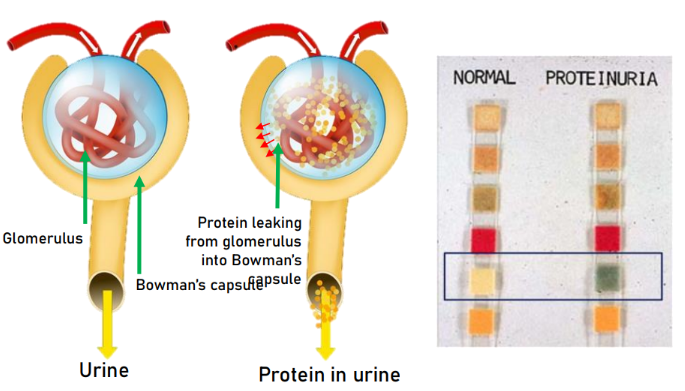
Effects of normal and decreased plasma protein levels on fluid movement across capillaries (diagram)

Excessive proteinuria causes a low level of protein in the plasma which can lead to odema (picture)

Glomerular Filtration Rate
Volume of fluid filtered from the renal glomerular capillaries into the Bowman’s capsule during a certain period of time
Best overall index of renal function
125mL/min or 180 L/day
It’s essential that GFR is maintained
Why is glomerular filtration rate clinically important?
GFR provides an indication of kidney filtration function
A reduced GFR can indicate impaired kidney function
GFR is therefore commonly used to:
Assess renal function
Detect and monitor chronic kidney disease
Help determine the severity of kidney impairment
Guide dosing of some medicines that are eliminated by the kidneys