BIO EXAM3
 Call Kai
 Learn
 Practice Test
 Spaced Repetition
 Match
 Flashcards
 Knowt Play
1/80

There's no tags or description
Looks like no tags are added yet.
81 Terms
all organisms are primarily composed of what 6 elements?
CHONPS
Carbon
Hydrogen
Oxygen
Nitrogen
Phosphorous
Sulfur
significance of CHONPS (provide examples)
building blocks of biological macromolecules
lipids: CHOP
carbohydrates: CHO
DNA, RNA: CHONP
proteins: CHONS
unlike energy, matter is _ and how
recycled
limited amount of CHONPS
each element cycles in/out of living systems differently
primary reservoir
where the element usually is when not part of an organism
PR for CHONPS
atmosphere and water
PR for C: CO2 in atmosphere
PR for N: N2 in atmosphere
PR for O: H2O molecules
PR for H: H2O molecules
sediment
PR for P & S: soil and ocean beds
cycling pattern of CHONPS
elements cycle between reservoirs and organisms
→ reservoir of element → incorporation → organisms → return →
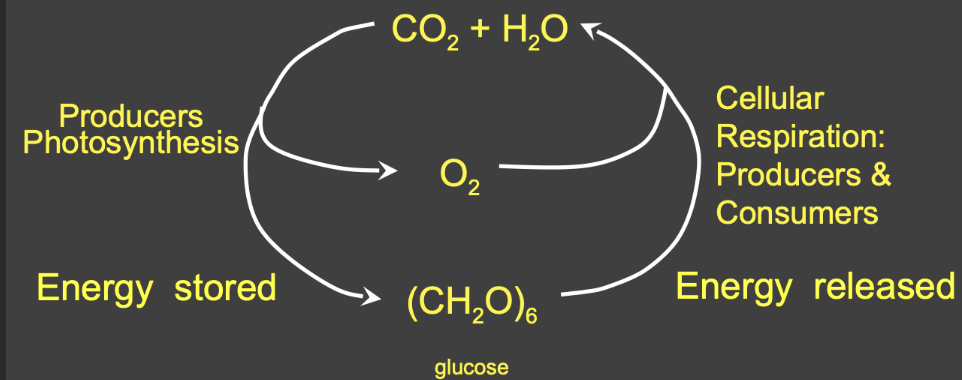
why is CHO cycling important
connects photosynthesis & cell res
critical components for all biological macromolecules
nitrogen
needed for proteins and nucleic acids
no shortage (atmosphere 80% N2)
problem: atmospheric N2 unusable for most organisms (very stable & unreactive)
nitrogen fixation
how nitrogen enters ecosystems from reservoir in atmosphere
nitrogen-fixing bacteria convert unusable inert N2 → reactive usable ammonia & nitrate
NFB live in soil & on roots of some plants

nitrogen recycling
Plants incorporate NH3 & NO3 into macromolecules
N containing MMs are taken up by consumers → taken up by decomposers
decomposers in soil convert nitrogen in MMs back into NH3 & NO3 (soil)

nitrogen sources
N recycling provides 95% of N needed for living things, N fixation provides 5%
N returned to air as N2 via denitrification (also done by bacteria)
nitrogen fixation in agriculture
global crop production supported by N-containing fertilizers (made by industrial nitrogen fixation)
industrial scale production of N w/ fertilizers has doubled natural rate of N-fixation
1-2% of world’s energy supply used to fix N for use in fertilizers
phosphorus is important for
nucleotides (ex. ATP)
nucleic acid polymers (RNA/DNA)
phospholipids (plasma membranes)
phosphorus cycle
plants & other organisms incorporate P from sediment
consumers eat plants, decomposers eat each other
plants/consumers die & decomposers return P to sediment
plants incorporate it again & cycle restarts
sulfur important for
certain amino acids (proteins)
critical for protein folding
sulfur cycle
plants & other organisms incorporate S from sediment
consumers eat plants, decomposers eat each other
plants/consumers die & decomposers return S to sediment
plants incorporate it again & cycle restarts
reduction/oxidation (redox) rxns
when molecules gain/lose e-
OIL RIG
Oxidation is Loss (of e-)
Reduction Is Gain (of e-)
how are redox rxns coupled
as molecules gain e-, they are Reduced
so other molecules must lose e- and be Oxidized
how do e- pass between molecules
ordered sequence (one molecule to another) in ETC
electron carriers in ETC
molecules that make up ETC
ECs accept e- (become reduced) and donate e- (become oxidized)
e- bind to redox center of ECs
redox potential of ECs in ETC and what are ECs/ETCs critical for
different ECs have different affinities for e-
first EC in ETC has lowest RP, each following EC has increasingly more RP, last EC has highest
ECs & ETCs critical to photosynthesis & cell res
photosynthesis and what is its efficiency of transfer (what does this mean)
sunlight + carbon dioxide + water → glucose (sugar) + oxygen
light energy powers glucose production (energy transferred)
efficiency of transfer 30%: 30% of photon energy stored as chemical energy in glucose
site of photosynthesis
chloroplasts
thylakoid membranes have pigments (chlorophylls) that capture light energy
stroma is where glucose is made
two parts to photosynthesis
light rxns (light-dependent): occur at thylakoid membrane
dark rxns (light-independent, (Calvin Cycle, Calvin-Benson Cycle): occur in stroma
light reactions requires/inputs and produces/outputs
inputs
light (energy source)
water (e- source)
ADP + Pi (ATP synthesis)
NADP+ as e- carrier (oxidized form)
outputs
ATP (used in ATP hydrolysis to release G)
NADPH (e- carrier, reduced form)
O2 (byproduct)
dark reactions requires/inputs and produces/outputs
inputs
CO2 (carbon source)
ATP (from light rxns, energy source)
NADPH (from light rxns, e- source)
outputs
glucose (energy storage molecule)
ADP + Pi (from ATP hydrolysis)
NADP+ (FROM NADPH oxidation)
osmosis
diffusion of water molecules
across selective (semi-permeable) barrier
high → low concentration
what is meant by a selective (semi-permeable) barrier
allows water molecules to pass through, but not most of molecules dissolved in water (ex. plasma membrane)
solutes
molecules dissolved in water
concentration of water is determined by
concentration of solutes in water
adding solutes lowers water concentration
solute potential (Ψs)
measure of how much solutes have lowered water’s tendency to move (free energy)
pure water has no solutes: Ψs = 0 (highest value)
relationship between solute concentration and Ψs / water concentration
as solute concentration increases, Ψs and water concentration decrease
where does water diffuse from and when does it stop
diffuses from areas of higher Ψs to areas of lower Ψs
until equal on both sides
plasma membranes and relationship with cells
selective semi-permeable barriers
cells depend on regulated diffusion of water molecules across PM to stay alive
why is osmosis critical to cell survival (isotonic, hypotonic, hypertonic)
if Ψs inside/outside cell is equal (isotonic)
water enters/exits cell in equal amounts
if Ψs higher outside cell than inside (hypotonic)
water diffuses into cell, cell will swell and can burst
if Ψs higher inside cell than outside (hypertonic)
water diffuses out of cell, cell will shrink and can dehydrate → die
brain capillaries, BECs and tight intercellular junctions
fine blood vessels that feed brain tissue
Brain Capillary Endothelial Cells: form a tube
tight intercellular junctions: physical connections between BECs
blood-brain-barrier (BBB)
molecules can’t pass BETWEEN BECs through intercellular junctions
must pass THROUGH PM of BECs
clinical significance of BBB
BBB prevents most medicines from entering into brain
can cause issues when doctors need to introduce medicines into brain
how do doctors breach the BBB
inject solute into blood (H2O conc. now lower in blood than inside BECs)
water diffuses out of BECs into blood
capillary walls shrink slightly / create space between cells
medicine can now pass between BECs into brain
role of mannitol in breaching BBB
lowers Ψs of blood
→ H2O diffuses out of capillary wall cells
energy
capacity to do work
kinetic energy
energy of motion
thermal, light, mechanical, e.t.c.
potential energy
stored energy
concentration gradients, chemical energy, e.t.c.
thermodynamics
branch of chemistry that deals with energy transformations (changes)
first law of thermodynamics
conservation law
energy cannot be created / destroyed
can only change from one form of energy to another
total amount of energy in universe remains constant
second law of thermodynamics
no energy transfer is 100% efficient
some energy always lost (usually as heat) & becomes unusable
entropy (measure of unusable energy) in universe constantly increasing
free energy (usable energy) in universe constantly decreasing
free energy equation
G = H - (TS)
G = energy available to do work
H = enthalpy (total amount of energy contained in molecule or system)
TS = amount of unusable energy in molecule or system
T = absolute temperature
S = entropy
change in free energy after chemical reactions
reactants → products
chemical reactions begin w/ reactants & end w/ products
reactants and products have certain amount of free energy
products will either have more / less free energy than reactants
exergonic reaction
-ΔG (products have less free energy than reactants)
free energy released can be used to do work
can be spontaneous (rxn has potential to go forward without extra energy input)
endergonic reaction
+ΔG (products have more free energy than reactants)
energy absorbed (input of energy needed)
NEVER spontaneous (rxn will not go forward without extra energy input)
endergonic graph

exergonic graph

reaction coupling in cells
exergonic & endergonic rxns coupled together in cells
free energy released by exergonic used to drive endergonic forwards
ATP is energy currency of cell
ATP hydrolysis is exergonic (releases free energy from ATP)
drives many endergonic in cells forwards
for what do plants use oxygen
cellular respiration
breaks down glucose to release energy in form of ATP for cellular activities
auto/heterotrophs & their carbon sources
authotrophs (self-feeding):
inorganic molecules (no C-H bonds, ex. CO2)
heterotrophs (feeding on others)
organic molecules (C-H bonds, ex. biological molecules)
organisms w/ corresponding carbon / energy sources (4)
light energy
inorganic molecules: photoautotrophs (plants & some prokaryotes)
organic molecules: photoheterotrophs (some prokaryotes)
chemical energy (from molecules)
inorganic: chemoautotrophs (some prokaryotes)
organic: chemoheterotrophs (all animals & fungi, many other eukaryotes & prokaryotes)
what do all organisms have in common
found within ecosystems: interactive systems with living and nonliving components
abiotic: light, temp, H2O, pressure
biotic: producers, consumers, decomposers
flow of energy
sun light energy → energy flow → producers → consumers → decomposers
producers → decomposers also
inefficient energy transfer from the sun
sun radiates a lot
only small amount reaches earth
some reflected back into space
very little absorbed by producers
trophic levels
‘trophic’: food / nourishment
trophic level: describes where an organism is in food chain/web (energy flow)
energy flow through ecosystem begins w/ producers
producers / plants occupy 1st trophic level
consumers occupy rest of trophic levels
energy flow through trophic levels
sun
1st trophic level (producers)
2nd: primary consumers (ex. herbivores)
3rd: secondary (primary carnivores)
4th: tertiary (secondary carnivores)
ALL flow back to decomposers: no trophic level (ex. prokaryotes, fungi)
inefficiency of energy transfer
efficiency of energy transfer between trophic levels: 10% (90% energy loss)
how is energy lost through transfer
energy lost through feces (inefficient energy absorption during digestion)
also can’t be extracted (energy in teeth, hair, claws, feathers)
used to stay alive (metabolizing, moving)
calories produced during energy transfer
inefficient energy transfer (limits # TL that can be supported)
1st TL: 1000 cal by photosynthesis
2nd: 100
3rd: 10
4th: 1
ATP structure
core: ribose and adenine
two phosphoanhydride bonds
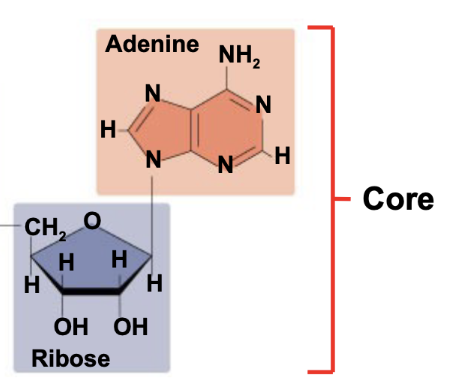
AMP
Adenosine MonoPhosphate
lowest G state

through _ of ATP to ADP, energy is _
hydrolysis; released
exergonic ATP hydrolysis
-∆G(energy released) and can be used to power endergonic rxn

ATP hydrolysis is _ and how
exergonic
ATP + H2O → ADP + Pi
(-∆G = -7.3 kcal/mol, drives endergonic)
glutamine synthesis is _ and how
endergonic
glutamate + NH3 → glutamine
(∆G = +3.4 kcal/mol)
how are ATP hydrolysis and glutamine synthesis coupled
reactants: glutamate + NH3 + ATP + H2O
products: glutamine + ADP + Pi (inorganic phosphate)
∆G = (-7.3) + (3.4) = - 3.9 kcal/mol → net exergonic
ATP cycle
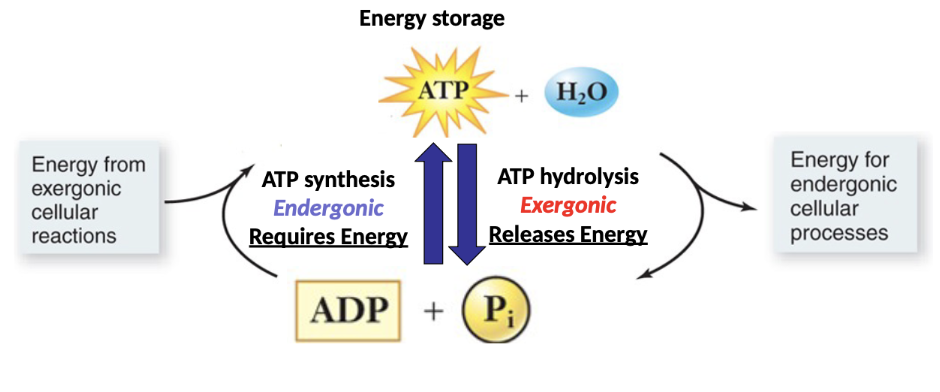
average cell has how many ATP molecules, and how often are they recycled
1 billion; every 90 sec
kinetics of rxn
rate at which rxn occurs
thermodynamics (TDs) of rxn
whether free energy released or absorbed
says NOTHING abt rates of rxns
rate of rxn affected by, and what is it
activation energy: amount of G needed to start chem rxn

rxns with high AE have _ rate of rxn, and rxns with low AE have _ rate of rxn
slow; fast
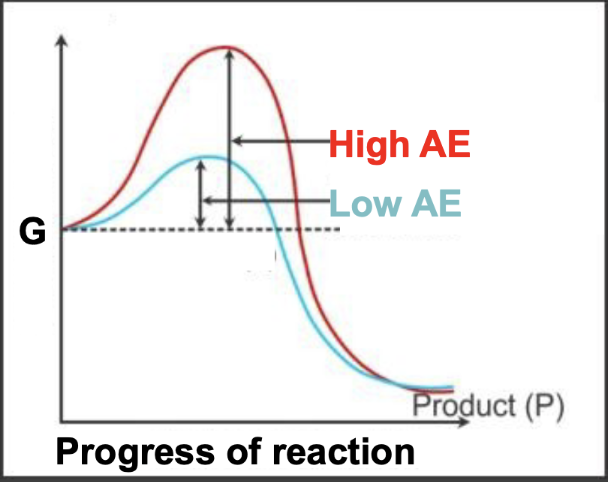
two components of AE
collision energy of reactants
orientation of reactants during collisions
what do catalysts do
lower activation energy and increase rate of reactions
enzymes
biological catalysts that can
hold reactants in favorable orientations
stress chemical bonds of reactants
what do enzymes do to AE of a rxn
lower it so rxn occurs at faster rate
