bio 2. cell life cycle/PMAT/cytokensis
 Call Kai
 Learn
Learn Practice Test
 Spaced Repetition
 Match
Match Flashcards
 Knowt Play
1/65

There's no tags or description
Looks like no tags are added yet.
Name | Mastery | Learn | Test | Matching | Spaced | Call with Kai | Chat |
|---|
No analytics yet
Send a link to your students to track their progress
66 Terms
What are the two major parts of the cell cycle?
Interphase and M phase.
What phases make up interphase?
G₀ → G₁ → S → G₂.
What happens during cytokinesis?
The cytoplasm divides, producing daughter cells
What is interphase?
The period when the cell performs normal functions, grows, copies DNA, and prepares for division
What are the four parts of interphase?
G₀, G₁, S, and G₂
G₀ phase
The cell is not actively progressing through the cell cycle.
It performs its normal specialized functions.
Some cells can remain in G₀ for long periods.
Example:
Many mature neurons remain in G₀.
G₀ = resting/non-dividing state

What is an easy way to remember G₀?
resting/non-dividing state.
G₁ phase
G₁ phase
The cell:
GrowsPerforms normal cellular activities , Produces proteins
Produces organelles
Prepares for DNA replication
Remember:
G₁ = growth
What does the cell produce during G₁
Proteins and organelles.
What does G₁ prepare the cell for?
DNA replication.
S phase
S = DNA synthesis/replication
The cell replicates its DNA.
By the end of S phase:
➡ Each chromosome has been copied.
Each duplicated chromosome consists of two sister chromatids joined together.

What happens to each chromosome during S phase?
Each chromosome is copied.
What does a duplicated chromosome consist of?
Two sister chromatids joined together.
Why does DNA replication occur before mitosis?
must happen before mitosis so each daughter cell receives the necessary genetic information.
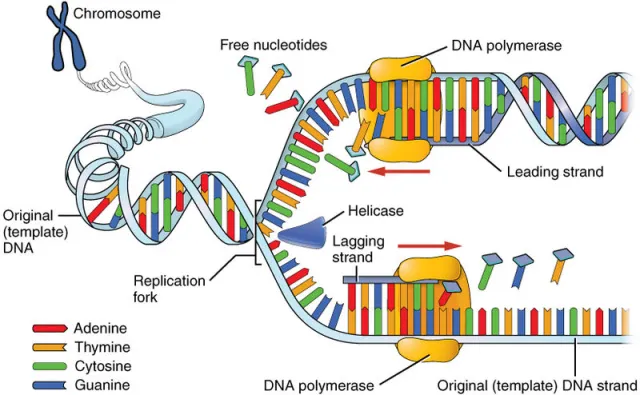
Process of DNA replication.
Purpose: make an accurate copy of the cell’s DNA before division.
DNA replication must happen before mitosis so each daughter cell receives the necessary genetic information.
Basic process:
The DNA double helix unwinds/unzips.
The two DNA strands separate.
Each original strand serves as a template.
New complementary nucleotides are added.
Two DNA molecules are produced.
Each new DNA molecule contains:
One original strand
One newly synthesized strand
What happens first during DNA replication?
The DNA double helix unwinds/unzips.
What happens to the two DNA strands during DNA Replaciton?
The two DNA strands separate.
What does each original DNA strand become?
A template for making a new strand.
What is added to each template strand?
New complementary nucleotides.
What is produced by DNA replication?
Two DNA molecules.
What does each new DNA molecule contain?
One original strand and one newly synthesized strand.
Base pairing
DNA follows complementary base pairing:
A ↔ T
C ↔ G
So:
Adenine pairs with thymine.
Cytosine pairs with guanine.
Conservative replication
What it produces:
Two copies of the DNA molecule.
Each copy contains:
One copy has two original strands (the parent DNA stays completely together).
One copy has two newly synthesized strands (the new DNA is entirely brand-new).
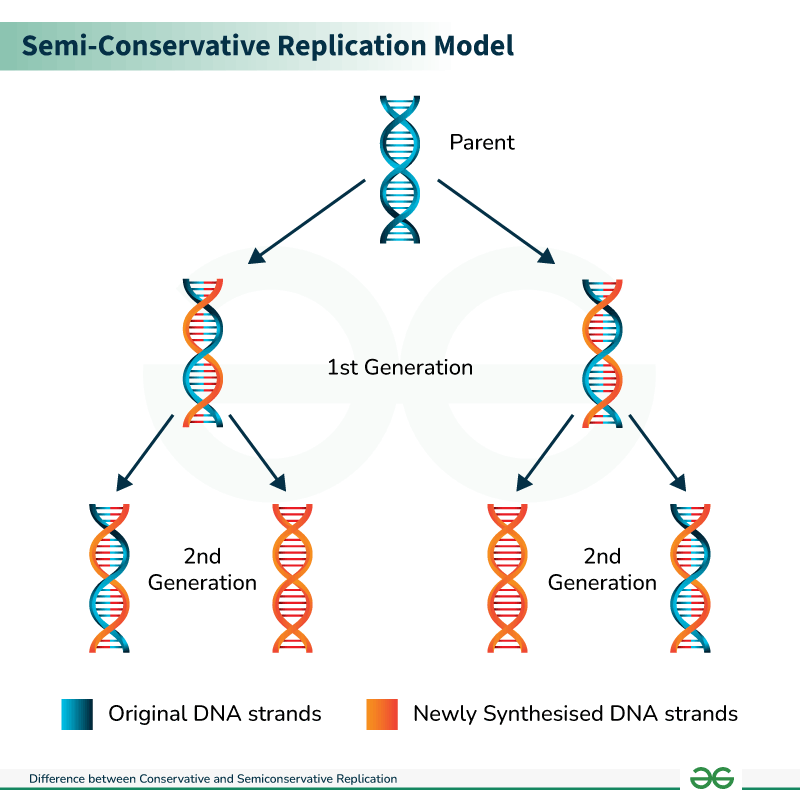
Semiconservative replication
Produces two Copies;
DNA molecule contains:
One original strand
One newly synthesized strand
Normal
G₂ phase
The cell:
Continues growing
Produces proteins
Prepares for mitosis
Checks/prepares replicated DNA
Remember:
G₂ = prepare for division
What happens to the replicated DNA during G₂?
The cell checks/prepares the replicated DNA.
What is mitosis?
Division of the nucleus and separation of duplicated chromosomes.
MITOSIS Stages
Mitosis divides the nucleus and separates duplicated chromosomes.
The four major phases are:
Prophase → Metaphase → Anaphase → Telophase
Memory:
PMAT
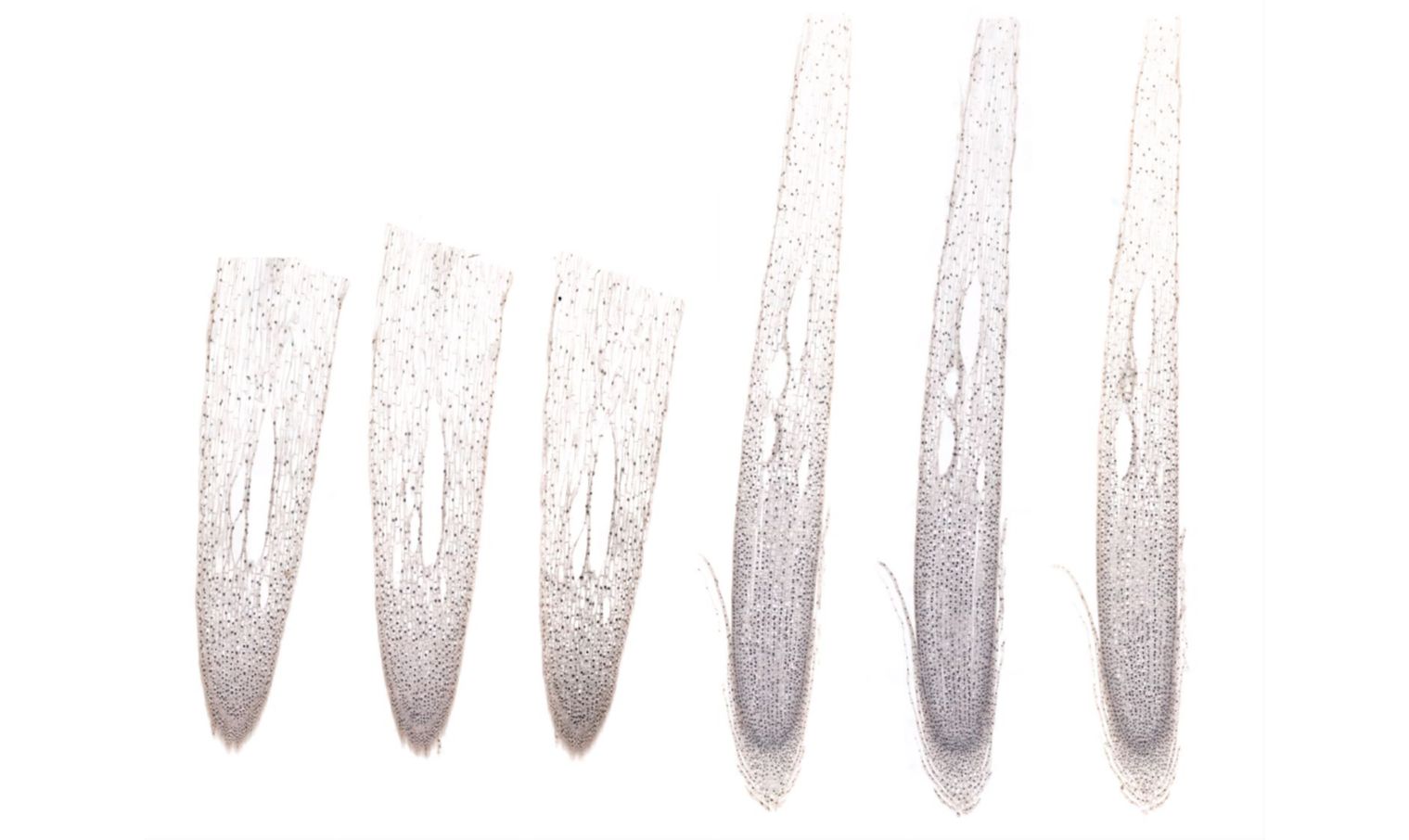
Prophase
Major events:
Chromatin condenses into visible chromosomes.
Each chromosome consists of two sister chromatids.
The mitotic spindle begins forming.
Spindle fibers interact with chromosomes.
The nucleolus disappears.
The nuclear envelope breaks down as mitosis progresses.
What to recognize:
Chromosomes become visible and the spindle develops.

What happens to chromatin during prophase?
It condenses into visible chromosomes.
What does each chromosome contain during prophase?
Two sister chromatids.
What begins forming during prophase?
The mitotic spindle.
What happens to the nucleolus during prophase?
It disappears.
What happens to the nuclear envelope as mitosis progresses?
It breaks down.
What should you recognize in a prophase cell?
Visible chromosomes and a developing spindle.
Metaphase
Major event:
Chromosomes line up in the middle of the cell.
This arrangement is called the:
Metaphase plate
Spindle fibers attach to chromosomes and help position them.
What to recognize:
Chromosomes lined up across the center.

What is the major event of metaphase?
Chromosomes line up in the middle of the cell.
What is the metaphase plate?
The arrangement where chromosomes line up across the center of the cell.
What do spindle fibers do during metaphase?
They attach to chromosomes and help position them.
What should you recognize in metaphase?
Chromosomes lined up across the center.
Anaphase
The sister chromatids separate.
Once separated, each chromatid is considered an individual chromosome.
Spindle fibers pull the chromosomes toward opposite poles of the cell.
What to recognize:
Chromosomes moving apart.

What happens during anaphase?
Sister chromatids separate
What are separated chromatids called after separation?
Individual chromosomes.
Where do the chromosomes move during anaphase?
Toward opposite poles of the cell.
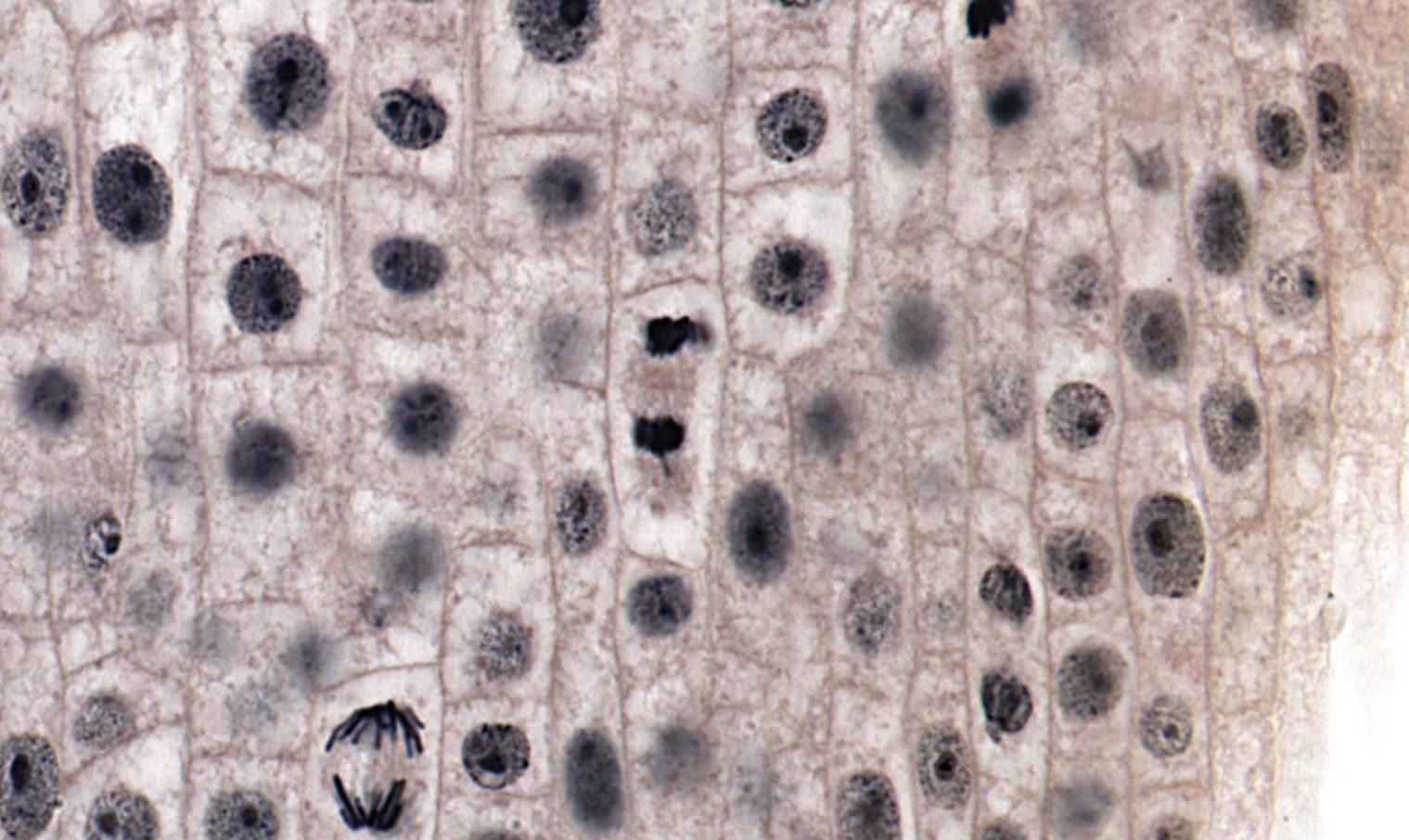
Telophase
Chromosomes arrive at opposite ends of the cell.
Major events:
Chromosomes begin to decondense.
New nuclear envelopes form around each set of chromosomes.
Nucleoli reappear.
The spindle breaks down.
What to recognize:
Two nuclei beginning to form.
What happens to the chromosomes during telophase?
They arrive at opposite ends of the cell and begin to decondense.
What should you recognize in telophase?
New nuclear envelopes, and nucleoili
What happens to the spindle?
It breaks down.

Cytokinesis
Cytokinesis is the division of the cytoplasm.
It usually occurs toward the end of mitosis/overlaps with late telophase.
Result:
Two daughter cells
Each daughter cell receives a nucleus containing a complete set of chromosomes.
What does each daughter cell receive during cytokinesis?
A nucleus containing a complete set of chromosomes
When does cytokinesis occur?
Toward the end of mitosis and overlaps with late telophase.
Chromatid
A duplicated chromosome contains two sister chromatids.
Stages: Prophase and Anaphase
Details: Chromatids condense and become visible during prophase. They separate into individual chromosomes during anaphase.

Spindle fibers
Stages: Prophase, Metaphase, and Anaphase
These protein ropes start growing in prophase.
hold the chromosomes in metaphase
pull the chromatids apart in anaphase.

Metaphase plate
Stage: Metaphase
Details: This is the imaginary center line where chromosomes line up before they split.

Daughter cells
Stages: Telophase and Cytokinesis
Details: These two identical new cells appear at the very end of the division process.
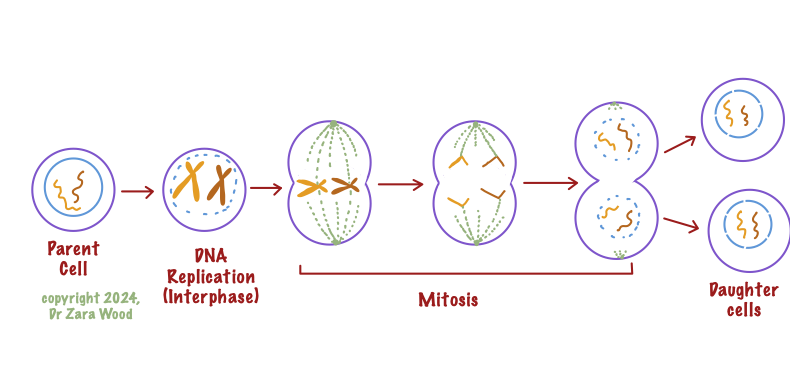
Cytokinesis
Stage: Cytokinesis (follows Telophase)
Details: The main cell body splits in half to completely finish \
creating the two new daughter cells.
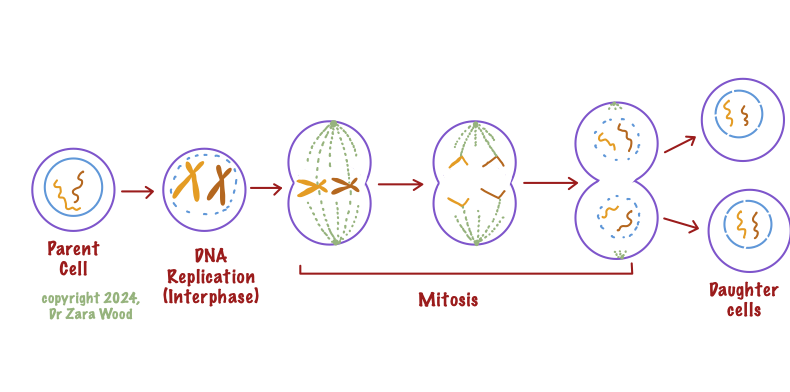
What is a chromatid, and during which stages is it relevant?
A duplicated chromosome has two sister chromatids. They are visible in prophase and separate during anaphase
What are spindle fibers, and what do they do during mitosis?
Protein structures that develop in prophase, position chromosomes in metaphase, and pull chromatids apart in anaphase
What is the metaphase plate, and when does it occur?
The imaginary center line where chromosomes line up during metaphase.
What are daughter cells, and when are they produced?
The two new cells produced at the end of telophase and cytokinesis.
What is cytokinesis, and when does it occur?
Division of the cytoplasm, occurring after/toward the end of telophase, producing two daughter cells.
Cell Division
Normal cells have mechanisms that regulate:
Cell growth
DNA replication
Cell division
Cell death
This prevents cells from dividing uncontrollably.
What processes are normally regulated in cells?
Cell growth, DNA replication, cell division, and cell death.
Why are these processes regulated?
To prevent cells from dividing uncontrollably.
Cancer
Cancer occurs when cells acquire genetic changes that disrupt normal control of cell division.
The cells may:
Divide too frequently.
Ignore signals telling them to stop dividing.
Cancer cell division = uncontrolled/abnormally regulated
Why mutations matter
Genes help regulate cell growth and division.
Mutations can affect genes that:
Stimulate cell division
Stop cell division
Repair DNA
Control programmed cell death
If these control systems become abnormal, cells can continue dividing when they shouldn’t