The Chemical Senses: Taste and Smell
 Call Kai
 Learn
 Practice Test
 Spaced Repetition
 Match
 Flashcards
 Knowt Play
1/18

There's no tags or description
Looks like no tags are added yet.
19 Terms
Chemical Senses
The sensory systems of gustation (taste) and olfaction (smell).
Taste vs. Flavor
Taste is specific receptor sensation; flavor is the combination of taste and aroma.
5 Basic Tastes
Saltiness, sourness, sweetness, bitterness, and umami.


Papillae Types
Filiform (cone), fungiform (sides/tip), foliate (folds), and circumvallate (mounds).

Taste Bud Structure
Clusters of about 50 taste receptor cells with microvilli extending into the taste pore.

Saltiness Transduction
Na+ enters selective ion channels; blocked by the drug amiloride.

Sourness Transduction
H+ ions block K+ leak channels, depolarizing the cell to release serotonin.

Bitterness Receptors
T2R family GPCRs that trigger internal calcium release and ATP secretion.
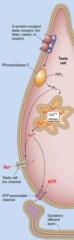
Sweetness Receptors
G-protein-coupled receptors formed by the T1R2 + T1R3 combination.

Umami Receptors
G-protein-coupled receptors formed by the T1R1 + T1R3 combination.
Primary Gustatory Cortex
Located in the insular cortex; responsible for identifying taste sensations.

Ageusia
The complete loss of the sense of taste.
Anosmia
The inability to perceive smell.
Cribriform Plate
A thin sheet of bone through which olfactory axons pass to the olfactory bulb.
Olfactory Nerve
Cranial Nerve I, formed by the axons of olfactory receptor cells.
Glomerulus (Olfactory Bulb)
Spherical structure receiving input from receptor cells expressing a specific olfactory protein.
Pyriform Cortex
The primary olfactory cortex located in the temporal lobe.
Vomeronasal Organ (VNO)
Distinct sensory organ specialized for detecting pheromones.
Flehmen Response
Animal behavior of curling the lip to draw pheromones into the vomeronasal organ.