Vestibular System
 Call Kai
 Learn
 Practice Test
 Spaced Repetition
 Match
 Flashcards
 Knowt Play
1/31

There's no tags or description
Looks like no tags are added yet.
32 Terms
What is vestibular “sensation”?
We do not sense vestibular input; it is your body's primary sensory system for detecting motion, head position, spatial orientation, and gravity
What are the components of the peripheral vestibular system?
Three semicircle canals that function as accelerometers, two otoliths that function as accelerometers and inertial sensors, and vestibular part of CN VIII which transmit info about head acceleration and tilt, and head position relative to gravity
What are the components of the central vestibular system?
Afferent pathways, four vestibular nuclei, efferent paths, that perform major roles in gaze stability, postural stability, and orientation/navigation, and reciprocal paths
What is the function of afferent pathways in the central vestib. system?
Transmit info about head acceleration and tilt to the brainstem, cerebellum, subcortical and cortical structures
What is the function of efferent pathways in the central vestib. system?
Perform major roles in gaze stability, postural stability, and orientation/navigation
What is the function of reciprocal pathways in the central vestib. system?
In the brainstem and cerebellum that allow for tuning and balancing the vestibular system
Where are the end organs for hearing and balance and what do they do?
The cochlea and semicircular canals and otoliths; temporal bone, the hardest in the body
What does the external ear do?
Funnels sound
What does the middle ear do?
Mechanical sound transmission and impedance matching
What does the inner ear do?
Transduction of mechanical energy to an electrochemical signal
What supplies the entire vestibular-cochlear labyrinth?
The labyrinthine artery; arises from the anterior-inferior cerebellar artery or basilar artery
What are the 2 types of motion sensors?
Angular and linear acceleration
What senses angular acceleration?
The semicircular canals: anterior, horizontal, posterior
What senses linear acceleration?
2 otolith organs: utricle and saccule
What is perilymph?
Fluid found in the perilymphatic space of the canals and vestibule; similar to ECF it has low K+ and high Na+, communicates with CSF via cochlear aqueduct, and is a conduit for bacterial meningitis into the inner ear
What is endolymph?
Fluid found in the endolymphatic space of the vestibule and canals; similar to ICF it has high K+ and low Na+, it’s mintained by dark cells, communicates with endolymphatic ducts and sac
Hair cells fire at what rate at rest?
Continuously at 90 spikes/s; inhibitory stimuli can drive cells to 0 spikes/s, and excitatory stimuli can drive cells to extreme firing rates
What is the importance of a high resting firing rate?
It allows for di-directional sensitivity and compensation for lesions
What is the kinocilium?
A single true cilium located on the apex of sensory hair cells in the vertebrate inner ear
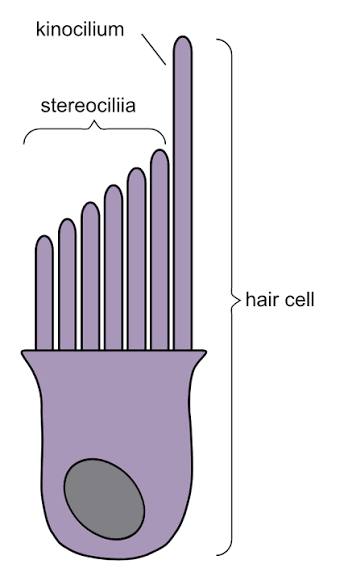
How does firing rate differ depending on the kinocilium?
Movement of endolymph deflects the stereocilia towards the kinocilium which opens in the channels allowing K+ in, the cells depolarizes and is excited, then Ca2+ enters causing NT release and the afferent nerves increase in firing rate; if stereocilia is deflected away from kinocilia, then the channels close, the hair cells hyperpolarize and are inhibited, and the firing rate decreases
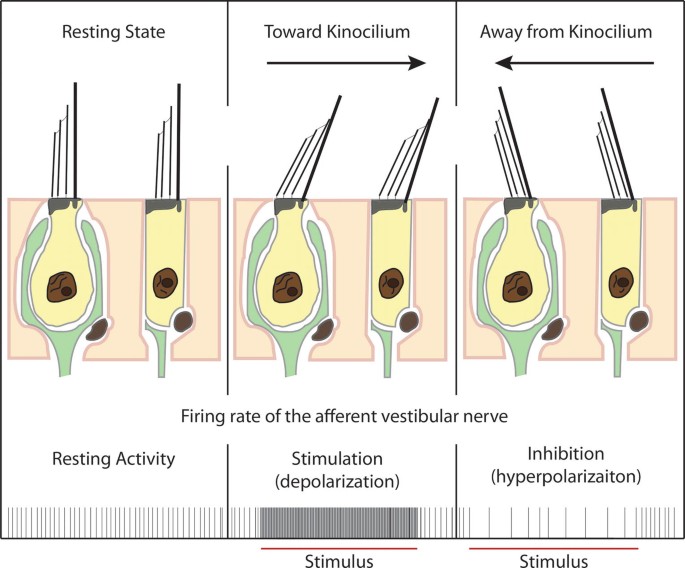
What also deflects the stereocilia other than endolymph?
Cupula (canals) or macula (otoliths) displacement
What is the striola?
The dividing line between otoliths


What is ampullofugal and ampullopetal movement?
The direction of endolymph fluid flow relative to the ampulla in the semicircular canals of the inner ear
What is ampullofugal movement?
Movement of the endolymph in the anterior and posterior canal that is away from the ampulla and therefore inhibitory
What is ampullopetal movement?
Movement of the endolymph in the lateral canals that is towards the ampulla and therefore excitatory
Movement of otoconia towards striola of utricle is excitatory or inhibitory?
Excitatory
What is the crista ampullaris?
The sensory organ located inside the ampulla at the base of each of the three semicircular canals;

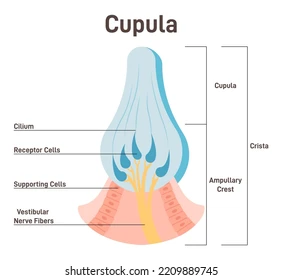
What is the cupula
A gelatinous, dome-shaped structure located in the ampulla; hairlike projections (stereocilia and a single kinocilium) from the underlying crista ampullaris project directly into and are embedded within; the hair cells move with the cupula that is deflected from endolymph movement
What happens in the canal at rest?
There is no angular acceleration, relative motion b/w canal and endolymph, the cupula is not deflected, and no perceived movement
What happens in the canal during constant angular motion?
The endolymph is moving at the same speed as the canal so there is no relative motion between canal and endolymph, the cupula is not deflected, and no perceived movement
What happens in the canal during angular clockwise acceleration?
Inertia causes endolymph to lag behind in the cc direction ?, the cupula is deflected right, and there is perceived clockwise movement
What happens in the canal during deceleration or stopping of motion?
Endolymph momentum keeps it moving clockwise, the cupula is deflected left, and there is perceived counterclockwise movement