BSC2010: Chapter 3 Vocabulary
 Call Kai
 Learn
Learn Practice Test
 Spaced Repetition
 Match
Match Flashcards
 Knowt Play
1/48

There's no tags or description
Looks like no tags are added yet.
Name | Mastery | Learn | Test | Matching | Spaced | Call with Kai | Chat |
|---|
No analytics yet
Send a link to your students to track their progress
49 Terms
organic molecules
molecules that contain carbon
macromolecules
A very large organic molecule composed of many smaller molecules

hydrocarbons
Compounds composed of only carbon and hydrogen

functional groups
A group of atoms with a characteristic chemical structure that exhibits particular properties. Each functional group exhibits the same properties in all molecules in which it occurs.

isomers
Two different molecules that have the same chemical formula
structural isomers
Isomers that contain the same atoms but in different bonding relationships.

stereoisomers
Isomers with identical bonding relationships, but different spatial positioning of their atoms.
cis-trans isomers
Organic molecules with the same chemical composition but existing in two different configurations determined by the positions of hydrogen atoms on the two carbons of a C═C double bond.

enantiomer
One of a pair of stereoisomers that exist as mirror images.

monomers
building blocks of polymers

polymers
large compound formed from combinations of many monomers
condensation reaction
a chemical reaction in which two or more molecules combine to produce water or another simple molecule

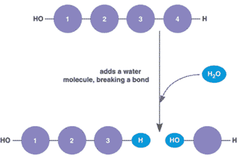
hydrolysis reaction
A chemical reaction that breaks apart a larger molecule by adding a molecule of water
carbohydrates
A carbon-containing organic molecule often represented by the general formula, Cn(H2O)n; carbohydrates include starches, sugars, and cellulose.

monosaccharides
Single sugar molecules

disaccharides
Carbohydrates that are made up of two monosaccharides

glycosidic bond
covalent bond between two monosaccharides

polysaccharides
large macromolecules formed from monosaccharides
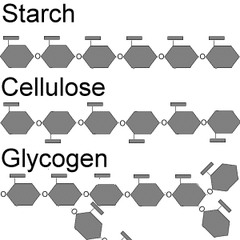
starch
energy storage form of glucose in plants

glycogen
energy storage form of glucose in animals

cellulose
Carbohydrate component of plant cell walls.

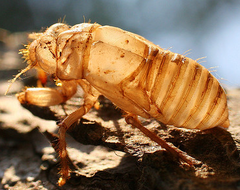
chitin
A structural polysaccharide, consisting of amino sugar monomers, found in many fungal cell walls and in the exoskeletons of all arthropods.
glycosaminoglycans
large polysaccharides that play a structural role in animals

lipids
Energy-rich organic compounds, such as fats, oils, and waxes, that are made of carbon, hydrogen, and oxygen.
triglycerides
an energy-rich compound made up of a single molecule of glycerol and three molecules of fatty acid.

saturated fatty acid
A fatty acid in which all carbons in the hydrocarbon tail are connected by single bonds, thus maximizing the number of hydrogen atoms that can attach to the carbon skeleton.

unsaturated fatty acid

ester bond
bond that connects the glycerol and fatty acid in fat molecules

phospholipids
a lipid consisting of a glycerol bound to two fatty acids and a phosphate group.

steroids
lipids characterized by a carbon skeleton consisting of four or five fused rings

proteins
polymers of amino acids
amino acids
building blocks of proteins

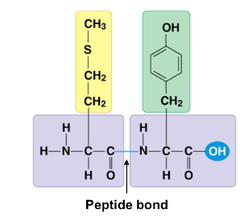
peptide bond
The chemical bond that forms between the carboxyl group of one amino acid and the amino group of another amino acid
polypeptide
A polymer (chain) of many amino acids linked together by peptide bonds.

N-terminus
the end of a polypeptide or protein that has a free amino group

C-terminus
the end of a polypeptide or protein that has a free carboxyl group

primary structure of protein
the amino acid sequence of the polypeptide chain

secondary structure of protein
protein structure is formed by folding and twisting of amino acid chain; alpha helices and beta sheets
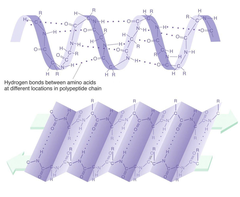
tertiary structure of protein
protein structure is formed when the twists and folds of the secondary structure fold again to from a larger 3D structure

quaternary structure of protein
protein structure is a protein consisting of more than one folded amino acid chain

disulfide bridge
tertiary structure; strong covalent bond formed when one sulfur of one cysteine monomer bonds to the sulfur of another

nucleic acids
Polymers of nucleotides - DNA and RNA.

deoxyribonucleic acid (DNA)
nucleic acid that contains the sugar deoxyribose; genetic material in cells; ATGC

ribonucleic acid (RNA)
A type of nucleic acid consisting of nucleotide monomers with a ribose sugar and the nitrogenous bases adenine (A), cytosine (C), guanine (G), and uracil (U); usually single-stranded; functions in protein synthesis and as the genome of some viruses.

nucleotide
monomer of nucleic acids made up of a 5-carbon sugar, a phosphate group, and a nitrogenous base

deoxyribose sugar
A five-carbon sugar that is a component of DNA nucleotides

ribose sugar
A five-carbon sugar that is a component of RNA nucleotides

purine nitrogenous bases
Either of the bases adenine (A) and guanine (G), which have a fused double ring of carbon and nitrogen atoms.

pyrimidine nitrogenous bases
Any of the bases thymine (T), cytosine (C), and uracil (U), which have a single ring of carbon and nitrogen atoms.
