Week 2 Lecture 1 - Nonverbal Communication
 Call Kai
 Learn
 Practice Test
 Spaced Repetition
 Match
 Flashcards
 Knowt Play
1/15

There's no tags or description
Looks like no tags are added yet.
16 Terms
What is non-verbal behaviour?
Communicative actions that don’t have verbal content, for example voice or actions There is an encoder who sends nonverbal cues, and an decoder who is receiving non-verbal cues.
Body Posture
Describe body posture as a function of dominance?
People consistently rate a standing figure to be more dominant than a seating figure. People can also identify dominance vs. submission of body postures based on 40ms exposures. It is generally found (Kopponetsiner et al. 2016), that when politicians' speeches are converted to stick figures, speakers who were ranked as higher in dominance were expansive and when a large amount of movement occurs.
Describe body posture as an inference about self ?
Body posture can also allow for inferences about the self - that is, individuals can feel differently about themselves depending on their own posture. The study (Petty & Briñol (2009) ) asked individuals to list three positive or three negative traits, in either confident or doubtful postures – creating 4 conditions. They measured self-attitudes as potential professionals. They found that the confident posture allowed for more extreme positive or negative statements, compared to the doubtful posture group.
Describe body posture’s impact on cognitive functions (memory recall)
The study (Dijkstra et al. (2006)) had participants recall memories in congruent or incongruent poses. They measured the reaction time to generate memory and recall 14 days later. They found that memory generation and recall was better for memory congruent compared to incongruent body posture.
Describe body postures impact on romantic attraction?
The study (Vacharkulksemsuk et al., 2016 ) manipulated online dating profile pictures with expansive or contractive postures. They measured participants swiping behaviour They found that profiles with expansive postures were more likely to receive yes responses compared the contractive postures.
Power Posing
What is the controversy about Body Posing?
People suppose that Power posing = poses that are expansive and confident, allows for downstream effects such that people feel more powerful, increase hormones (testosterone) and other people believe in an individual more. This contradicts with other research (Jonas et al. (2017) ) which has generally found that there are virtually zero effect of power poses on any behavioural or hormonal measures, and only a small overall effect for measure of felt power.
What about the boundary conditions around body posing?
Jonas et al. (2017) acknowledges that there may be boundary conditions around body posing, that is, perhaps in some conditions the effect may hold. Park et al., 2013 looked at the effect of culture as a boundary condition. Acknowledging that individual cultures may reward or punish certain poses, they study compared the effect of expansive postures across Eastern Asia compared to the US. They measured self-power across the 4 conditions (east asia vs US, constricted vs. Expansive Feet on Desk posture) They found no difference between constricted sitting postures, but there was a difference in the Expansive posture – east asians lost self-power and the US increased self-power.
Eye Gaze
Can people perceive eye contact?
The study (Rogers et al., 2018 ) had participants wear head-mounted eye-trackers during a 4 minute ‘getting acquainted’ conversation with a stranger. They measured self-reported eye contact, and eye gaze data. They found that participants thought that eye contact occurred for more than what actually occurred. They found that individuals actually had more ‘actual face gaze’ than anything else.
Facial Expressions
Describe what a smize is?
Individuals can smile genuinely or not - that is, smiling with the eyes and without them. The study (Gunnery et al., 2013) asked individuals to smile with the eyes and without the eyes. They showed photographs of these smiles to raters. They found that rated genuineness of the faked smiles correlated with ability to deliberately produce smiles with eyes.
Decoding fake vs. real smiles?
The study (Krumhuber et al., 2014 ) watched short videos of fake or real smiles whilst activity in their own facial musculature was measured. They found increased muscle activity in genuine smile vs. fake smile video.
Proxemics
What is Proxemics?
The study of personal space and interactions in that personal space. The effect of space on interactions.
Describe the study on social ostracism and proxemics
In the study (Marinovic et al., 2017) individuals watched a video depicting ostracism of someone else or a video simply depicting an interaction. They measured where children picked a seat in a row of chairs with an experimenter at the end of the experiment. They found children who watched the ostracism video picked the seats closer to the experimenter, compared to those who watched an interaction video.
Describe the study on physical similarity and proxemics?
In the study (Mackinnon et al., 2011), measured seating patterns in various labs, classrooms, lab paradigms and hypothetical situations. Found that individuals typically chose to sit next to those who look like them, even when controlling for sex and race.
Gesture
Describe the study on congruent vs. incongruent features?
In the study ( Wood et al., 2019 ), participants watched short videos or an actor displaying either congruent or incongruent facial expressions and gestures. They were instructed to either attend to the face or the hand and report to the valence of the input. They measured a participant's accuracy and reaction time to the input. They found that there were more errors and longer reaction times in the incongruent trials.

Touch
Describe the Haptic study?
In the study (Hertenstein et al., 2 ) Pairs of strangers were asked to make contact with other participant’s bodies to communicate - Anger, Disgust, Fear, Love, Happiness, Surprise, Sadness and Sympathy. The actions used to communicate each type of emotion were measured. The researchers found

Describe the study on haptic channels?
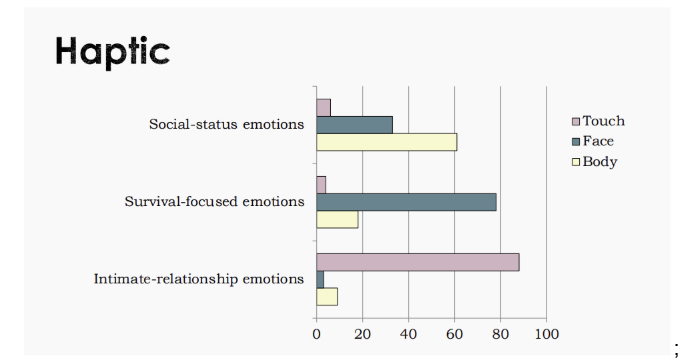
In the study (App et al., 2011 ) Participants were asked to send emotions to mannequins who they imagined to be close same-sex friends. Research split emotions into categories Social Status emotions (pride, embarrassment), Survival emotions (angry, disgust), Intimate Relationship emotions (love, sympathy).
They measured whether or not participants used haptic, facial or body channels.
Theorised that each type of emotion would correspond to a different channel (body - social status), (facial - survival) (haptic/touch- inmate relationship)
They found agreement.