Biology Honors ~ Unit 7: Photosynthesis
 Call Kai
 Learn
 Practice Test
 Spaced Repetition
 Match
 Flashcards
 Knowt Play
1/49

There's no tags or description
Looks like no tags are added yet.
50 Terms
Why do all creatures depend on the sun?
It provides the free energy that powers life on earth
Autotrophs
Organisms that use light (the sun) or inorganic carbon to live and to produce organic compounds (sugars)
Heterotrophs
Organisms that depend upon autotrophs for food because they can’t produce their own(animals).
Photosynthesis
The process in which green plants, algae, and some bacteria convert solar energy into chemical energy.
Chemical Equation for Photosynthesis
Light + 6CO2 + 12H2O —> C6H12O6 + 6O2 + 6H2O
_______________(pigments)_________________
Requirements of Photosynthesis
Light - Provides energy for the process to occur
CO2 - from atmosphere, supplies carbon and oxygen for glucose
H2O - supplies hydrogen for glucose, oxygen is released as gas
Photon
Unit of light energy that travels in specific wavelengths
Electromagnetic spectrum
a scale that depicts a range of solar radiation based on wavelength

Radiation with the shortest wavelength and highest energy
Gamma rays
Radiation with the longest wavelength and lowest frequency
Radio Waves
Portion of the spectrum utilized by photosynthesis
Visible light
Chlorophyll
the green pigments in plants that absorbs or reflects light
Two main kinds of chloropyhll
Chlorophyll a and chlorophyll b
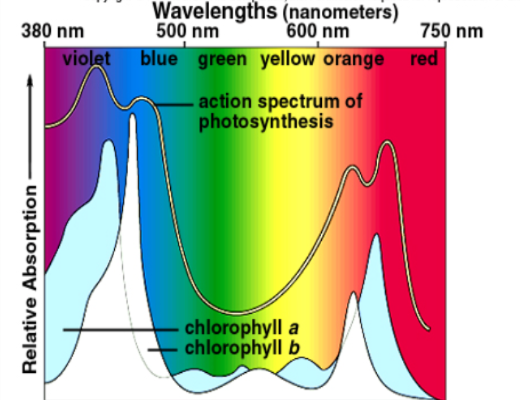
Light that chlorophyll absorbs
Violet, blue, orange and red
Light that chlorophyll reflects
Chlorophyll a: blue-green
Chlorophyll b: green
Carotenoids
pigments that absorb and transfer additional energy to chlorophyll(absorb green/blue light, reflect red/orange light)
Spectrophotometer
measure the amount of light that passes through a sample of pigments
Absorption Spectrum
percentage of light absorbed at each wavelength

Action Spectrum
indicates O2 production and thus photosynthetic activity at each wavelength
Chloroplast
a double membrane-bound organelle that contains chlorophyll

Thylakoid
a membrane-bound sac within the inner membrane of chloroplast that contains chlorophyll
Granum
stack of thylakoids(used in light reactions)
Stroma
the enzyme-rich fluid between the granum and inner-membrane(used in dark reactions)
Light Reactions are also called
light capture, light-dependent reactions, & photophosphorylation
Where do light reactions take place?
thylakoids
Three pathways of light reactions
Fluroesence
Cyclic photophosphorylation(includes E.T.C.)
Non-cyclic photophosphorylation(i.e. photosystems I & II; includes E.T.C.)
Purpose of Light reactions
Uses light and water to make ATP and O2, also produces NADPH for dark reactions
Dark reactions are also known as
light-independent reaction, Calvin-Benson Cycle, & “CO2 Fixation”
Where do Dark reactions take place?
the stroma
Purpose of Dark reactions
uses the products of light reactions (ATP & NADPH) to reduce CO2 and make glucose
Fluoresence Process
Light strikes chlorophyll and becomes “excited”
Electrons “jump” to a higher energy level(ground state to excited state)
If nothing further happens, the electron falls back to grounds state and the gained energy is emitted as light(cannot be used by plant)

What must happen in order for the plant to use the energy from the excited electron?
the energy must be transferred to another molecule, either by cyclic or non-cyclic photophosphorylation
3 steps of Cyclic photophosphorylation
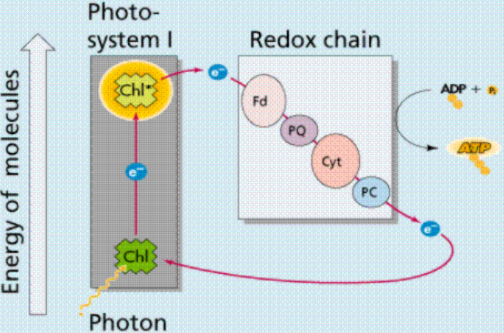
Chlorophyll absorbs light
Electron becomes excited and jumps to a higher energy level
Electron returns to the chlorophyll by travelling down Electron Transport Chain(produces ATP)
What is NOT produced during Cyclic photophosphorylation
O2, because there is no electron deficit in chlorophyll(thus no need to split water molecules)
Non-cyclic photophosphorylation results in the synthesis of what?
O2, ATP, NADPH
Two components of non-cyclic photophosphorylation
a. Photosystem I
b. Photosystem II
(each has pigments and is activated by a different wavelength)
First two steps of non-cyclic photophosphorylation
PS II absorbs light, is activated at 680mm
Two electrons become “excited” and jump to a higher energy level
(the chlorophyll now has a two electron deficit)


Third and fourth steps of non-cyclic photophosphorylation
Two electron deficit is paid by taking two electrons from hydrogen, thus H2O is split & O is released as gas(H2O → 2e- + 2H+ + ½ O2)
The two excited electrons move down the Electron Transport Chain
(energy is released to form ATP)
Final three steps of non-cyclic photophosphorylation
the two electrons reach the bottom and enter PS I
PS I absorbs light, is activated at 700mm, two electrons get re-excited and jump up
two excited electrons react with NADP+ and H+ to form:
2e- + NADP++ 2H+ → NADPH

Why choose cyclic over non-cyclic photophosphorylation?
Sometimes an organism has all the NADPH that it needs to synthesize new carbon skeletons, but still needs ATP to power other activities in the chloroplast.
Why can many cyanobacteria shut off PS II?
To allow the production of ATP in the absence of glucose(cyclic photophosphorylation)
What is ATP production called?
Chemiosmosis
How does chemiosmosis work?
As e- moves down the E.T.C. b/n PS II and PS I, H+ ions will be pumped from the stroma into the interior of the thylakoid. (proton motive force) They will collect along the membrane. This creates an electrochemical gradient (where the interior of the thylakoid is more acidic than the outside). Thus, H+ ions return to the stroma by diffusing across the thylakoid membrane thru ATP Synthase “channels”. This action activates the synthase to catalyze the formation of ATP.

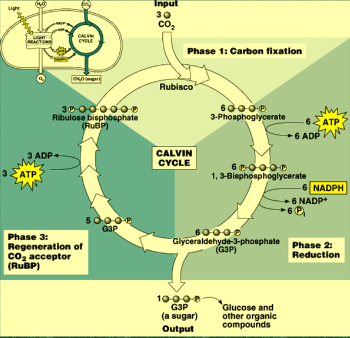
What is the purpose of Dark reactions?
to use the products of the light reactions(ATP and NADPH) to produce glucose
First two steps of dark reactions
CO2 is fixed to a five-carbon molecule called Ribulose Biphosphate (RuBP)
This forms a six-carbon molecule, which almost immediately splits into two, three-carbon molecules called 3-phosphoglyceric acid(3-PGA)

Final two steps of dark reactions
PGA is reduced to phosphoglyceraldehyde, or PGAL(this is where the NADPH and ATP from light reactions are used)
ONE molecule of PGAL leaves to make glucose(CH2O), the other five molecules are used to regenerate RuBP through a series of reactions
(this must occur five more times to make ONE molecule of glucose(C6H12O6))
Karotenes
orange pigments(carotenoids)
Anthocyanins
red pigments (carotenoids)
Xanthopyhlls
yellow pigments (carotenoids)
Importance of carotenoids
they allow the plant to absorb as much light as possible, by absorbing green and yellow light, which chlorophyll mainly reflects