5. Bone growth and healing
 Call Kai
 Learn
 Practice Test
 Spaced Repetition
 Match
 Flashcards
 Knowt Play
1/66

There's no tags or description
Looks like no tags are added yet.
67 Terms
5 reasons for why we need bone
mechanical support
transmission of forces generated by muscle
protection of vital organs
calcium homeostasis
haematopoiesis
how often are bones completely replaced
once every 10 years
2 different microscopic types of bone
woven bone
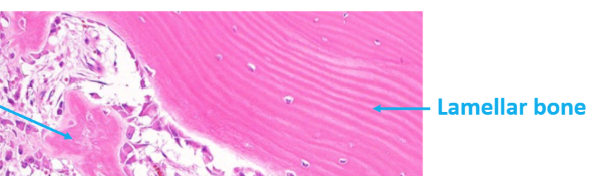
lamellar bone
what bones feature lamellar bone
most matures ones
how does collagen run in lamellar bone & why’s that good
opposite directions in alternating layers so the bone resists torsion forces
How are (type 1) collagen fibres ordered in woven bone
criss crossed over eachother to make a woven sorta vibe

when’s woven bone needed
when it’s made quickly or when bone’s needed asap
examples for both needs of woven bone
embryo development when made quickly. Fracture healing when it’s needed asap
what happens to woven bone over time
osteoblasts turn the woven bone into lamellar bone after some time, surrounding the bone and making osteoids
what are osteoids
minerals required for making lamellar bone
what are osteoids made of
type 1 collagen and glycosaminoglycans
what gives woven bone the rigidity to turn into lamellar bone
calcium salts
Two ways of bone growth in the embryo
intramembranous ossification
endochondral ossification
what’s intramembranous ossification
when bone forms in a sheet of immature connective tissue

what bones form w intramembranous ossification
flat bones, face bones, clavicle
what bits of bone aren’t calcified yet & why
shoulders and head, so the baby can be easily pushes out of the uterus
What happens in endochondral ossification
bones form from pre-existing cartilage models, that act as templates
what bones form w endochondral ossification
base of the skull, long bones
what form of ossification’s slower
endochondral. much slower.
how are osteons & spongy bone connected
perpendicular canals called spongy bone
How does lacunae form
osteoblasts become trapped in the osteoid they form, turning int osteocytes
Step 1 of bone remodelling
Pre-osteoclasts arrive at the bone surface
Pre-osteoclasts arrive at the bone surface
the pres differentiate into osteoclasts
the pres differentiate into osteoclasts
they secrete acid & proteins onto the bone surface, creating an excavation pit
they secrete acid & proteins onto the bone surface, creating an excavation pit
the osteoclast undergoes apoptosis, ending the resorption phase
the osteoclast undergoes apoptosis, ending the resorption phase
Mesenchymal stem cells are activated into osteoblasts to replace the excavated bone
Mesenchymal stem cells are activated into osteoblasts to replace the excavated bone
the make osteiods, which are mineralised to form mature bone
what do used osteocytes become after use here
osteocytes or bone lining cells
what is the bone remodelling process modulated by
cell-to-cell interactions and cytokines
How are pre-osteoclasts activated
osteoblasts (or stromal cells) give a protein called RANK ligand to the RANK receptor on the pre. And also give an M-CSF to the M-CSF receptor.
How do osteoblasts stop activation of osteoclasts
they produce osteoprotegerin (OPG) to bind to the RANK ligand, preventing it from binding to the receptor on the pre.
why would activation wanna be stopped
to avoid constant resorption, which can cause osteonecrosis
how to control the rate or resprtion
the ratio of RANK to OPG is altered by Hormones, Vit D, inflammatory cytokines, and growth factors
what can rapidly increase resorption
steroids
How does bone strength change over time
increases till it peaks at 20-25. then decreases over time
why’s bone strength decrease anyway
osteoblasts can’t keep up w osteoclasts. also genes.
what can help maintain bone strength
exercising, not too much alcohol, sleeping
what’s a pathological fracture
a fracture due to less dense bones, due to less calcium.
4 steps to normal fracture healing, and how long they take
Haematoma (day 0-1)
Soft callus (day 1- week 2)
Bony callus (week 2- week 3)
Remodelling (week 3- months)

What’s a haematoma
blood clot around a fracture
how’s a haematoma formed
rupture of blood cells w the fracture, filling in the fracture gap
what does the haematoma form
a fibrin mesh, sealing the fractured site, providing a scaffold for the action of inflammatory cells, fibroblasts, and support for new capillary growth.
What do platelets and inflammatory cells do in the haematoma
releast PDGF, TGF-β, FGF and other growth factors
what do these growth factors do
promote osteoprogenitor cells in the periosteum, medullary cavity and surround soft tissues.
what do osteoprogenitor cells activate into
osteoclasts and blasts
what’s a soft callus here
connection between the two bones while all this activation’s happening.
what do the clasts and blasts do next
make woven bone on the connection between the two bits of bone
what’s sometimes formed w woven bone
hyaline and fibrocartilage
what’s the cartilage do
forms along the fracture line, then undergoes endochondral ossification to form a bony callus
what happens to the woven bone
turned into lamellar by clasts and blasts
what happens to the bone as it matures
bits that don’t udnergo stress are resorbed
when’s remodelling done
when there’s spongy bone and compact bone there now. fracture’s bridged. it’s all made of lamellar bone.
what can caused impaired healing
inadequate immobilisation
avascular necrosis
bone loss
space/tissue between fragments
extensive trauma
infection
intra-articular fractures for joints
age
drugs like steroids
what bones or parts of bone heal slower
tibia heals slow.
diaphysis fractures heal slower than metaphysis
What’s osteonecrosis/avascular necrosis
ischaemic necrosis of bone & bone marrow due to lack of blood supply to the bone
what can osteonecrosis be caused by other than fractures
steroids, alcohol, sickle cell anaemia, blood clotting. (non-traumatic osteonecrosis)
what’s idiopathic osteonecrosis
osteonecrosis w no risk factors impacting the person
What’s osteomyelitis
infection of the bone/bone marrow
how’s osteomyelitis happen
pressure ulcers and trauma,
ischemia,
lack of blood supply,
foreign bodies previous explosed to infection
2 type of osteomyelitis
haematogenous or multimicrobial
haematogenous meaning
coming from 1 organism
Multimicrobial meaning
coming from multiple different bacteria
what’s staphylococcus aureus
bone pain + systematic signs of infection
what;s used to diagnose osteomyelitis
blood or bone culture
what’s used to treat osteomyelitis
antibiotics
why’s treatment for osteomyelitis have to be good
if the acute case is only partially fixed, it becomes chronic
what sort of response is caused by a bacterial infection
a neutrophilic inflammatory response