General Science - Life Science - The Digestive System
 Call Kai
 Learn
 Practice Test
 Spaced Repetition
 Match
 Flashcards
 Knowt Play
1/55

There's no tags or description
Looks like no tags are added yet.
56 Terms
The digestive tract is essentially a long, winding tunnel that extends from the ________ to the anus.
mouth
Which of the following best defines the structural architecture of the digestive tract?
It is essentially a long, winding tunnel extending from the mouth to the anus.
The mouth, esophagus, stomach, small intestine, large intestine, rectum, and anus are characteristic of which system's anatomical components?
The digestive tract, because these structures form the complete continuous passage through which food travels.
Which organs are explicitly included as components of the digestive tract?
The mouth, esophagus, stomach, small intestine, large intestine, rectum, and anus.
One of the primary functions of the digestive system is to control food ________.
intake
How is the system's management of food intake and processing defined?
It controls food intake and manages the chemical breakdown of nutrients.
What is the relationship between digestion and nutrient utilization in the body?
The digestive system manages digestion because it processes ingested food for cellular absorption.
Which of the following accurately describes the operational properties of the digestive system regarding food processing?
It controls food intake and manages digestion.
The digestive system controls the absorption of digested material by the body’s cells for energy and building ________.
muscle
For what ultimate purposes do the body's cells absorb digested material?
For energy and building muscle.
Teeth and tongue aiding in mechanical digestion, alongside amylase acting on starch, are characteristic of which organ's functions?
The mouth, because mechanical and initial chemical breakdown occur through teeth, tongue, and saliva.
What specific mechanical and chemical processes occur in the mouth?
Teeth and tongue aid mechanical digestion, and salivary amylase acts on starch.
In the stomach, food is mixed with acidic gastric juice and ________, which acts on the protein.
pepsin
What substances are mixed with food in the stomach to break down proteins?
Acidic gastric juice and pepsin.
The rectum stores the solid ________.
waste
Which of the following correctly states the function of the rectum?
The rectum stores the solid waste.
How does the anus function in relation to solid waste management?
The anus releases the solid waste from the body periodically because it serves as the terminal exit point of the digestive tract.
What operational features characterize waste elimination through the anus?
The anus releases solid waste periodically from the body.
Returning needed water and minerals to the blood while sending liquid waste to the bladder is characteristic of which organ?
Kidneys
What is the primary function performed by the kidneys regarding fluid balance?
They return needed water and minerals to the blood because they filter circulating fluids and route liquid waste to the bladder.
Urine is stored in the bladder and released periodically through the ________ out of the body.
urethra
Which sequence describes how the bladder and urethra handle liquid waste?
The bladder stores urine, and it is released periodically through the urethra.
The bulk of digestion occurs within the ________ intestine.
small
Which of the following accurately defines where the bulk of digestion takes place?
The small intestine is where the bulk of digestion occurs.
Food pulp mixing with alkali and digestive juices manufactured by the pancreas and liver is characteristic of which anatomical location?
The duodenum, because it marks the beginning of the small intestine where pancreatic and liver secretions are released.
What is the relationship between digestive secretions and the duodenum at the start of the small intestine?
Food pulp mixes with alkali and digestive juices released into the duodenum.
Which of the following pancreatic juice components is responsible for chemical conversion processes?
Lipase
Which of the following pancreatic juice components is NOT involved in protein or lipid conversion pathways?
Trypsins
Which of the following pancreatic juice components participates in polypeptide processing?
Trypsins
Which of the following options correctly lists the specific enzymes contained in the juice manufactured by the pancreas along with their primary chemical functions?
Lipase changes fat to glycerol and fatty acids, amylase changes complex carbohydrates to simple sugars, and trypsins change polypeptides to amino acids.
What is the origin and function of bile in digestion?
Bile is produced by the liver and stored in the gallbladder to aid in the digestion and absorption of fats and oils.
What is the relationship between bile and lipid processing in the digestive system?
Bile aids in the digestion and absorption of fats and oils because it is produced by the liver and stored in the gallbladder.
Absorption of all digested substances, except fatty acids and glycerol, occurs through capillaries that carry blood to the ________ and then to all body cells.
liver
What distinguishes the pathway of capillary absorption from lymphatic absorption for digested substances?
Capillaries absorb all digested substances except fatty acids and glycerol and carry blood to the liver, whereas fatty acids and glycerol are absorbed by the lymphatic system.
Which features characterize the absorption and transport of fatty acids and glycerol?
Absorbed and transported by the lymphatic system to the neck before entering the bloodstream.
How do fatty acids and glycerol reach the bloodstream after digestion?
They enter the bloodstream after being transported by the lymphatic system to the neck because they bypass direct capillary absorption into the liver.
The large intestine produces certain ________.
vitamins
Which of the following accurately defines a synthetic capability of the large intestine?
The large intestine produces certain vitamins.
Which of the following substances is absorbed along with other essential elements from the remaining material by the large intestine?
Vitamins
Which of the following substances is NOT among those absorbed from the remaining material by the large intestine?
Undigested dietary protein blocks
Which of the following essential components is absorbed from the remaining material by the large intestine alongside fluids and organic nutrients?
Essential minerals
Which of the following options correctly lists the substances absorbed from the remaining material by the large intestine?
Vitamins, water, and essential minerals.
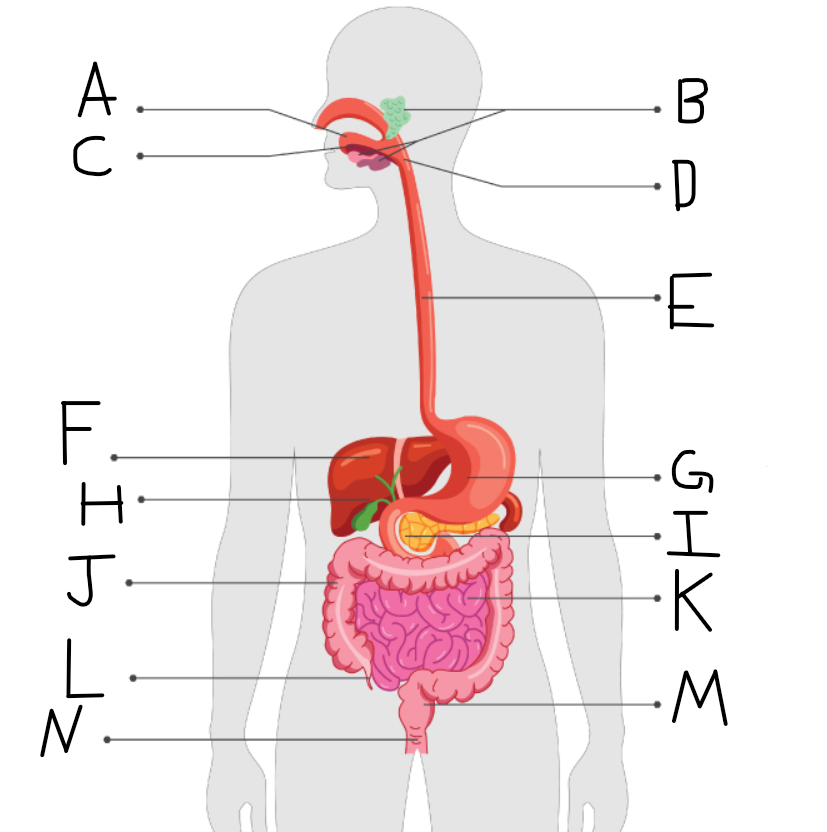
What should the label be for position A?
Mouth

What should the label be for position B?
Salivary Glands

What should the label be for position C?
Tongue

What should the label be for position D?
Pharynx

What should the label be for position E?
Esophagus

What should the label be for position F?
Liver
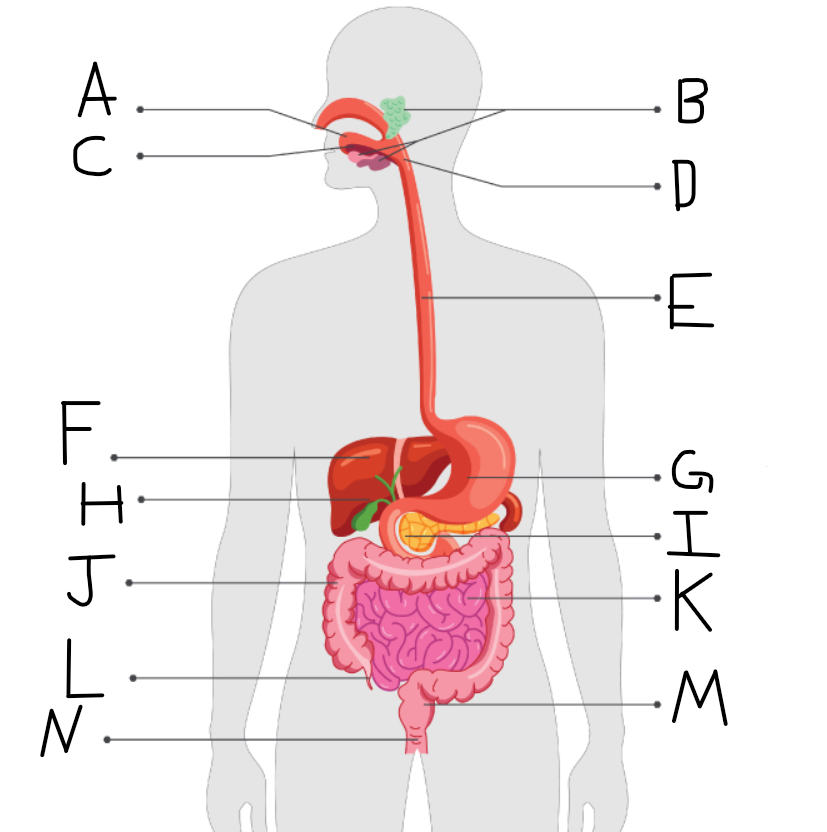
What should the label be for position G?
Stomach

What should the label be for position H?
Gallbladder

What should the label be for position I?
Pancreas

What should the label be for position J?
Large Intestine

What should the label be for position K?
Small Intestine
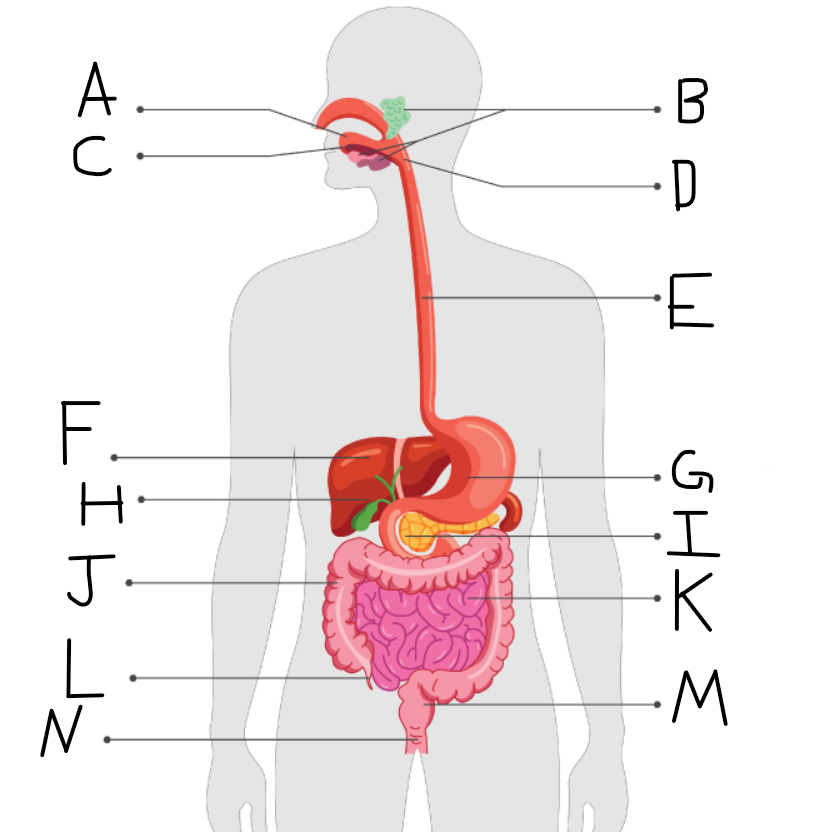
What should the label be for position L?
Appendix
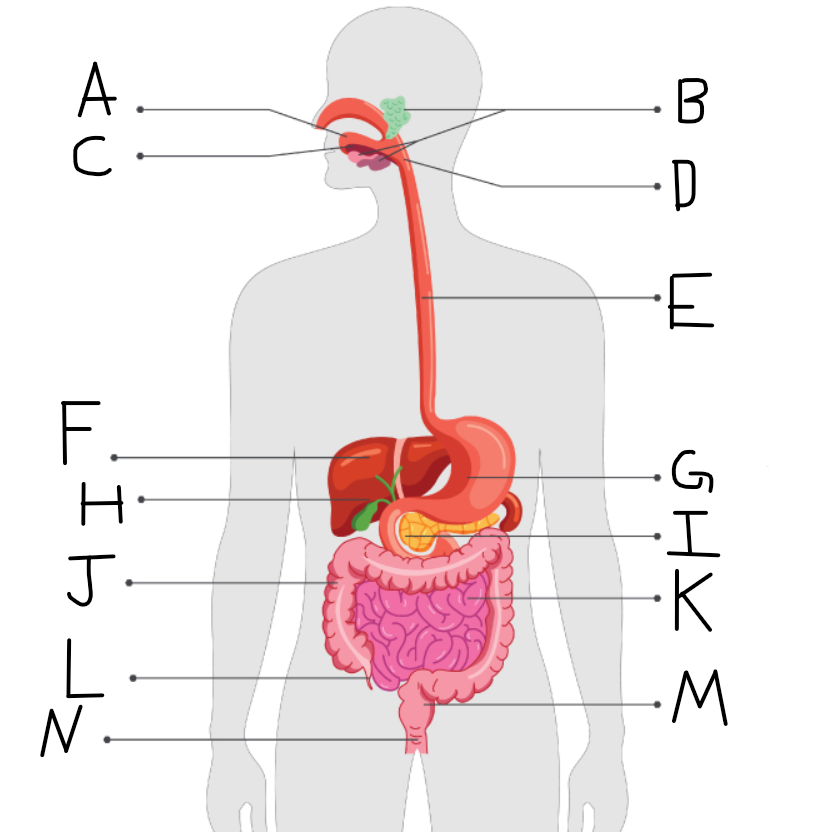
What should the label be for position M?
Rectum

What should the label be for position N?
Anus