Sept 9-28 : I Hear You Say So, Look Back in Anger, Pentecost
 Call Kai
 Learn
Learn Practice Test
 Spaced Repetition
 Match
Match Flashcards
 Knowt Play
1/151

There's no tags or description
Looks like no tags are added yet.
Name | Mastery | Learn | Test | Matching | Spaced | Call with Kai | Chat |
|---|
No analytics yet
Send a link to your students to track their progress
152 Terms
The ___ was a political plan that proposed a local Northern Ireland administration including both nationalists and unionists to bring peace and stability.
Sunningdale Agreement
The Sunningdale Agreement was a political plan that proposed a local Northern Ireland administration including both ___ to bring peace and stability.
nationalists and unionists
The ___ was a massive strike by unionists aimed at collapsing the Sunningdale Agreement.
Ulster Workers Council strike of 1974
The ___ was formed in 1969 and increased violence against the police and army during the Troubles.
Provisional Irish Republican Army (PIRA)
The Provisional Irish Republican Army (PIRA) was formed in ___ and increased violence against the police and army during the Troubles.
1969
The ___ was viewed by the Roman Catholic population as a pro-Protestant organisation during the Troubles.
Royal Ulster Constabulary (RUC)
The Royal Ulster Constabulary (RUC) was viewed by the Roman Catholic population as a ___ during the Troubles.
pro-Protestant organisation
Stewart Parker's play Pentecost was first performed in ___ amidst the context of the Troubles in Northern Ireland.
September 1987
Belfast in 1974 the setting of Pentecost is depicted as a ___ with cluttered shabby but order-keeping furnishings.
working-class parlour house
Marian and Lenny's relationship is characterized by ___ and Marian's search for a quiet life.
frustration
Marian and Lenny's relationship is characterized by mutual frustration and Marian's search for a ___.
quiet life
The dialogue between Marian and Lily explores themes of ___ during the Troubles including the burning of Lily's house by Fenian savages.
reprisals and destruction
The dialogue between Marian and Lily explores themes of reprisals and destruction during the Troubles including the burning of Lily's house by ___.
Fenian savages
The interaction between Marian and Ruth reveals the pressures on police including domestic violence and ___ from losses in the force.
psychological trauma
The Ulster Volunteer Force (UVF) and Ulster Defence Association (UDA) are ___ intent on keeping Northern Ireland as part of the United Kingdom.
loyalist paramilitary groups
The Ulster Volunteer Force (UVF) and Ulster Defence Association (UDA) are loyalist paramilitary groups intent on keeping Northern Ireland as part of the ___.
United Kingdom
Jimmy's character in Look Back in Anger is described as ___ and futile caught between historical eras.
born out of his time
Jimmy's character in Look Back in Anger is described as "born out of his time" and ___ caught between historical eras.
futile
Helena expresses belief in ___ as a modern scientific belief despite her time in a madhouse contrasting with Jimmy's views.
good and evil
The play Look Back in Anger explores themes of ___ expressed through Jimmy and Alison's complex relationship.
love, suffering, and moral conflict
Alison in Look Back in Anger states she wants to be a lost cause rejecting neutrality and sainthood in favor of ___.
corruption and futility
Stewart Parker viewed artists as responsible for constructing ___ to help Northern Irish society rise above sectarian division during the Troubles.
a working model of wholeness
Stewart Parker viewed artists as responsible for constructing a working model of wholeness to help Northern Irish society rise above ___ during the Troubles.
sectarian division
The Ulster Workers Council strike of 1974 was a massive strike by unionists aimed at collapsing the ___.
Sunningdale Agreement
___ was formed in 1921 when six of Ireland's 32 counties remained part of the United Kingdom after Irish secession.
Northern Ireland
The ___ was viewed by the Catholic population as a pro-Protestant police force during the Troubles.
Royal Ulster Constabulary (RUC)
The ___ was formed in 1969 and increased violence against police and British Army during Northern Ireland's Troubles.
Provisional Irish Republican Army (PIRA)
"Stewart Parker's play ""Pentecost"" is set against the backdrop of ___ in 1941 reflecting political and cultural turmoil. "
East Belfast
The Loyalist paramilitary groups including the ___ and Ulster Defence Association (UDA) sought to keep Northern Ireland part of the United Kingdom.
Ulster Volunteer Force (UVF)
The Loyalist paramilitary groups including the Ulster Volunteer Force (UVF) and ___ sought to keep Northern Ireland part of the United Kingdom.
Ulster Defence Association (UDA)
The British government deployed troops to Northern Ireland in ___ to counter sectarian violence and civil rights protests.
August 1969
The Troubles were a ___ in Northern Ireland over governance identity and national allegiance lasting from the late 1960s to 1998.
30-year conflict
What change does Alison observe after Helena Charles arrives at the attic flat in Act Two, Scene One?
Alison observes that "Everything seems very different here now - with you here," noting Helena settled in easily despite her upper-middle-class background.
How does Alison describe the "Zoo for Two" fantasy game that she and Jimmy created?
She describes it as "a sort of unholy priest-hole of being animals to one another" and "a silly symphony for people who couldn't bear the pain of being human beings any longer."
What direct command does Helena give Alison after witnessing Jimmy's verbal abuse in Act Two Scene One?
Helena grips Alison's arm and says, "Listen to me. You've got to fight him. Fight, or get out. Otherwise, he will kill you."
How does Jimmy theatrically mock Helena when she asks why he tries so hard to be offensive?
He calls her a "tiresome young man" target and sarcastically shouts, "Pass Lady Bracknell the cucumber sandwiches, will you?"
Why does Jimmy view Alison going to church on Sunday evening as an ultimate act of betrayal?
He views it as an affliction organized by Helena to win Alison over, asking, "You're determined to win her, aren't you?"
How does Alison respond when Jimmy brings up his narrative of rescuing her from her family?
She panics and confronts him, saying, "You rescued me from the wicked clutches of my family, and all my friends! I'd still be rotting away at home, if you hadn't ridden up on your charger, and carried me off!"
How does Jimmy respond when Cliff tries to de-escalate tension by saying "Don't let's brawl boyo"?
Jimmy rejects peaceful intervention, saying, "Why don't we brawl? It's the only thing left I'm any good at."
What violent verbal attack does Jimmy direct toward Alison's mother in Act Two Scene One?
He says, "The old bitch should be dead!" and adds, "My God, those worms will need a good dose of salts the day they get through her!"
According to the transcript, what was Jimmy's defining childhood trauma involving his father?
At ten years old, Jimmy spent twelve months watching his father die after returning injured from fighting for the Republicans in the Spanish Civil War.
How long did ten-year-old Jimmy spend each day in a small room with his dying father?
Jimmy spent eleven hours a day in a small room with his dying father while his family showed embarrassment and indifference.
What assertion does Jimmy make about anyone who has never watched someone die?
Jimmy asserts, "Anyone who's never watched somebody die is suffering from a pretty bad case of virginity."
How does Cliff describe his historical role between Jimmy and Alison in the household?
Cliff describes himself as "a no-man's land between them," comparing the flat to a battlefield where he acts as a buffer.
What news does Jimmy receive regarding Hugh Tanner's mother (Mrs. Tanner) in Act Two Scene One?
Jimmy receives news that Mrs. Tanner has suffered a stroke and is dying in a London hospital.
What does Jimmy do immediately after Alison leaves for church with Helena instead of going to the hospital with him?
Jimmy picks up Alison's toy teddy bear, throws it downstage making a rattling, groaning sound, and collapses face down on the bed with his face buried in the covers.
How are Colonel Redfern's age and background described in the Act Two Scene Two stage directions?
He is described as a large, handsome man about sixty years old, whose forty years of soldiering conceal an essentially gentle, kindly man.
What fundamental divide between her father and Jimmy does Alison summarize in Act Two Scene Two?
Alison states, "You're hurt because everything is changed. Jimmy is hurt because everything is the same. And neither of you can face it."
When did Colonel Redfern leave England and when did he return after commanding the Maharajah's army in India?
Colonel Redfern left England in March 1914 and returned in 1947.
What is Jimmy's immediate reaction when Helena calmly informs him that Alison is pregnant?
Jimmy responds with callous indifference, stating, "I don't care. I don't care if she's going to have a baby. I don't care if it has two heads!"
What physical encounter leads directly to Helena passionately kissing Jimmy at the end of Act Two Scene Two?
Helena slaps Jimmy's face savagely; after Jimmy utters a muffled cry of despair, Helena tears his hand away and kisses him passionately.
What visual details in Act Three Scene One signify Helena's settled domestic role in the flat?
Alison's personal items on the dressing table have been replaced by Helena's, and Helena stands at the ironing board wearing an old shirt of Jimmy's.
How does Helena's reaction to Jimmy's pipe smoke in Act Three Scene One contrast with Cliff's complaint?
While Cliff complains about "That stinking old pipe!", Helena answers Jimmy's question by saying, "No. I quite like it."
What bizarre literary theory about Shakespeare does Jimmy share in Act Three Scene One?
Jimmy recounts a theory by an American Yale professor claiming Shakespeare changed his sex and married a Warwickshire farmer after having three children by him.
What does Jimmy state regarding "good brave causes" for his generation in Act Three, Scene One?
Jimmy states, "There aren't any good, brave causes left," explaining that generation-defining causes were done in the thirties and forties when they were kids.
How does Alison describe her altered concept of marriage in Act Three Scene Two?
Alison explains she gave up believing in the "divine rights of marriage" long ago and views it now as a "constitutional monarchy" where "You are where you are by consent."
How does Helena diagnose Jimmy's fundamental existential flaw in Act Three Scene Two?
Helena states Jimmy "was born out of his time," feels like he's "still in the middle of the French Revolution," and "will never do anything, and he'll never amount to anything."
What specific train does Helena plan to catch to London upon leaving Jimmy?
Helena packs her belongings to catch the 7:15 PM train to London.
What does Jimmy say is required for love in his monologue following Helena's departure?
Jimmy says love "takes muscle and guts," and that without dirtying your hands, "you'll never make it as a human being."
What tragic event does Alison reveal upon her emotional collapse in Act Three Scene Two?
Alison reveals that she suffered a miscarriage and lost her unborn baby.
What does Alison declare about wanting to be neutral or a saint during her breakdown?
Alison cries, "I don't want to be neutral, I don't want to be a saint. I want to be a lost cause. I want to be corrupt and futile!"
How do Jimmy and Alison seal their final reconciliation in Act Three Scene Two?
They retreat into their animal fantasy game, imagining themselves as a bear and a squirrel living on honey and nuts in their cave and dray.
Playwright of Look Back in Anger
John Osborne
Jimmy Porter's primary character trait
Fierce articulate anger, disillusionment, and class resentment.
Alison Porter
Jimmy's upper-middle-class wife who endures his verbal onslaughts through quiet detachment.
Cliff Lewis
Welsh lodger who acts as a peacekeeper and emotional buffer between Jimmy and Alison.
Helena Charles
Alison's actress friend who challenges Jimmy and pushes Alison to leave him.
The Squirrel and Bear Game
An imaginative, childlike sanctuary where Jimmy and Alison escape human pain.
Jimmy's view of Sundays
He views them as a depressing, repetitive ritual highlighting their stagnant youth.
We get our cooking from Paris...
Jimmy's cynical quote about British culture adopting French cooking, Moscow politics, and Port Said morals.
Pusillanimous
The dictionary word Jimmy uses to mock Alison, meaning cowardly and wanting firmness of mind.
Bishop of Bromley reference
Mentioned in Act 1 as making a moving appeal for H-bomb manufacture.
Hugh and Hugh's mum
Working-class figures from Jimmy's past who support him, including helping him buy a sweet-stall.
Jimmy's childhood experience
He claims he knew more about love, betrayal, and death by age ten than most people ever learn.
Alison's pregnancy in the play
Becomes a catalyst for cruelty when Jimmy expresses a desire for her to face losing a child.
End of Act 2, Scene 1
Alison leaves for church with Helena, leaving Jimmy devastated with his teddy bear.
Edwardian Period dates
1901-1910, during the reign of King Edward VII.
Jimmy's romanticizing of the Edwardian era
He nostalgically envisions it as a time of homemade cakes, croquet, and bright linen, despite acknowledging it was phoney.
The American Age
The modern era of mass culture that Jimmy complains about living in.
Angry Young Men
A group of 1950s British playwrights and novelists, including Osborne, who expressed disillusionment with traditional British society.
Kitchen Sink Realism
A 1950s theatrical and artistic movement focusing on gritty, domestic, working-class settings and social realism.
Look Back in Anger and Kitchen Sink Drama
Widely regarded as launching the kitchen sink movement by bringing domestic working-class life to the British stage.
Visual symbol of domesticity in the play
Alison's ironing board, symbolizing the tedious routine of domestic life.
Origin of the kitchen sink label
Derived from an expressionist painting by John Bratby featuring everyday kitchen items.
The Wolfenden Report (1957)
A British government report recommending that homosexual behavior between consenting adults no longer be a criminal offense.

Social climate surrounding the Wolfenden Report
Sparked intense public debate on the reform of traditional British laws regarding private morality.
Sexual Offences Act 1967
Legislation that decriminalized homosexual acts in private between two consenting adults aged 21 or over in England and Wales.

Significance of the Sexual Offences Act 1967
A milestone in the British LGBT rights movement, marking a shift away from state-enforced Victorian morality.
Connection between 1950s drama and 1960s legal reform
Both challenged rigid British social norms, censorship, and traditional moralities regarding sex and class.
Lord Chamberlain's role in theatre
The official censor of British theatre whose powers were challenged by provocative post-war plays before censorship ended in 1968.
Post-war British social shifts
The gradual dismantling of rigid class boundaries and moral codes following World War II.
Central conflict of Look Back in Anger
The clash between post-war disillusionment, class differences, and painful marital intimacy.
Allusion (Definition)
An indirect reference to a person, event, statement, or literary/cultural work.
Purpose of Allusion
Enriches meaning and broadens the impact of a statement through connotations.
Keats' 'Ode to a Nightingale' (Theme)
Meditation on human mortality vs. the immortal beauty of the nightingale's song.
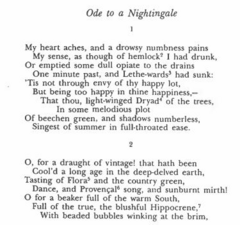
Nightingale Symbolism in Keats
Represents carefree art moving easily through time, contrasting human historical suffering.
Theme (Definition)
The specific claim or statement a literary text makes about its subject.
Subject vs. Theme
Subject is the topic treated; theme is what the work says about that topic.
Bowen's Subject: War to Peace
Explores the relationship between pre-war and post-war national identity.
Bowen's Theme: Transition to Peace
Transitioning to peace forces people to confront previously repressed emotions.