Chem 4.1-4.3 objectives
 Call Kai
 Learn
Learn Practice Test
 Spaced Repetition
 Match
Match Flashcards
 Knowt Play
1/65

Earn XP
Description and Tags
naming
Name | Mastery | Learn | Test | Matching | Spaced | Call with Kai | Chat |
|---|
No analytics yet
Send a link to your students to track their progress
66 Terms
how do ionic compounds form?
happens between a metal + nonmetal.
Electrons are transferred.
Metal loses electrons → cation (+).
Nonmetal gains electrons → anion (−).
Opposite charges attract and form an ionic compound.
cation
positive ion
anion
negative ion
example of ionic bond
Na → Na⁺ + e⁻
Cl + e⁻ → Cl⁻
Na⁺ + Cl⁻ → NaCl
how do covalent bonds form?
Usually happens between nonmetal + nonmetal.
Atoms share electrons.
The shared electrons form a covalent bond.
The resulting substance is a molecule.
covalent bond example
H₂O → oxygen shares electrons with two hydrogen atoms
Breaking bonds requires energy. →
Energy goes in.
A bond forms when the overall arrangement becomes
more stable/lower in energy.
Electronegativity
how strongly an atom attracts shared electrons
electronegativity increases when
you move left to right across periodic table
electronegativity decreases when
you move top to bottom across periodic table
Bonding isn't always simply
"ionic" or "covalent."
The difference in electronegativity (ΔEN) helps determine
the type of bond
Nonpolar covalent
Electrons are shared almost equally.
Small or zero electronegativity difference.
Polar covalent
Electrons are shared unequally.
One atom attracts the electrons more strongly
Ionic
Electrons are essentially transferred.
Large electronegativity difference
Polyatomic ion
a group of atoms covalently bonded together that has an overall charge
In a polar covalent bond, the atom with the higher electronegativity has
the higher electron density
The atoms inside the polyatomic ion are connected by _____ bonds, but the entire ion can form an _____ bond with another ion
covalent, ionic
The more electronegative atom gets a
a partial negative charge (δ−)
The less electronegative atom gets
a partial positive charge (δ+)
Acid
Usually starts with H when written as a formula
Before nomenclature you have to
Idientify if it’s ionic,covalent, or acid
Which group on the periodic table can have multiple charges?
transition metal
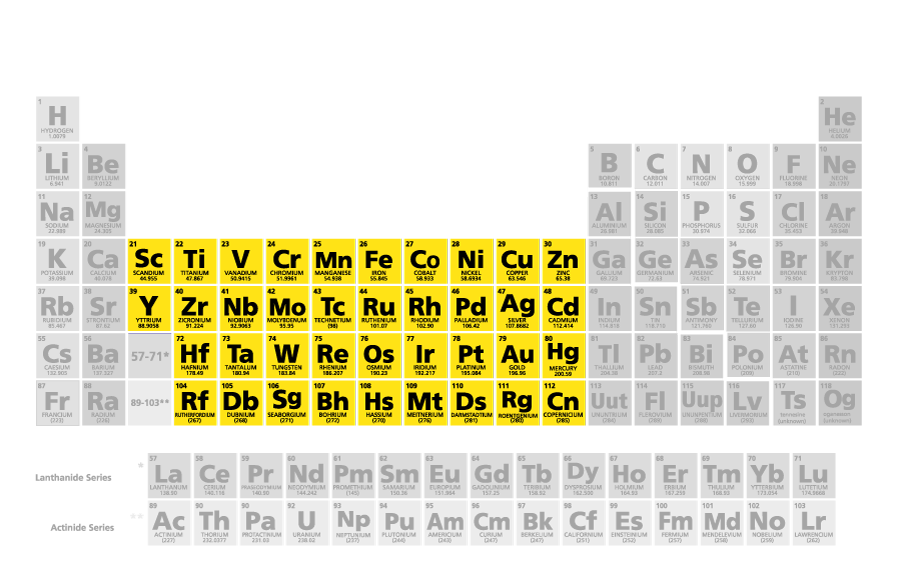
transition metals
Valence electrons: Varies
Common charges: Multiple positive charges
Characteristics: Transition metals are metals that are generally hard, strong, shiny, and good conductors of heat and electricity. They usually have high melting points and can form multiple ions with different charges. Many transition-metal compounds are colorful. They are generally less reactive than Groups 1 and 2. When naming compounds, a Roman numeral tells you the charge of the transition metal.
Examples: Fe²⁺ = iron(II), Fe³⁺ = iron(III), Cu⁺ = copper(I), Cu²⁺ = copper(II)
alkali metals
Valence electrons: 1
Common charge: +1
Characteristics: Alkali metals are very reactive metals because they have only 1 valence electron, which they easily lose to become more stable. They are soft, have relatively low melting points, and react strongly with water. Their reactivity increases as you move down the group. They are almost never found as pure elements in nature because they react so easily.
Example: Na → Na⁺ + e⁻

alkaline earth metals
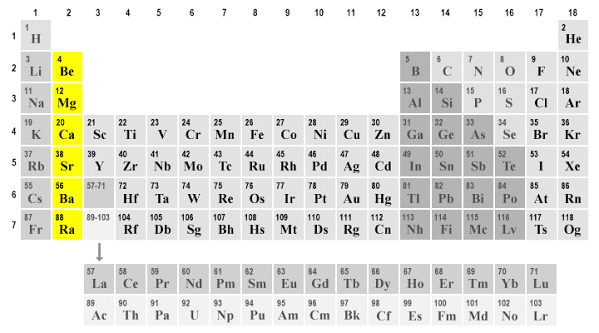
Valence electrons: 2
Common charge: +2
Characteristics: These are reactive metals that have 2 valence electrons. They usually lose both electrons to become stable and form +2 ions. They are harder and less reactive than Group 1 metals. Their reactivity increases as you move down the group.
Example: Mg → Mg²⁺ + 2e⁻
boron group
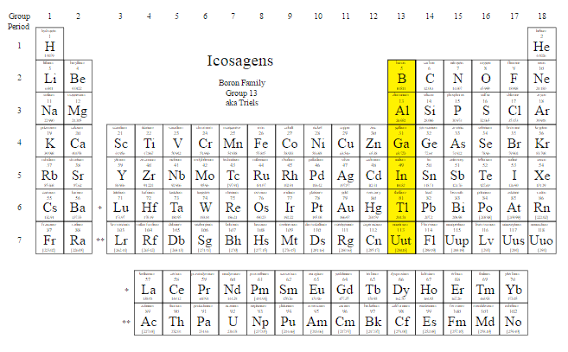
Valence electrons: 3
Common charge: +3
Characteristics: Group 13 elements have 3 valence electrons and can lose those electrons to form +3 ions. Boron is a metalloid, while the elements farther down the group are mostly metals. Metallic character increases as you move down the group. They can form both ionic and covalent compounds.
Example: Al → Al³⁺ + 3e⁻
carbon group
Valence electrons: 4
Common charges: Can vary; often form covalent bonds
Characteristics: Group 14 elements have 4 valence electrons. Because gaining or losing 4 electrons requires a lot of energy, these elements often share electrons and form covalent bonds. Carbon is a nonmetal, silicon and germanium are metalloids, and tin and lead are metals. Metallic character increases as you move down the group.
Important: There is not one simple charge that applies to every Group 14 element.

nitrogen group
Valence electrons: 5
Common charge: −3 for many main-group ionic compounds
Characteristics: Group 15 elements have 5 valence electrons. They need 3 more electrons to complete their outer shell, so they can gain 3 electrons and form −3 ions. They can also share electrons and form covalent bonds. Nitrogen and phosphorus are nonmetals, arsenic and antimony are metalloids, and bismuth is a metal.
Example: N + 3e⁻ → N³⁻

oxygen group/chalcogens
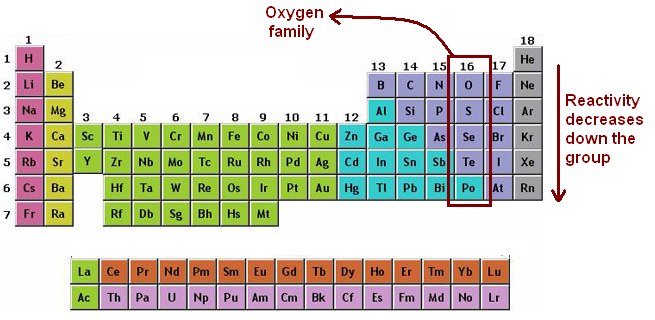
Valence electrons: 6
Common charge: −2
Characteristics: Group 16 elements have 6 valence electrons and usually gain 2 electrons to achieve a full outer shell. They commonly form −2 ions. Oxygen and sulfur are important nonmetals. Metallic character increases as you move down the group.
Example: O + 2e⁻ → O²⁻
halogens group
Valence electrons: 7
Common charge: −1
Characteristics: Halogens are very reactive nonmetals because they only need 1 more electron to complete their valence shell. They usually gain 1 electron and form −1 ions. They react readily with metals to form salts. Halogens are diatomic, meaning they naturally occur as pairs: F₂, Cl₂, Br₂, I₂. Their reactivity decreases as you move down the group. Fluorine is the most reactive halogen.
Example: Cl + e⁻ → Cl⁻

noble gases group
Valence electrons: 8, except He which has 2
Common charge: 0
Characteristics: Noble gases have a full valence shell, making them extremely stable and generally very unreactive. They are gases at room temperature and normally exist as individual atoms, rather than molecules. They do not normally gain or lose electrons, so their common charge is 0.
Examples: He, Ne, Ar

lanthanides
Valence electrons: Varies
Common charge: Usually +3
Characteristics: Lanthanides are metals located in the top row underneath the main periodic table. They are shiny, conductive, and relatively reactive metals. They are often called rare-earth elements and are important in magnets, electronics, batteries, and other technologies.

actinides
Valence electrons: Varies
Common charges: Multiple positive charges
Characteristics: Actinides are metals located in the bottom row underneath the main periodic table. All actinides are radioactive. Many of them are synthetic, meaning they are made artificially. Uranium and plutonium are especially important examples. They can have multiple oxidation states.

Ionic-elements with multiple charges/transition metals naming
(equation to name)
switch the elements charge
then use roman numerals to indicate the specific charge

elements with multiple charges/transition metals naming
(equation to name) example
how to know if element has a positive or negative charge
charge=protons-electrons, if the difference is positive it has a positive charge, if it has negative charge it’s negative
how to find amount of protons a element has
looking at the atomic number, they’re equal to each other
how to find amount of electrons a element has
electrons usually match amount of protons unless it has a charge alongside it
covalent naming
Name the first element.
Use a greek prefix to symbolize charges, if needed
use greek prefixes for the second element to symbolize charges, if needed.
Change the second element's ending to -ide.
polyatomic ions have specific___
names
example of polyatomic ion
NH₄⁺ | ammonium |
whats NH₄⁺
Ammonium
Ionic hydrate
an ionic compound containing a specific number of water molecules
covalent name example
N₂O₅
→ dinitrogen pentoxide
ionic naming
write the positive metal or cation first and the negative nonmetal or anion second
change the nonmetal's ending to "-ide"
ionic naming example
MgO-Magnesium oxide
don’t use “mono” prefix for the _____ element
first
“mono” prefix rule example
NO-Nitrogen Monoxide
1-greek prefix
mono
2-greek prefix
di
3-greek prefix
tri
4-greek prefix
tetra
5-greek prefix
penta
6-greek prefix
hexa
7-greek prefix
hepta
8-greek prefix
octa
9-greek prefix
nona
10-greek prefix
deca
the seven diatomic elements
H₂, N₂, O₂, F₂, Cl₂, Br₂, I₂
the seven diatomic elements mnemonic
Have No Fear Of Ice Cold Beer
H₂-have
N₂-no
F₂-fear
O₂-of
I₂=ice
Cl₂-cold
Br₂-beer
Binary/Hydro acids naming
Binary acid = H + one nonmetal
Naming:
hydro + root + ic acid
Binary acid name example
HBr → hydrobromic acid
Oxyacid naming
contain H + oxygen-containing polyatomic ion.
Naming rule
-ate → -ic acid
-ite → -ous acid
Oxyacid name example
NO₃⁻ = nitrate
HNO₃ = nitric acid
NO₂⁻ = nitrite
HNO₂ = nitrous acid