NS101-7 Rules of the Road
 Call Kai
 Learn
 Practice Test
 Spaced Repetition
 Match
 Flashcards
 Knowt Play
1/31

There's no tags or description
Looks like no tags are added yet.
32 Terms
Rule 1 Applicability
International waters are seaward of demarcation lines
Rule 2 Responsibility
The mariner is responsible not only for complying with the rules but also for avoiding a collision
Rule 3
General definitions
Vessel
Includes EVERY description of watercraft
capable of being used as a means of
transportation on water e.g Sailboats, Seaplanes, Non-displacement craft, Paddle board
Power driven vessel
any vessel propelled by machinery
Sailing Vessel
Any vessel under sail
equipped propulsion machinery not in use
Vessel engaged in Fishing
Vessels engaged in fishing means any vessel fishing with nets, lines, trawls or fishing apparatus which restrict maneuverability
only when actively fishing (trawling with nets)
Does NOT include vessel engaged in trolling
Vessels Not Under Command (NUC)
not under command/ exceptional circumstance is unable to maneuver to comply with the rules
propulsion casualty
steering casualty
Restricted in Ability to Maneuver (RAM)
nature of work —> unable to keep out of way of another vessel eg servicing nav aids, dredging/surveying, UNREP, flight ops, mine clearance op, towing
Vessel Constrained By Draft (CBD)
International only
Vessel constrained by draft means a power-driven vessel
which, because of her draft in relation to the available depth
and width of navigable water, is severely restricted in her
ability to deviate from her present course.
• Power-driven vessel
Underway
any vessel that is:
• Not at anchor,
• Not made fast to the shore (moored)
• Not aground
• Can be underway making way or underway not making way
Seaplane
• Any aircraft designed to
maneuver on the water
Wing in Ground (WIG)
Any multimodal craft that flies in close proximity to
the surface by using ‘surface-effect’ action
In sight of one another
Pilothouse-to-Pilothouse
Restricted Visibility
Any condition in which visibility is reduced by
fog, mist, falling snow, heavy rainstorms,
sandstorms, smoke, or other similar causes
• Darkness is not restricted visibility – must be
atmospheric conditions
Rule 4 any conditions of visibility
“all ships, all the time”
rules 4-10
Rule 5 lookout
must maintain proper lookout AT ALL TIMES
use all available means
a proper lookout should have no other duties
Rule 6 Determinants of Safe Speed
VTMBWD
Visibility
Traffic density
Maneuverability: Stopping
distance and turning abilityBackground lighting
Winds, sea, and current
Draft in relation to available
depth
Vessels with operational RADAR shall also consider
characteristics efficiency + limitations of the RADAR Set
Rule 7 Risk of Collision (same for Int’l)
every vessel shall use ALL available means to determine if risk of collision exists
shall be positive, made early, in observance of good seamanship
Rule 8 Action to avoid collision (same for Int’l)
action should be large enough to be obvious to another vessel / small changes of course and/or speed should be avoided
if there is enough sea room alteration of course alone is the best option as long as it is made early
there is a give way and stand on vessel
Rule 9 narrow channels
stay on “right” side of the channel
do not anchor in a channel
Which vessels should not impede the safe passage of vessels restricted to the channel?
20 Sailors From Chicago
vessel <20 meters
sailing
fishing
crossing
Rule 10 TSS Traffic Separation Scheme
divides high traffic areas into traffic lanes to assist in safe passage
enter/depart at the termination or use a small angle of approach
cross the scheme at right angles
fishing vessels are allowed in the separation vessels
20 Sailors From
Rule 11 vessels in sight of one another
applicability for rules 12-18
Rule 12 Sailing
when two sailing vessels are approaching there is one designated to keep out of the way
on different sides = wind on port clear
on same side = windward must keep clear
wind on port sides another vessel windward but cannot tell = must keep clear
Rule 13 - Overtaking
when a vessel is coming up with
another vessel more than 22.5° abaft the beam
Requires the overtaking vessel to keep out of the way of the vessel being overtaken.
when in doubt, assuming you are overtaking
Rule 14: Head-On Situation
requires both power-driven vessels to maneuver to
starboard (unless otherwise agreed upon; inland only)
Determined by your ability to see masthead lights in-line or
nearly in-line and both sidelights at night, or the
corresponding aspect during the day.
Dual action rule
Both ships shall alter course to
avoid collision
Rule 15: Crossing Situation
two power-driven vessels
any angle of crossing (not overtaking or head-on)
risk of collision exists
vessel which has the other to starboard must give-way/ shall avoid crossing ahead of the other vessel
Give-way vs Stand-on Vessels
See Red, STOP!
See Green, GO!
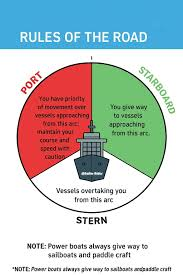
Rule 16 - Action by Give-way Vessel
Give-way = every vessel which is directed to keep out of the way of another vessel, shall so far as possible, take early and substantial action to keep well clean