Personality and Intelligence
 Call Kai
 Learn
 Practice Test
 Spaced Repetition
 Match
 Flashcards
 Knowt Play
1/143

Earn XP
Description and Tags
What they are, how they are measured, how traits develop
144 Terms
What specific differences are differential psychologists interested in?
Any psychological characteristics that can differentiate one individual from another (e.g. demographics, personality, intelligence)
Personality + intelligence affect many other psychological phenomena
Inter + intraspecific differences
Where these differences come from, how they can be described most accurately, what they can be used to predict
What is intelligence?
Wechsler (1958) → “A global concept that involves an individual’s ability to act purposefully, think rationally + deal effectively with the environment”
Gottfredson (1994 consensus statement) → "A very general mental capability that, among other things, involve the ability to reason, plan, solve problems, think abstractly, comprehend complex ideas, learn quickly + learn from experience. It is not merely book learning, a narrow academic skill, or test-taking smarts. Rather, it reflects a broader + deeper capability for comprehending our surroundings - ‘catching on’, ‘making sense’ of things, or ‘figuring our what to do’”
Flynn (2007) → “Mental acuity [ability to prove on-the-spot solutions to new problems]; habits of mind [pattern of thinking]; attitudes [foundations for acquiring habits of mind]; knowledge”
What are some cultural differences in intelligence?
The Confucian tradition’s conception of intelligence emphasises flexibility in thinking, as well as the ability to spot wisdom in others (Pang et al., 2017)
The Taoist tradition emphasises humility and self-knowledge and the Buddhist tradition emphasises determination and mental effort (Yang and Sternberg, 1997)
Western cultures tend to regard people as intelligent when they speak quickly and often
Many African cultures regard people as intelligent when they are deliberate and quiet (Irvine, 1978)
People in some African and Asian societies conceive of intelligence as including social responsibility and cooperativeness (Azuma and Kashiwagi, 1987; Serpell, 1974; White and Kirkpatrick, 1985)
In Zimbabwe, the word for ‘intelligence’ is ngware, which means to be wise and cautious in one’s social relationships (Sternberg and Grigorenko, 2004)
Intracultural differences
Californians of Latino ancestry are more likely to equate intelligence with social competence, while Californians of Asian ancestry are more likely to equate it with cognitive skill (Okagaki and Sternberg, 1993)
Difference in concept or difference in language -> every culture values the ability to solve important problems and what really distinguishes cultures is the kinds of problems considered to be important
What is omitted from intelligence?
Emotional intelligence (EQ) = ability to empathise and evaluate others’ emotions
Multi-Factorial Emotional Intelligence Scale (Mayer et al., 1999) -> main substrates:
Identification of emotion in oneself
Using emotion to facilitate thoughts and actions
Understanding and reasoning about emotions
Being able to regulate emotion in oneself and others
BUT may be simply a convenient way of redescribing a collection of traits that psychologists can already measure in other ways
Creativity = ability to generate ideas or alternatives that may be useful in solving problems, communicating and entertaining ourselves
Involves the realisation of a problem, determining the causes of the problem, formulating a plan to address it and executing the correct solution (Feldhusen, 1993)
Eysenck → creative individuals possess personality traits (notably psychoticism) that promote novel behaviour and thoughts, think in analogical ways, are highly intelligent, love hard work, dislike the traditional and are self-confident
BUT difficult to test in a valid way, link between creativity + intelligence isn't particularly strong
According to meta-analytic evidence, the average correlation between manifest indicators of these two traits is rather modest (r=0.17; Kim, 2005)
BUT a stronger relationship is found at lower compared to higher levels of IQ in a phenomenon known as the threshold effect (Karwowski and Gralewski, 2013). According to the threshold effect hypothesis, intelligence represents a necessary (but not sufficient) precondition of creativity that is relevant up to a certain intelligence level, then further increases of intelligence beyond that threshold become less important
Being smart depends on being able to hold something in mind, whereas being creative also requires the ability to suppress thoughts and actions that can interfere with performance
Wisdom = an expert knowledge system concerning the fundamental pragmatics of life
Comes with age + experience
How did Francis Galton (Darwin’s half-cousin) contribute to psychology?
Made basic contributions to modern biometrics (application of statistics to biological phenomena)
Contributed to the theory, testing and statistical analysis of mental abilities
Mental ability as a heritable trait with a normal distribution
Aspects of mental ability differences
Their origins
Their applications
Devised the correlation coefficient
Psychological contributions :
Study of memory
Devising the self-report questionnaire
Suggesting the twin study to examine genetic influences
How did Spearman contribute to the study of cognitive ability differences?
Factor analysis = statistical technique that explains a large number of correlations in terms of a small number of underlying factors
Provided evidence that differences in the ability to make fine sensory discriminations are part of the foundation of differences in higher cognitive functions
Proposed that intelligence has a core general component shared by all tasks with specific aptitudes on different measures
What does factor analysis do?
Sorts trait terms into a small number of underlying dimensions/factors based on how people use the traits to rate themselves
How is factor analysis carried out?
Hundreds of people rate themselves on hundreds of adjectives, indicating how accurately each one describes their personality
Researcher calculates the patterns to determine similarities in the raters’ usage of descriptions of personality
What factors are determined/studied in factor analysis?
Oblique factors = items that correlate with each other
Orthogonal factors = items that are uncorrelated
Each factor is typically presented as a continuum, ranging from one extreme trait to its opposite (e.g. responsible → careless)
What are the limitations of factor analysis?
Only get out what you put in -> if the descriptions entered into the analysis do not include aspects of ‘pride’ this can never come out in the analysis as an aspect of personality
Only a stats technique that reveals correlations -> not cause + effect, 3rd variable problem
Structure of personality depends on whether you think it's important to look for oblique or orthogonal factors
Cattell (1950) concentrated on oblique factors and ended up with a 16-factor theory of personality, whereas others have found his scheme too complex and have argued for theories with far fewer basic dimensions + Eysenck (1967) took the opposite tack of looking for orthogonal factors (believed that many behavioural tendencies could be understood in relation to introversion, extraversion, neuroticism + psychoticism)
What is Spearman’s 2-factor theory?
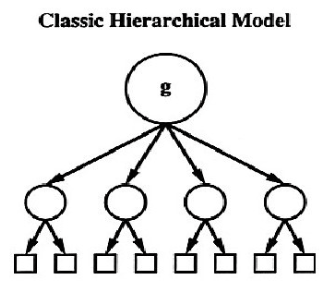
Intelligence is generated by a general cognitive factor (g) + specific factors (s) → every task requires a combination of a general ability (g) and skills that are specific to the task (s) and shared with no other
Not correct to associate Spearman with an emphasis solely on general ability (g) -> also thought that there were individual differences in these more specific mental abilities
Discovered g by assessing groups of schoolchildren on tests of sensory acuity → related these to their score on school subjects + teachers' estimates of intellectual ability
Found most of these measures were positively correlated → children who scored high on one measure (e.g. distinguishing the musical note C sharp from D) tended to score high on the other measures (e.g. solving algebraic equations)
Replicated
BUT not perfectly correlated → the child who had the highest score on one measure didn’t necessarily have the highest score on every measure.
What is g and theories of multiple intelligence?
Is it one capacity or many?
What about differential types of intelligence (verbal, numerical, emotional)?
All tend to correlate (Spearman’s g)
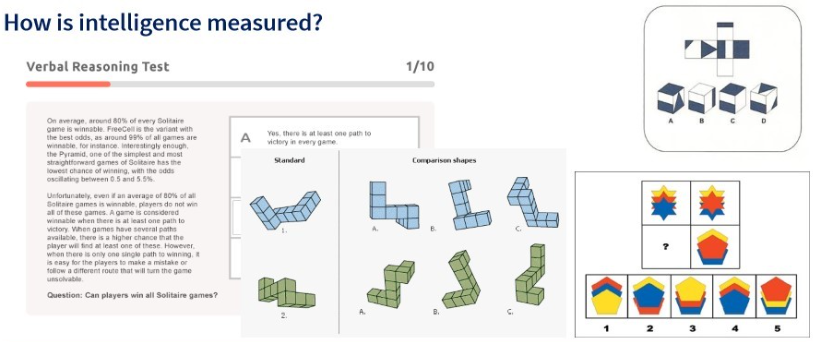
What are some examples of how intelligence can be measured?
Quiet, 1 on 1 with psychologist
IQ score is performance relative to the average (100)
Often include analogies between meanings, synonyms, logical conclusions from a short story
What are psychometrics?
Science of measuring mental capacities + processes
How are psychometrics used to measure intelligence/what topics do they address?
It asks about the nature and number of abilities on which humans show differences
It composes tests to measure cognitive differences
It seeks the origins of mental ability differences, including social, cognitive and biological causes
It studies whether cognitive ability tests predict differences in real-life attainments
What are tests? How should this be kept in mind when testing intelligence?
Tests measure responses that are known to be correlated with consequential behaviours which are thought to be correlated with a hypothetical property
Intelligence tests measure the ability to answer questions and perform tasks that are highly correlated with the ability to get good grades, solve real-world problems and so on
What are some widely used intelligence tests?
Standford-Binet
Wechsler adult intelligence scale
What encouraged Binet to create the first intelligence test (context)?
Testing French children to allow educators to develop remedial programmes for children who lagged behind their peers
Worried that if teachers were allowed to do the selecting, the remedial classrooms would be filled with low-income children, and if parents were allowed to do the selecting, the remedial classrooms would be empty
Looked for tasks that could distinguish the best + worst students in a class + that could be used to predict a future child's success in school
Solving logic problems, remembering words, copying pictures, distinguishing edible and inedible foods, making rhymes and answering questions such as: ‘When anyone has offended you and asks you to excuse him, what ought you to do?’
What is natural intelligence and how did Binet create a test for this?
Measure of child's aptitude for learning independent of child's prior educational achievement
Suggested that teachers could use their test to estimate a child’s ‘mental level’ by computing the average test score of children in different age groups + finding the age group whose average test score was most like that of the child’s
Stern (1914) → mental level could be thought of as a child’s mental age
Best way to determine whether a child was developing typically was to examine the ratio of the child’s mental age to the child’s physical age
Terman (1916) formalised this comparison with the intelligence quotient or ratio IQ = statistic obtained by dividing a person’s mental age by the person’s physical age and then multiplying the quotient by 100
BUT comparing mental age to chronological age works well enough for kids, but not for adults because adults of different ages don’t have remarkably different intellectual capacities (Ackerman, 2017)
Deviation IQ = a statistic obtained by dividing a person’s test score by the average test score of people in the same age group and then multiplying the quotient by 100
BUT doesn't allow comparisons between people of different ages -> modern researchers compute the ratio IQ for children and the deviation IQ for adults
How did Goddard apply Binet’s tets of intelligence?
Took test + used to support eugenics + laws restricting immigration of people from Southern + eastern Europe
Intelligence tests used to rationalise discrimination + intelligence
What are the applications of intelligence tests?
Predict school performance
Correlation between a person’s score on a standard intelligence test and their academic performance is roughly (r = 0.5) across a wide range of people and situations
Best predictor of the number of years of education an individual will receive → can be used to predict a variety of important life outcomes
Do a reasonably good job of predicting a wide variety of behaviours that most of us think of as ‘clever’
Epidemiology = scientific exam of factors that contribute to disease
Evidence that intelligence test scores predict basic responses that cannot possibly be influenced by the scores themselves
How can intelligence tests predict school performance?
Deary et al. (2007):
Large + representative longitudinal study of intelligence at 11 years of age + educational outcomes at 16 years was conducted with over 70,000 English children
Correlation between a latent intelligence trait (Spearman’s g) + students’ scores on GCSEs was 0.81
Variance on measures ranged from 58.6% in mathematics to 48% in English
Even in the more practical subjects, such as art and design, outcomes at age 16 years were predicted by general intelligence at age 11 years with 18.1% variance accounted for
Girls showed no advantage in g, but performed significantly better on all subjects except physics
How can intelligence tests be used to predict a variety of important life outcomes?
Murray (2002) → compared siblings who had significantly different IQs + the less intelligent sibling earned roughly half of what the more intelligent sibling earned over the course of their lifetimes
Explanations:
Intelligent people are more patient, better at calculating risk + better at predicting how other people will act and how they should respond, all of which makes them more successful financially (Burks et al., 2009)
Get more education (Deary et al., 2005; Nyborg and Jensen, 2001)
Intelligent people not only spend more time in school but also perform better when they’re there (Roth et al., 2015)
Intelligence test scores may predict occupational success in part because they influence it
Hunter and Hunter (1984) → reanalysis of the data from thousands of studies showed intelligence test scores are among the best predictors of how well employees will perform in their jobs + job performance correlates more highly with intelligence (r = 0.53) than with other factors (performance during a job interview, r = 0.14; education, r = 0.10)
How do intelligence tests predict a wide variety of behaviours that we deem ‘clever’
Lubinski et al. (2001):
Identified 320 people with extremely high intelligence test scores at age 13 → followed them for 10 years
Were 50x more likely than the general population to gain graduate degrees + 500x more likely than the general population to obtain a perfect GRE score
At a time when <1/4 of their peers had completed an UG degree, they had already published scientific studies in peer-reviewed journals + stories in leading literary magazines, obtained prestigious scholastic fellowships, written operas, developed successful commercial products + obtained patents
How can intelligence tests be applied to epistemology?
Repeatedly demonstrated that a variety of diseases are linked to social class + education (related to intelligence)
Different levels of intelligence represent degrees of risk
Cognitive ability measured at age 11 was a strong predictor of whether the individual would be alive at 76 years of age
The mean chances of being alive when the IQ score was 1 SD below the group average was 71% for women and 83% for men
The lesser effect of mental ability on longevity for men was because, during WW2, the men killed in military service had higher mean IQs than the general population
Follow-up studies with the Scottish Mental Survey’s PPTs → lower IQ at age 11 was related to an increased chance of developing + dying from lung cancer (Deary et al., 2003) + cardiovascular diseases (Hart et al., 2005), + having psychiatric illness (Walker et al., 2002)
Associations that do not appear to be substantially caused by the confounding influence of social class (Hart et al., 2005)
What evidence supports that intelligence score can predict basic responses that cannot be influenced by the score themselves?
When people are briefly exposed to a pair of vertical lines + asked to determine which is longer, people with high intelligence test scores have considerably shorter inspection times (min duration of exposure necessary to obtain the right answer)
Deary + Stough (1996), Grudnick + Kranzler (2001), Nettleback + Lally (1976)
Same is true when people attempt to distinguish between colours or between tones (Acton and Schroeder, 2001)
People with high intelligence test scores also have faster and less variable reaction times to almost any kind of stimulus (Deary et al., 2001)
How did Thurstone (1938) challenge Spearman’s g?
Noticed that while scores on most tests were indeed positively correlated, scores on verbal tests were more highly correlated with scores on other verbal tests than they were with scores on perceptual tests
Results couldn't be arranged in Spearman's strict hierarchy → took this ‘clustering of correlations’ to mean that there was actually no such thing as g
Posited that there were a few stable and independent mental abilities such as perceptual ability, verbal ability and numerical ability (the primary mental abilities)
PMAs weren't general like g or specific like s
We have abilities such as verbal ability and perceptual ability but no general ability called ‘intelligence’
What demonstrated that Spearman and Thurstone were both right in their own ways?
Confirmatory factor analysis → showed that the correlations between scores on different mental ability tests are best described by a three-level hierarchy:
General factor (top)
Group factors
Specific factors
How can the bottom-up approach be used to describe group factors?
Simply by examining the pattern of correlations between different tests, we can determine the nature and number of the middle-level abilities
Carroll (1993) -> what kinds of patterns do we observe when calculating the correlations between tests of mental ability
Independent middle-level abilities found
Memory + learning
Visual perception
Auditory perception
Retrieval ability
Cognitive speediness
Processing speed
Fluid intelligence = biologically limited capacity for processing information
The way the machine runs
Generally assessed by tests that pose novel, abstract problems that must be solved under time pressure (e.g. Raven’s Progressive Matrices test)
Crystallised intelligence = accuracy and amount of information available for processing
The info it uses + produces
Generally assessed by tests of vocab, factual info etc
Problems that require crystallised or fluid intelligence activate different networks in the brain (Barbey, 2018), which is why impairment of one kind of intelligence does not always lead to impairment of the other BUT difficult to tease these apart in practice
BUT incapable of discovering any middle-level ability that intelligence tests fail to measure
How can the top-down approach be used to describe group factors?
Sternberg's types of intelligence
Analytical intelligence = ability to identify and define problems and to find strategies for solving them
What standard intelligence tests measure
Creative intelligence = ability to generate novel solutions
Practical intelligence = ability to apply and implement these solutions/tacit knowledge (info people have about specific, everyday situs) in everyday settings
Argued that tests of practical intelligence are better at predicting a person's job performance
Sought to place his theory between what he viewed as two extremes in this area of research:
Those who emphasise the g factor, who are limited to using standard psychometric tests and employ factor analysis
Those who emphasise newer, multiple intelligences, but have collected few data to support them
Gardner (1983)
Observations of ordinary healthy people, people with brain damage, prodigies (people of typical intelligence who have an extraordinary ability) + savants (people of low intelligence who have an extraordinary ability)
8 types of intelligence
Linguistic
Logical-mathematical
Spatial
Musical
Bodily-kinaesthetic
Interpersonal
Intrapersonal
Naturalistic
BUT hasn't operationalised these intelligences in the form of valid assessments + hasn't conducted adequate empirical research
What do specific factors suggest?
People have a general ability called intelligence, which is made up of a small set of independent subabilities, which are made up of a large set of specific abilities that are unique to particular tasks
What evidence is there of the intelligence hierarchy?
Carroll (1993):
Reanalysis data collected >60 years from >130,000 healthy adults, schoolchildren, infants, university students, people with learning disabilities + people with mental and physical illnesses
Showed that almost every study done over the past half-century results in a three-level hierarchy of this kind
How does intelligence relate to genetics and the environment?
Bouchard + McGue (1981):
The intelligence test scores of identical twins are correlated about r=0.86 when the twins are raised in the same household and about r=0.78 when they are raised in different household (e.g. adopted by different families)
BUT the intelligence test scores of unrelated people raised in the same household (e.g. two siblings, one or both of whom were adopted) are correlated about r=0.32
What is a heritability coefficient?
Statistic (commonly denoted as h2) that describes the proportion of the difference between people’s scores that can be explained by differences in their genetic makeup
What is the heritability coefficient for intelligence?
When the data from numerous studies of children and adults are analysed together, the heritability of intelligence is roughly 0.5 → about 50% of the difference between people’s intelligence test scores is due to genetic differences between them (Plomin and Spinath, 2004; Plomin et al., 2013; cf. Chabris et al., 2012)
Value changes depending on groups measured (due to environment) + age of people being measured
Is typically larger among adults than among children which suggests that the environments of any pair of 65-year-olds tend to be more similar than the environments of any pair of 3-year-olds
What are the individual differences in intelligence?
What most clearly distinguishes gifted children from their less gifted peers is the sheer amount of time they spend engaged in their domain of excellence (Ericsson and Charness, 1999; Lubinski and Benbow, 2021)
This passionate devotion may explain why gifted children are much more likely to become high-achieving adults (Lubinski, 2016)
People with intellectual disabilities can range from mild (50 < IQ < 69) to moderate (35 < IQ < 49) to severe (20 < IQ < 34) to profound (IQ < 20)
Prevalent in 1% of the global population, varying from 1% to 3% by country, with a male-to-female ratio of 2:1 (Patel et al., 2020)
Most common causes of intellectual disability:
Down syndrome
Foetal alcohol syndrome
Men and women have the same average IQ BUT the distribution of men’s IQ scores is wider + more variable than the distribution of women’s IQ scores
There are more men than women at both the very top and the very bottom of the IQ range (Hedges and Nowell, 1995; Lakin, 2013; Wai et al., 2012)
Some of this difference is due to the different ways in which boys + girls are socialised
Some psychologists believe there is a link between creative genius + certain forms of psychopathology (Gale et al., 2012; Jamison, 1993; cf. Schlesinger, 2012; Simonton, 2014)
What are some group differences in intelligence?
Asian people routinely outscore White people, who routinely outscore Black people (Mendoza-Denton, 2014; Nisbett et al., 2012)
Women routinely outscore men on tests that require rapid access to and use of semantic information, production + comprehension of complex prose, fine motor skills and perceptual speed of verbal intelligence
BUT men routinely outscore women on tests that require transformations in visual or spatial memory, certain motor skills, spatiotemporal responding + fluid reasoning in abstract mathematical and scientific domains (Halpern et al., 2007; Nisbett et al., 2012)
BUT the average difference between groups is not large – usually less than the average difference within group
Culturally biased tests are unlikely to explain group differences in intelligence test scores
BUT intelligence tests have come a long way in a century, + there’s no evidence that modern intelligence tests are biased in this way (Sackett et al., 2008)
Group differences emerge even on those portions of intelligence tests that measure nonverbal skills (e.g. Raven’s Progressive Matrices test)
Testing situations may remain biased even if test questions aren't
Black African American students perform more poorly on tests if they are asked to report their race at the top of the answer sheet, because doing so causes them to feel anxious about confirming racial stereotypes about their group (Steele and Aronson, 1995) + anxiety naturally interferes with test performance (Reeve et al., 2009)
Stereotype threat = anxiety associated with the possibility of confirming other people’s stereotypes about one’s group (Aronson and Steele, 2004; Schmader et al., 2008; Walton and Spencer, 2009) -> impairs performance
Presence of people who don't share these may help improve performance (Inzlicht and Ben-Zeev, 2000)
The situation in which intelligence tests are administered can affect members of different groups differently, and may cause group differences in performance that do not reflect group differences in ability or intelligence
How do genes and experience affect intelligence?
Socioeconomic status, exposure to toxic messages about innate abilities -> affect intelligence
Some percentage of the between-group difference in intelligence is accounted for by experiential differences, and the only question is whether any of the between-group difference in intelligence is accounted for by genetic differences
Nidentification of a gene or gene complex whose presence is strongly correlated with performance on intelligence tests to make conclusions + demonstration that this gene or gene complex is more prevalent in one group than another → would take the same evidence scientists find when studying the physical differences between groups (to establish a genetic difference in intelligence)
Intelligence is not strongly influenced by a single gene but is instead weakly influenced by a very large number of genes (Davies et al., 2011; von Stumm and Plomin, 2021)
Unless researchers isolate those genes and show that they are more prevalent in one group than another, most scientists are unlikely to embrace a genetic explanation of between-group differences in intelligence
What is cultural intelligence?
Includes a broad range of individual difference characteristics, including cognitive ability, emotional intelligence, openness, extraversion and international experience
Cultural Intelligence Scale (Ang et al., 2007) has four factor subscales:
Metacognition – for example, ‘I adjust my cultural knowledge as I interact with people from a culture that is unfamiliar to me’
Cognitive – for example, ‘I know the rules for expressing nonverbal behaviours in other cultures’
Motivation – for example, ‘I enjoy interacting with people from different cultures’
Behaviour – for example, ‘I alter my facial expressions when a cross-cultural interaction requires it’
BUT it is not clear whether CQ represents one valid Gestalt concept or just a collection of abilities
What are some gender differences which relate to intelligence?
Size, grey matter + white matter volumes + asymmetries between the two hemispheres → may be responsible for regional specialisation that supports different thinking styles + aptitudes for spatial reasoning
BUT the effect sizes are too small to account for an observed gender gap
When gender differences have been found (e.g. maths ability) the effect sizes favouring men are smaller than international differences → biology plays a lesser role than culture
Gender differences in maths + science ability are smaller in countries with higher gender equality → cognitive gender differences are decreasing as a function of increased gender equality (Else-Quest et al., 2010; Guiso et al., 2008)
Most likely explanation:
Cultural stereotypes bias girls + boys to study different topics (Halpern et al., 2007) → kick in when students are considering the different types of careers they want to pursue (Ferriman et al., 2009)
How does working memory relate to intelligence?
Conway et al. (2002) → strong correlations between working memory capacity and fluid intelligence, suggesting both depend on controlled attention and executive processes
Kyllonen + Christal (1990) → both working memory + fluid intelligence reflect the ability to maintain information in the face of distraction and interference
Other studies (e.g., Engle et al., 1999) also found high correlations between working memory measures + psychometric intelligence
Working memory may be a fundamental basis of intelligence differences (Miyake et al., 2001)
Some argue that WM causes intelligence differences
Others suggest that WM tests resemble intelligence tests → WM differences may simply reflect g itself, rather than being a separate underlying mechanism
What tasks are used to assess working memory?
Complex cognitive tasks that manipulate memory load in structured ways.
Reading span tasks, where participants recall words from sentences while processing them.
These tasks consistently show that people with higher intelligence scores tend to have higher working memory capacity.
How does reaction time relate to intelligence?
Early research found that faster reaction times correlated with better performance on intelligence tests (Beck, 1933)
Hick’s Law and Choice Reaction Time
Hick reaction time test measures how quickly people respond when choosing among multiple options
Reaction time increases with the number of choices, producing a linear relationship between reaction time + the logarithm of the number of choices (Hick’s law)
Researchers initially believed that the slope of this relationship reflected how efficiently someone processes information and predicted intelligence
BUT the slope of Hick’s function has only a weak correlation with intelligence
Variability in reaction time, not average speed, correlates more strongly with intelligence
Individuals with higher intelligence show more consistent (less variable) reaction times.
The reason for this is unclear, but evidence suggests it reflects basic processing efficiency rather than strategic differences.
How does cognition relate to intelligence?
Research shows modest but reliable correlations between:
High-level cognitive abilities (e.g., reasoning, problem-solving), and
Low-level cognitive processes (e.g., reaction time speed and consistency).
Suggests that complex intellectual performance may be built on simpler cognitive mechanisms, such as:
Speed of processing
Stability and reliability of neural processing
Is relative intelligence stable?
Yes → longitudinal studies show that people who score high or low on intelligence tests early in life tend to remain relatively high or low later (e.g. people with high IQ at age 11 tend to remain high at age 90)
Which aspect of intelligence changes over time?
Absolute intelligence → intelligence scores can rise or fall across the lifespan (intelligence is stable in rank but flexible in level
How does intelligence change across the lifespan?
Intelligence generally increases from adolescence to middle adulthood, then declines in later life
The decline is sharpest in old age and is thought to be linked to slower brain processing speed
Crystallised intelligence remains stable from ages 18–70
Fluid intelligence declines after middle age
What is the Flynn effect?
James Flynn discovered that average IQ scores have increased by about 0.3% per year, resulting in roughly 30 IQ-point gains over a century
Possible explanations
Researchers suggest several environmental factors:
Improved nutrition and healthcare
Better parenting and schooling
Greater exposure to visual and abstract problem-solving (e.g., technology, media)
Increased familiarity with testing
Generational gains are larger for fluid intelligence than crystallised intelligence, possibly because modern environments demand more abstract thinking
BUT some question whether the Flynn effect reflects true intelligence increases or test artefacts
What can cause short-term fluctuations in intelligence?
Sleep quality affects cognitive performance the next day
Fatigue during the school day reduces cognitive performance, with large declines across hours
Breaks significantly improve performance
Emotions such as anxiety and frustration impair cognitive performance
This supports the idea that genes set a range, but environment determines where within that range performance falls
What is some evidence of the effect of education on intelligence?
Summer learning loss: intelligence declines when schooling stops.
School disruption (war, crises, teacher shortages) lowers IQ.
Relative age in school affects IQ scores (older students perform better).
Each year of schooling increases IQ by 1–5 points.
Limits of Educational Interventions
Many educational programmes produce small and temporary IQ gains.
Gains often fade after enrichment ends, though some intensive early programmes produce long-lasting benefits.
Education has lasting effects on skills (e.g., reading), even when IQ gains fade
How does socioeconomic status relate to intelligence?
Family socioeconomic status strongly predicts intelligence, with differences of 12–18 IQ points between high- and low-SES environments
Studies of siblings raised in different SES environments show large IQ differences (around 14 points), demonstrating environmental causation beyond genetics
Low SES affects intelligence through:
Poor nutrition and healthcare
Chronic stress
Exposure to toxins (e.g., pollution, lead)
Reduced cognitive stimulation
Early childhood poverty has particularly strong negative effects on brain development
What cognitive enhancement technologies improve intelligence?
Drugs (stimulants, e.g., Ritalin; ampakines, glutamate enhancers; modafinil) can improve attention, memory + planning, leading to misuse among healthy individuals
Research in animals shows genetic manipulation can increase learning and memory (e.g., “smart mice”)
Experts predict future gene-editing and brain-enhancement technologies may increase intelligence in humans
What are the ethical and social implications of cognitive enhancement technologies?
There is no clear boundary between technological enhancement (drugs, genetic engineering) + traditional methods (education, nutrition)
The difference may be moral: traditional methods require effort, while drugs may allow intelligence to be “bought”
Society must decide whether intelligence should be earned, inherited, or technologically purchased
What is personality?
AN individual’s characteristic style of behaving, thinking + feeling
Pervin + John (1999) → “Those characteristics that account for a person’s consistent patterns of feeling, thinking, + behaving”
Mischel (2004) → “A set of individual differences that are affected by the development of an individual: values, attitudes, personal memories, social relationships, habits + skills”
Contemporary definitions
Johnson (now) → “A person’s ongoing adaptations of temperament, emotion, info-processing, motivational + interest tendencies + capacities to the social + physical demands + opportunities of the surrounding environment”
What are some problems with the definitions for personality in comparison to intelligence?
Little agreement
Incorporates lots of qualitively different elements (unlike intelligence)
Goal to explain the whole person → difficult
What do personality psychologists study?
Questions of how our personalities are determined by the forces in our minds, by our personal history of heredity and environment, and by the choices we make and the goals we seek
Who was arguably the first personality theorist?
Theophrastus (approximately 371–287 bce):
Fascinated by the fact that his fellow Athenians generally shared the same upbringing but were so different in the ways they behaved and thought
Studied people as they went about their daily lives and noted that certain styles of behaviour and thinking seemed to cluster together, which led him to conclude that there were character types or personalities -> 29 different personalities (e.g. superstitious, whose main features involved religiosity in excess of the usual)
What are explanations about personality differences concerned with?
Prior events that can shape an individual’s personality, or anticipated events that might motivate the person to reveal particular personality characteristics
Prior -> delve into subconscious, circumstances + interpersonal surroundings, biology + brain
Anticipated -> emphasises person's own perspective, seems intimate + personal in its reflection of the person's inner life
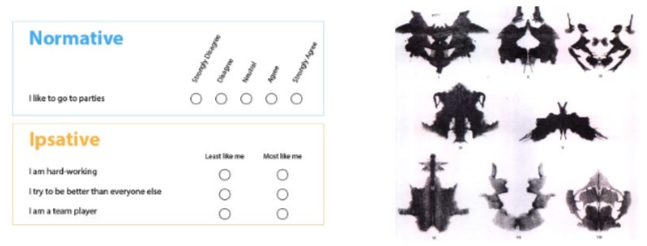
How is personality measured?
Normative -> compared to a group
E.g. used in hiring process (likert scales)
Ipsative -> compared to individual
Use forced choice question (either/or) -> often used for team building
How do psychologists typically study the personality?
Self-reports = a series of answers to a questionnaire that asks people to indicate the extent to which sets of statements or adjectives accurately describe their own behaviour or mental state
Researcher then combines the answers to get a general sense of the individual’s personality with respect to a particular domain
How are self-report scales created?
Collect sets of self-descriptive statements that indicate different degrees of a personality characteristic
What is an example of a personality test?
Minnesota Multiphasic Personality Inventory (MMPI, 1939) = a well-researched, clinical questionnaire used to assess personality and psychological problems
338 self-descriptive statements to which the respondent answers ‘True’, ‘False’ or ‘Cannot say’
Measures a wide range of psychological constructs:
Clinical problems (such as antisocial behaviour or thought dysfunction)
Somatic problems (such as head pain or cognitive complaints)
Internalising problems (such as anxiety or self-doubt), externalising problems (such as aggression or substance abuse)
Interpersonal problems (such as family problems or avoidance)
Includes validity scales that assess a person’s attitudes towards test taking and any tendency to try to distort the results by faking answers
Person’s scores can be calculated by a computer and compared with the average ratings of thousands of other test takers
No interpretation of the responses is needed -> biases are minimised BUT response style
What is an issue with using self-reports to study the personality?
Certain personality factors may function largely outside consciousness → asking people to tell us about them makes little sense
What are projective tests and why were they created?
Designed to reveal inner aspects of individuals’ personalities by analysis of their responses to a standard series of ambiguous stimuli
Circumvent limitations of self-reports → assume that people will project personality factors that are below awareness (wishes, concerns, impulses and ways of seeing the world) onto the ambiguous stimuli and will not censor these responses
What are some examples of projective tests? Are there any weaknesses to these?
Rorschach Inkblot Test = respondents’ inner thoughts and feelings are believed to be revealed by analysis of their responses to a set of unstructured inkblots
Responses are scored according to complicated systems (derived in part from research involving people with psychological disorders) that classify what people see (Exner, 1993; Rapaport, 1946)
Thematic Apperception Test (TAT) = respondents’ underlying motives, concerns and the way they see the social world are believed to be revealed through analysis of the stories they make up about ambiguous pictures of people
BUT bias -> a TAT story may seem revealing but the examiner must always add an interpretation
What else can be used to measure personality in the current day?
Modern technology:
E.g. social media, electronically activated recorder
Allows psychologists to study people as they actually behave out in the world while interacting with others (as opposed to in the lab under experimental conditions
E.g. Schwartz (2013) -> significant differences in how people who self-identified as women and men express themselves, as well as differences by age and personality
E.g. Mehl et al. (2007) -> women and men were equally talkative, each averaging about 16,000 words per day
What is trait theory?
Uses such trait terms to characterise differences among individuals
What are the differences between traits and types?
Types = discrete, rigid categories
Personality types are much broader
Not typically used when doing research
Used for simplicity + quick understanding
Traits = relatively stable, long-term characteristics and patterns of thinking, feeling, and behaving that define an individual's personality
Continuous measure (vary across spectrum)
More interested in
Links to 5-factor model
How do traits develop/change?
Quantitatively (magnitude)
Qualitatively (change in nature)
Improvement
Negatively (e.g. cognitive decline)
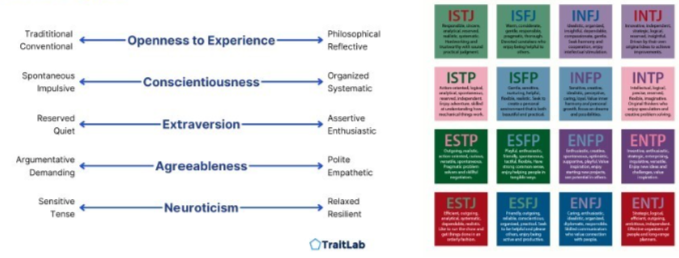
What factors are included in the 5-factor model?
Openness to experience
Conscientiousness
Extroversion
Agreeableness
Neuroticism
OCEAN
Why is the 5-factor model preferred?
Modern factor analysis techniques confirm that this set of five factors strikes the right balance between accounting for as much variation in personality as possible while avoiding overlapping traits
In a large number of studies using different kinds of data (people’s descriptions of their own personalities, other people’s descriptions of their personalities, interviewer checklists and behavioural observation) the same five factors have emerged
E.g. spouses’ ratings for each other on the Big Five reveal moderately high correlations of +0.59 for openness, +0.57 for conscientiousness, +0.53 for extroversion, +0.59 for agreeableness and +0.53 for neuroticism (McCrae and Costa, 1990)
The basic five-factor structure seems to show up across a wide range of participants, including children, adults in other cultures and even among those who use other languages – suggesting that the Big Five may be universal (Denissen et al., 2019; Kajonius and Giolla, 2017; John and Srivastava, 1999)
Show up even when people are asked to evaluate the traits of complete strangers (Passini and Norman, 1966)
What has research into the Big 5 shown in relation to time?
People’s personalities tend to remain stable throughout their lifetime, with scores at one time in life correlating strongly with scores at later dates, even later decades (Caspi et al., 2005)
How can the Big 5 affected individual outcomes?
Subjective wellbeing (SWB) = an individual’s evaluation of their own life in terms of how satisfied they are and how they feel about their life -> strongly predicted by personality traits that are largely a function of temperament, that is, extroversion and neuroticism (possibly due to self-esteem)
Relationship between these factors is moderated by culture ->iIn individualistic Western cultures where pleasure and positive mood are highly prized and emphasised, high extroversion and low neuroticism are a strong predictor of SWB
High extroversion and conscientiousness predict longer lives (Danner et al., 2001; Friedman et al., 1995), whereas low agreeableness predicts poorer physical health and earlier death (Miller et al., 1996)
High extroversion might operate because those who are more outgoing have more extensive social networks and support, which are associated with better health outcomes (Berkman et al., 2000). People who have high conscientiousness are also more careful about exercise and diet, and less likely to smoke and have unhealthy habits (Bogg and Roberts, 2004)
How can the Big 5 affect interpersonal outcomes?
Agreeableness and extroversion are the best predictors of those who have friends (Jensen-Campbell et al., 2002)
Children who are less agreeable and less extroverted are more argumentative and withdrawn and, unsurprisingly, have fewer friends (Newcomb et al., 1993). Children who have high neuroticism, low conscientiousness and low extroversion also have poorer relationships with their parents (Belsky et al., 2003)
However, German researchers have recently demonstrated that peer contexts account for individual differences in personality development well after childhood (Reitz et al., 2014). For instance, longitudinal studies showed that life experiences involving different peer contexts, such as graduation (Bleidorn, 2012), military service (Jackson et al., 2012) or occupation (Denissen et al., 2014; Wille and De Fruyt, 2014), influence personality development beyond adolescence. For example, even 5 years after the end of military training in the German army, individuals had lower levels of agreeableness (Jackson et al., 2012).
Those who have low agreeableness and high neuroticism tend to have higher dissatisfaction with their partners, experience more conflict and abuse and, ultimately, higher rates of separation and divorce (Karney and Bradbury, 1995)
All the Big Five have been related to attachment styles (Shaver and Brennan, 1992)
How can the big 5 affect occupational outcomes?
Two large meta-analyses (Barrick et al., 2003; Larson et al., 2002) found that, in general, employees with high extroversion and high agreeableness tended to work in jobs that require good social skills and teamwork
Those with high openness tended to be in jobs that require more artistic and creative effort
Neuroticism was not reliably related to any occupation
Across all types of work, high conscientiousness was predictive of job performance
Low conscientiousness seems to be consistently associated with various aspects of criminality and antisocial behaviour (Shiner et al., 2002)
It is related to behaviour problems in adolescent boys (Ge and Conger, 1999), antisocial behaviour (Shiner et al., 2002), deviance and even suicide attempts (Verona et al., 2001), and along with low agreeableness, low conscientiousness predicts those most likely to abuse alcohol and drugs (John and Srivastava, 1999; Walton and Roberts, 20090-4)
What did Allport argue about personality and traits? How did he define ‘trait’?
Trait = a relatively stable disposition too behave in a particular + consistent way
Characteristics of the brain that influence the way people respond to their environment
Personality can be best understood as a combo of traits
Trait as an explanation:
Pre-existing disposition of the person that causes the person's behaviour
Allport (1937) -> traits = pre-existing dispositions + causes of behaviour that reliably trigger the behaviour
Examined/measured using personality inventories
Motivation that guides the person's behaviour
Examined/measured using projective techniques
How do traits realate to genetics?
In one review of studies involving over 24,000 twin pairs, identical twins proved markedly more similar to each other in personality than fraternal twins did (Loehlin, 1992
The more genes you have in common with someone, the more similar your personalities are likely to be
Genes seem to influence most personality traits, and current estimates, based on a recent study of more than 100,000 participants, place the average genetic component of personality at about 0.40 (Vukasović and Bratko, 2015)
BUT potential confounding factors must be ruled out to ensure that effects are truly due to genetics and not environmental experiences. Are identical twins treated more similarly and do they have a greater shared environment than fraternal twins
BUT studies of identical twins reared far apart in adoptive families – an experience that pretty much eliminates the potential effect of shared environmental factors – suggest that shared environments have little impact
Reared-apart identical twins end up at least as similar in personality as those who grow up together (McGue and Bouchard, 1998; Tellegen et al., 1988)
What are some problems with trait theory?
Narrowing down the almost infinite set of adjectives
Answering the more basic question of why people have particular traits – whether they arise from biological or hereditary foundations
What is right wing authoritarianism? Why was in studied?
Tendency towards political conservatism, obedience to authority + conformity)
Questioning support of Nazi Germany + fascism -> Adorno (1950)
What is studied in order to determine how personality is represented in language?
Core traits:
Generation after generation, people have described people with words, so early psychologists proposed that core traits could be discerned by finding the main themes in all the adjectives used to describe personality
BUT over 18,000 potential traits (Allport and Odbert, 1936)
How might behavioural tendencies be related?
In a hierarchy
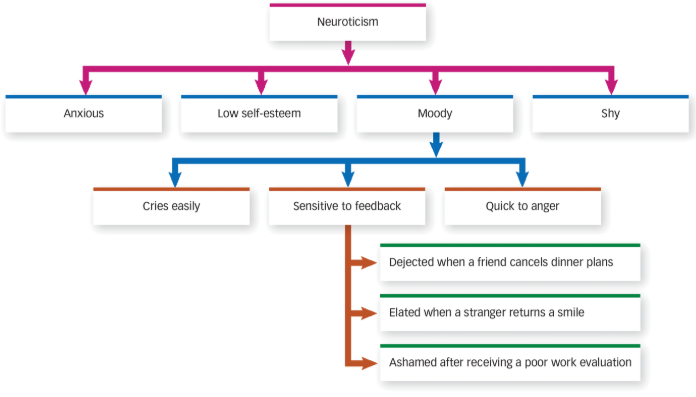
How do gender differences relate to traits?
Many of the gender differences that do exist among adults seem to have developed over time
Chaplin and Aldao (2013) → review >150 studies that (>20,000 PPTs) found gender differences in the expression of emotion, with boys showing more externalising emotions like anger and girls showing more internalising emotions such as sadness and anxiety
BUT these differences were much more pronounced as children aged into adolescence → cultural factors play a role in how children learn to express their emotions
Cultural universality (De Bolle et al., 2015)
Simultaneous emergence of differences in sex hormones during puberty → emergence of personality differences in adolescence
Keo-Meier et al. (2015) → followed a sample of trans men over 3-month period (undergoing testosterone treatment) → personality tests administered before + after testosterone treatment showed significant changes (viewed themselves as being more masculine + scores more closely matching those of cis men)
How do personality traits relate to animals?
Gosling (1998) → recruited 4 observers to use personality scales + rate the different hyenas in the group → found 5 dimensions
3 closely resembled the Big Five traits of neuroticism (fearfulness + emotional reactivity), openness to experience (curiosity) + agreeableness (absence of aggression)
Individual differences in traits resembling extraversion, neuroticism + agreeableness are the most commonly observed across different species (Gosling, 2008) (studies with mammals, fish, birds, reptiles and other animals)
In studies of guppies + octopi, individual differences in traits resembling extroversion + neuroticism were reliably observed (Gosling and John, 1999)
Researchers identified particular behaviours they felt reflected each trait based on their observation of the animals’ typical repertoire of activities
Mikkola et al. (2021) → asked pet owners of 4,300 cats to rate their personalities on various dimensions
3 of the most prominent traits emerging as neuroticism (fearfulness), extraversion (sociability toward cats and humans) + agreeableness (aggression)
Reliable → different observers seem to agree on where an animal falls on a given dimension (don’t reflect a particular observer’s imagination or tendency to anthropomorphise)
Personalities within animals show consistency over time
Fratkin et al. (2013) → examined 31 studies that measured the consistency of personality traits in dogs over time →aw personality characteristics present during puppyhood tend to persist into dogs’ adult years
Evidence of a genetic basis for a number of these traits (Ilska et al., 2017)
Important for working dogs (for example, bomb-sniffing dogs, service dogs) + pet owners who sometimes select their pets for their apparent personality
What are the benefits of testing for personality in non-human animals?
Improved ability to measure physiology
More opportunities for naturalistic observation (for example, observing aggression and social hierarchies)
Accelerated life span (for example, making longitudinal + lifespan studies much more efficient; Gosling, 2008)
How do differing personalities in species relate to evolution?
Reflect alternative adaptations that species have evolved to deal with the challenges of survival and reproduction
E.g. people who are extroverted might show off to attract attention, whereas you’d be likely to see people high in agreeableness displaying affection + nurturance (Buss, 1996)
Both approaches might work well to attract mates and reproduce successfully – depending on the environment
How did Eysenck relate biology to personality traits?
Differences in levels of cortical arousal underlie differences between extroverts and introverts
Extroverts pursue stimulation because their reticular formation – the part of the brain that regulates arousal, or alertness → not easily stimulated
Drawn to activities such as listening to loud music and having a lot of social contact
Introverts may prefer reading or quiet activities → their cortex is easily stimulated to a higher than optimal point
What is psychoticism?
People who score high on this factor were ‘egocentric, aggressive, impulsive, impersonal, cold, lacking in empathy and concern for others, and generally unconcerned about the rights and welfare of others’
What is some evidence for Eysenck’s biological explanation of extroversion and introversion?
Bartol and Costello (1976), Stelmack (1990) → when introverts/extroverts are presented with a range of intense stimuli, introverts respond more strongly (e.g. salivating more when a drop of lemon juice is placed on their tongues + reacting more negatively to electric shocks or loud noises)
This reactivity has an impact on the ability to concentrate
Geen (1984), Lieberman + Rosenthal (2001), Matthews + Gilliland (1999) → extroverts tend to perform well at tasks that are done in a noisy, arousing context (e.g. bartending or teaching) + introverts are better at tasks that require concentration in tranquil contexts (e.g. librarian or night-time security guard)
How are neuroticism, extraversion and psychoticism assessed?
Eysenck’s Personality Questionnaire → found to be almost uncorrelated → are independent dimensions of personality
What is some supporting evidence of Eysenck’s theory?
DeYoung and Gray (2009) → EEGs + functional brain imaging suggest that individual differences in activation + inhibition arise through the operation of distinct brain systems underlying these tendencies
Studies have suggested that the core personality traits may arise from individual variations in the volume of the different brain regions associated with each trait
Self-reported neuroticism is correlated with the volume of brain regions involved in sensitivity to threat, agreeableness with areas associated with processing information about the mental states of other people, conscientiousness with regions involved in self-regulation + extraversion with areas associated with processing information about reward (DeYoung et al., 2010)
Research aimed at understanding how the structure + activity of our brains can contribute to the formation of our personality traits is still in its early stages
How did Gray (1970) refine Eysenck’s ideas about arousability?
Proposed that the dimensions of extroversion/introversion + neuroticism reflect two basic brain systemas:
Behavioural activation system activates approach behaviour in response to the anticipation of reward
Behavioural inhibition system inhibits behaviour in response to stimuli signalling punishment
Individual differences in the reactivity of these systems may underlie Eysenck’s two personality dimensions:
People with a highly reactive BAS may actively engage the environment, seeking social reinforcement in a highly extroverted manner
People with a highly reactive BIS might tend towards neuroticism + emotional instability, anxiously focusing on the possibility of negative outcomes and perceiving the world as threatening
Each person might have some combination of these two tendencies → each person’s level of extroversion + neuroticism is produced by the activity of specific brain systems
How does the psychodynamic approach explain the personality?
Formed by needs, strivings + desires, largely operating outside awareness → motives that can produce emotional disorders
What is the dynamic unconscious?
An active system encompassing a lifetime of hidden memories, the person's deepest instincts + desires + the person's inner struggle to control these forces
Power comes from experiences that shaped the mind before a person could even put thoughts + feelings into words + from its contents (are embarrassing, unspeakable and even frightening because they operate without any control by consciousness)
How is the dynamic unconscious revealed?
Revealed in psychoanalytic psychotherapy
Use projective tests such as the Rorschach Inkblot Test (described earlier in this chapter) in the hope of discerning unconscious themes and issues that can be examined in therapy
Makes use of a number of indirect techniques (e.g. dream interpretation and word association) as a means of assessing the workings of the unconscious mind
How does the preconscious and the conscious differ?
Aspects of mental life that are outside awareness but could easily enter consciousness vs aspects of mental life are those in awareness at any given moment
What is the id?
The most basic system
Part of the mind containing the drives present at birth; it is the source of our bodily needs, wants, desires + impulses, (particularly our sexual + aggressive drives)
Reflects our ‘true psychic reality’ before the impact of the outside world with all its restraints
Operates according to the pleasure principle = psychic force that motivates the tendency to seek immediate gratification of any impulse
What is the ego and what is its function?
Emerges from the id during the first 6 to 8 months of life to deal with reality
Developed through contact with the external world
Component of personality that enables us to deal with life’s practical demands
Operates according to the reality principle = regulating mechanism that enables the individual to delay gratifying immediate needs and function effectively in the real world
Can be thought of as the ‘self’, with functions such as logical thought, problem solving, creativity, attention + decision making
Helps you to resist the impulse to snatch others’ food and also finds the restaurant and pays the bill → in doing this work, however, it serves the id
What is the superego?
Emerges between the ages of 3 and 6 years
Mental system that reflects the internalisation of cultural rules, mainly learned as parents exercise their authority
Consists of a set of guidelines, internal standards and other codes of conduct that regulate + control our behaviours, thoughts + fantasies
Act as the conscience, punishing us when it finds we are doing or thinking something wrong (by producing guilt or other painful feelings) + rewarding us (with feelings of pride or self-congratulation) for living up to ideal standards
Hold on reality is tenuous (like id)
Not equipped to differentiate between a thought or fantasy + actual behaviour in the real world → will punish or reward regardless of whether we actually do something (bad or good) or merely think about it
What creates constant controversy?
The id force of personal needs
The superego force of social pressures to quell those needs
The ego force of reality’s demands
What are the dynamics between the id, ego and superego governed by?
Anxiety -> primary emotional reaction that has adaptive value (signals something is wrong), more often arises when the threats are ambiguous or even the product of imagination