NPB 101: Lecture 7 - Action Potential I

0.0(0)
Studied by 4 people
call kaiCall Kai
learnLearn
examPractice Test
spaced repetitionSpaced Repetition
heart puzzleMatch
flashcardsFlashcards
GameKnowt Play
Card Sorting

1/12

flashcard set

Earn XP

Description and Tags

Learning Objectives: Describe the sequence of sodium and potassium conductance changes underlying the threshold, depolarization, peak, repolarization, and after-hyperpolarization phases of an action potential. Explain how the voltage- and time-dependent states of sodium and potassium channels produce the action-potential waveform. Distinguish the positive-feedback process responsible for rapid depolarization from the negative-feedback processes responsible for repolarization. Explain now action-potential frequency and patterns of activity across populations of neurons can encode information even through individual action potentials are all-or-none.

Last updated 10:43 PM on 10/13/26
Name
Mastery
Learn
Test
Matching
Spaced
Call with Kai
Chat

No analytics yet

Send a link to your students to track their progress

13 Terms

1
New cards

Sodium (Na+) Channel

Specialized transmembrane proteins that allow sodium ions (Na+) to cross cell membranes.

  • Both voltage and time gated

    • Voltage-gated:

      • Inward current (Na+ enters the cell)

      • Responds rapidly to depolarization

      • Three states:

        • Deactivated: Closed but capable of opening

        • Activated: Open upon depolarization.

        • Inactivated: Closed and NOT capable of opening. Inactivation is caused by time-gate and is removed upon repolarization.

    • Time-gated:

      • Stops membrane from further depolarizing

      • Responds to depolarization with a slight time delay (~1 ms after activation gate opens)

      • “Ball and Chain”

        • When voltage-gate is closed, the balls float freely

        • When the gate is open, the balls are attracted to the open pore of the channel + will block the pore

        • Upon repolarization, the voltage-gate closes and the ball is dislodged, returning the Na+ channel to its resting closed state
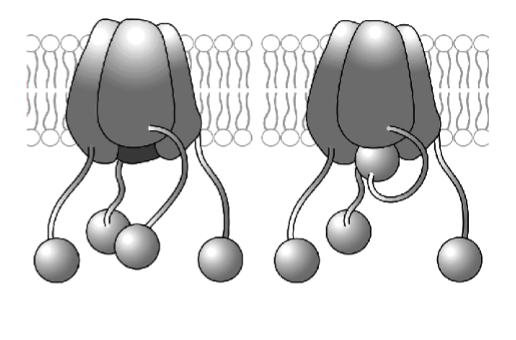

<p>Specialized transmembrane proteins that allow sodium ions (Na<sup>+</sup>) to cross cell membranes.</p><ul><li><p><u>Both</u> voltage and time gated</p><ul><li><p><strong><u>Voltage-gated:</u></strong></p><ul><li><p>Inward current (Na<sup>+</sup> enters the cell)</p></li><li><p>Responds <strong>rapidly</strong> to <strong>depolarization</strong></p></li><li><p><u>Three states</u>:</p><ul><li><p><strong>Deactivated: </strong>Closed but <u>capable of opening</u></p></li><li><p><strong>Activated: </strong>Open upon <u>depolarization</u>.</p></li><li><p><strong>Inactivated: </strong>Closed and NOT capable of opening. Inactivation is <u>caused by time-gate</u> and is removed upon repolarization.</p></li></ul></li></ul></li><li><p><strong><u>Time-gated:</u></strong></p><ul><li><p><u>Stops</u> membrane from further depolarizing</p></li><li><p>Responds to depolarization with a <u>slight time delay</u> (~1 ms after activation gate opens)</p></li><li><p><strong>“Ball and Chain”</strong></p><ul><li><p>When voltage-gate is closed, the balls float freely</p></li><li><p>When the gate is open, the balls are attracted to the open pore of the channel + will <u>block the pore</u></p></li><li><p>Upon <strong>repolarization</strong>, the voltage-gate closes and the ball is dislodged, returning the Na<sup>+</sup> channel to its resting closed state</p></li></ul></li></ul></li></ul></li></ul><p></p>
2
New cards

Potassium (K+) Channel

Specialized transmembrane protein complexes that allow the selective outward flow to potassium (K+) ions to drive repolarization.

  • Voltage gated

    • Outward current (K+ leaves the cell)

    • Opening and closing depends on membrane potential

    • Slow response

    • Two states:

      • Deactivated: Closed but capable of opening

      • Activated: Open around the peak of the action potential (+30mV) to let K+ ions flow out of the cell, returning the AP from a positive peak back down to a negative resting state


3
New cards

Conductance of Na+ and K+ Channels

The conductance changes with membrane potential for voltage-gated Na+ and K+ are very similar.

  • When an axonal membrane is depolarized more, more of both channels will open

However, the conductance changes with time is very different for the two channels:

  • Voltage-gated Na+ channels:

    • Opens immediately following depolarization

    • Inactivates after < 1 ms

  • Voltage-gated K+ channels:

    • Opens after a delay (when AP reaches its peak)

    • Does NOT inactivate


<p>The conductance changes with <u>membrane potential</u> for voltage-gated Na<sup>+</sup> and K<sup>+</sup> are <strong>very similar</strong>. </p><ul><li><p>When an axonal membrane is depolarized more, more of both channels will open</p></li></ul><p>However, the conductance changes with <u>time</u> is very different for the two channels:</p><ul><li><p><strong>Voltage-gated Na<sup>+</sup> channels:</strong></p><ul><li><p>Opens immediately following depolarization</p></li><li><p><u>Inactivates</u> after &lt; 1 ms</p></li></ul></li><li><p><strong>Voltage-gated K<sup>+</sup> channels:</strong></p><ul><li><p>Opens after a delay (when AP reaches its peak)</p></li><li><p>Does <u>NOT</u> inactivate</p></li></ul></li></ul><p></p>
4
New cards

Stage One of the Action Potential

Resting State (Resting Membrane Potential)

  • Near EK, PK > PNa due to leaky K+ channels

  • K+ and Na+ voltage-gates are closed

  • Na+ time-dependent gate (ball and chain) is open


<p><u>Resting State (Resting Membrane Potential)</u></p><ul><li><p>Near E<sub>K</sub>, P<sub>K</sub> &gt; P<sub>Na</sub> due to leaky K<sup>+</sup> channels</p></li><li><p>K<sup>+</sup> and Na<sup>+</sup> voltage-gates are <strong>closed</strong></p></li><li><p>Na<sup>+</sup> time-dependent gate (ball and chain) is open</p></li></ul><p></p>
5
New cards

Stage Two of the Action Potential

Hypopolarization (Threshold)

  • Membrane is brought to threshold voltage by depolarizing stimulus

  • Na+ voltage-dependent gates open


<p><u>Hypopolarization (Threshold)</u></p><ul><li><p>Membrane is brought to <u>threshold voltage</u> by <u>depolarizing stimulus</u></p></li><li><p>Na<sup>+</sup> voltage-dependent gates <strong>open</strong></p></li></ul><p></p>
6
New cards

Stage Three of the Action Potential

Depolarization (Rising Phase)

  • Na+ flows through open time-dependent and voltage-dependent gates

  • Flow of Na+ into the cell rapidly depolarizes the membrane

    • Positive Feedback Loop: Na+ entry causes depolarization, which opens more voltage gated Na+ channels, which causes more depolarization


<p><u>Depolarization (Rising Phase)</u></p><ul><li><p>Na<sup>+</sup> flows through <strong>open</strong> time-dependent and voltage-dependent gates</p></li><li><p>Flow of Na<sup>+</sup> into the cell rapidly depolarizes the membrane</p><ul><li><p><strong>Positive Feedback Loop:</strong> Na<sup>+</sup> entry causes depolarization, which opens more voltage gated Na<sup>+</sup> channels, which causes <u>more depolarization</u></p></li></ul></li></ul><p></p>
7
New cards

Stage Four of the Action Potential

Overshoot

  • Closure of time-dependent Na+ gate and delayed opening of voltage-gated K+ channels halts membrane depolarization


<p><u>Overshoot</u></p><ul><li><p><strong>Closure </strong>of time-dependent Na<sup>+</sup> gate and delayed <strong>opening</strong> of voltage-gated K<sup>+</sup> channels <u>halts membrane depolarization</u></p></li></ul><p></p>
8
New cards

Stage Five of the Action Potential

Repolarization (Falling Phase)

  • Open voltage-gated K+ channes repolarize the membrane back to a negative membrane potential


<p><u>Repolarization (Falling Phase)</u></p><ul><li><p><strong>Open</strong> voltage-gated K<sup>+</sup> channes <strong>repolarize </strong>the membrane back to a <u>negative</u> membrane potential</p></li></ul><p></p>
9
New cards

Stage Six of the Action Potential

Hyperpolarization (Undershoot)

  • Slowly closing voltage-gated K+ channels hyperpolarize membrane towards EK

    • Negative Feedback Loop: voltage-gated K+ channels bring the action potential to an end and induce their own closing

  • Na+ channels return to closed resting state

    • Voltage-gate is closed

    • Time-dependent gate is open


<p><u>Hyperpolarization (Undershoot)</u></p><ul><li><p>Slowly closing voltage-gated K<sup>+</sup> channels <strong>hyperpolarize</strong> membrane towards E<sub>K</sub></p><ul><li><p><strong>Negative Feedback Loop:</strong> voltage-gated K<sup>+</sup> channels bring the action potential to an end and <u>induce their own closing</u></p></li></ul></li><li><p>Na<sup>+ </sup>channels return to <u>closed resting state</u></p><ul><li><p>Voltage-gate is closed</p></li><li><p>Time-dependent gate is open</p></li></ul></li></ul><p></p>
10
New cards

Stage Seven of the Action Potential

Return to Resting State

  • Closure of voltage-gated K+ channels returns the membrane potential to its resting value


<p><u>Return to Resting State</u></p><ul><li><p><strong>Closure</strong> of voltage-gated K<sup>+</sup> channels returns the membrane potential to its <strong>resting value</strong></p></li></ul><p></p>
11
New cards

Rate Coding

Information is carried by how often a single neuron fires.

  • A stronger stimulus increases action potential firing rate

    • Allows the threshold to be reached earlier in the refractory period


<p>Information is carried by how often <u>a single neuron</u> fires. </p><ul><li><p>A stronger stimulus <strong>increases action potential firing rate</strong></p><ul><li><p>Allows the <u>threshold to be reached earlier</u> in the refractory period</p></li></ul></li></ul><p></p>
12
New cards

Population Coding

Information is distributed across and decoded from the joint activity of many neurons working together.

  • Individual receptors differ in their sensory thresholds

  • Stronger stimulus excites more receptors


<p>Information is distributed across and decoded from the joint activity of <u>many neurons working together</u>.</p><ul><li><p>Individual receptors differ in their sensory thresholds</p></li><li><p><strong>Stronger stimulus excites more receptors</strong></p></li></ul><p></p>
13
New cards

Distributed Coding

A neural representation strategy where information is encoded not by a single neuron, but by the collective activity pattern of large ensemble of neurons.

  • Lecture Example:

    • Three neurons:

      • Danger neuron

      • Size-sensitive neuron (Small)

      • Size-sensitive neuron (Large)

    • The brain is able to encode all four invertebrates (Fly, Bee, Mosquito, Gnat) with just these three neurons


<p>A neural representation strategy where information is encoded not by a single neuron, but by the <u>collective activity pattern of large ensemble of neurons</u>.</p><ul><li><p>Lecture Example:</p><ul><li><p><strong>Three neurons:</strong></p><ul><li><p>Danger neuron</p></li><li><p>Size-sensitive neuron (Small)</p></li><li><p>Size-sensitive neuron (Large)</p></li></ul></li><li><p>The brain is able to encode <u>all four</u> invertebrates (Fly, Bee, Mosquito, Gnat) with <strong>just these three neurons</strong></p></li></ul></li></ul><p></p>



