Lesson 19: Ω-Verbs- Second Aorist Active and Middle Indicative; Second Aorist Active and Middle Infinitives; Second Aorist Active and Middle Imperative; Reflexive Pronouns
 Call Kai
 Learn
Learn Practice Test
 Spaced Repetition
 Match
Match Flashcards
 Knowt Play
1/6

There's no tags or description
Looks like no tags are added yet.
Name | Mastery | Learn | Test | Matching | Spaced | Call with Kai | Chat |
|---|
No analytics yet
Send a link to your students to track their progress
7 Terms
what is second aorist?
aka asigmatic or strong aorists
lack distinctive σα of first aorists
there is not diff in meaning between 1st and 2nd aorist in either verbs (that have both 1st and 2nd forms)
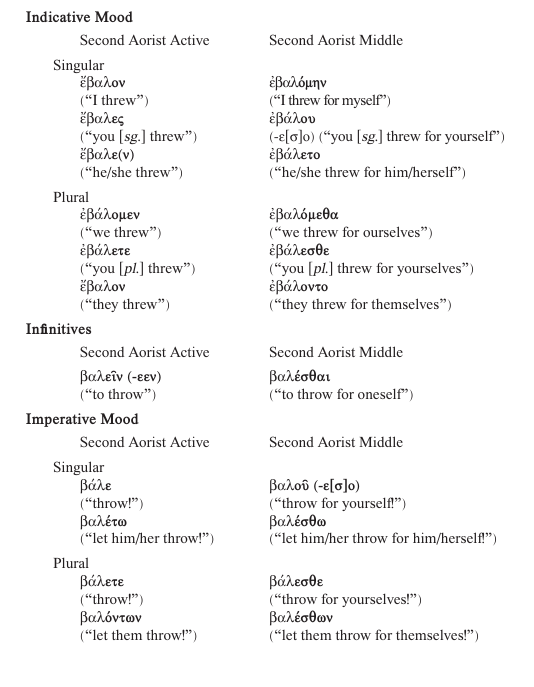
Paradigm of Second Aorist Active and Middle:
accent invariably falls on ultima of active infinitive (-εῖν), on ultima of 2nd person sing mid imperative (-οῦ), and on penult of mid inf (-έσθαι). All other 2nd aorist forms have recessive accent.
look a lot like imperfects (w their augments, thematic vowel (ε/ο), and secondary endings) but the stem (built on root of the verb) marks them as aorist → sometimes the case that one or more letter have been added to the root to construct the present stem.
If so, you can recover the root simply by removing those additional letters from the present stem; e.g., βαλλ- = βαλ- + λ; εὑρισκ- = εὑρ- + ισκ.

Paradigm of Second Aorist Active and Middle (with example βάλλω):
vowel gradations
// strong and weak verbs in engl

what are reflexive pronouns?
pronoun that reflects or directs attention back to the subj of sentence, but is not the subj itself
occurs only in gen, dat, and acc
can function in whatever ways personal pronouns can (so direct obj, indirect obj, obj of prep) but never the subj
Reflexive Prounouns Paradigm:
each form combines a personal pronoun or ἑ- with the intensive adjective αὐτός (in the proper case, number, gender).
the pronoun or ἑ- in all forms except the first- and second-person plural. In the first and second persons, no neuter endings are needed since the subject to which the pronoun refers must be someone either speaking (“I,” “we”) or spoken to (“you”), who would naturally refer to him- or herself as masculine or feminine.
Watch out for look-alikes such as αὐτήν (“her,” personal pronoun referring to someone other than the subject) and αὑτήν (“herself,” reflexive).

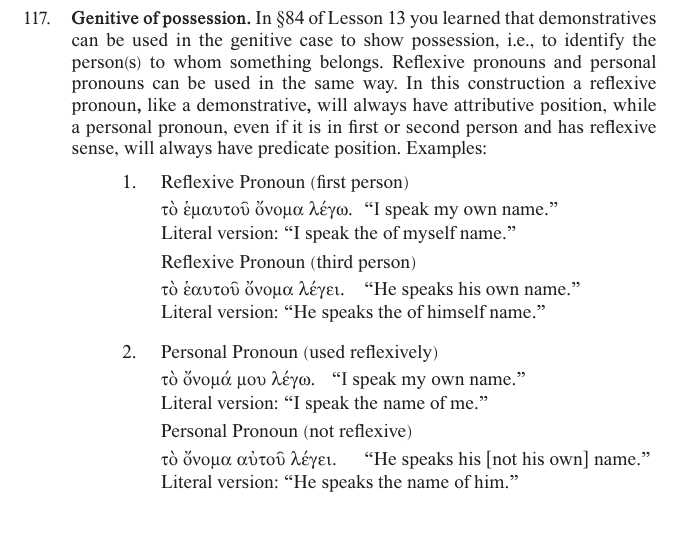
what is gen of possession?